What Is the Difference Between Class 1 and Class 2 Laser Distance Sensors?
Laser distance sensors have become an essential technology in industrial automation, robotics, warehouse logistics, construction, surveying, intelligent transportation, and smart manufacturing. Their ability to provide fast, accurate, and non-contact distance measurement makes them a preferred solution for engineers and equipment manufacturers around the world. However, when selecting a laser distance sensor, one question often appears before comparing measuring range, accuracy, or interface options:
Should you choose a Class 1 laser distance sensor or a Class 2 laser distance sensor?
Understanding the difference between these two laser classifications is important because laser safety affects both equipment design and end-user operation. While both types can deliver excellent measurement performance, they are designed for different applications, operating environments, and safety requirements.
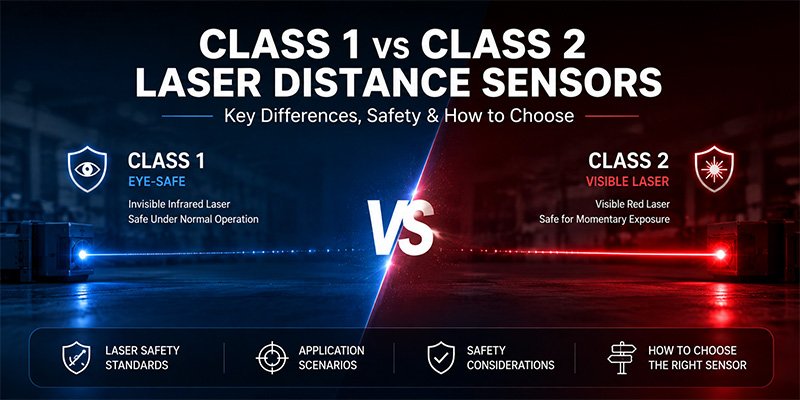
This guide explains how Class 1 laser distance sensors ve Class 2 laser distance sensors differ, how laser classifications are defined, and which option is best suited for your project.
Understanding Laser Classes
Laser products are classified according to the international safety standard IEC 60825-1, which evaluates the potential hazards of laser radiation. The classification is based on factors including laser wavelength, output power, exposure duration, and the likelihood of eye injury.
For industrial distance measurement, the most common classifications are Class 1 ve Sınıf 2.
Although these classifications focus on laser safety rather than measurement capability, they often influence product design, installation requirements, and application scenarios.
Choosing the correct laser class helps manufacturers comply with safety regulations while ensuring reliable performance in their target environment.
What Is a Class 1 Laser Distance Sensor?
A Class 1 laser distance sensor is considered safe under normal operating conditions. The laser radiation emitted is below the Maximum Permissible Exposure (MPE), meaning users can operate the sensor without special eye protection during intended use.
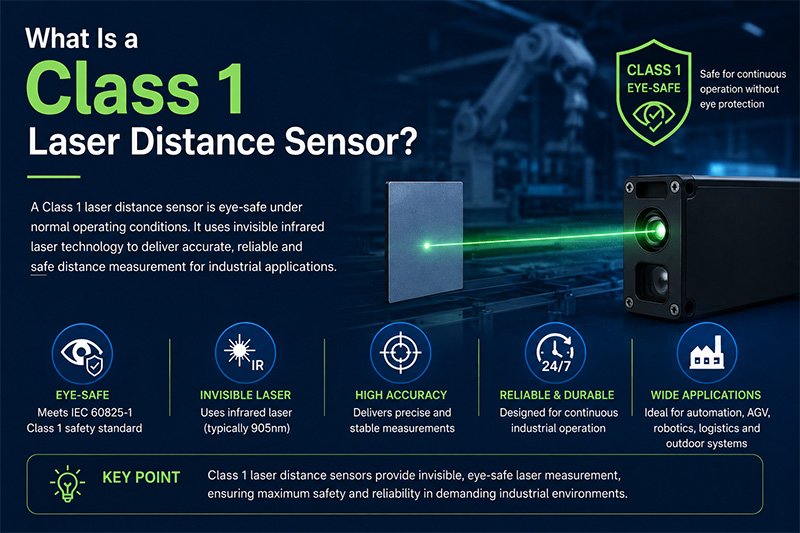
Many Class 1 products achieve this safety level by using infrared laser wavelengths, optical design, beam expansion, or enclosed laser structures that limit accessible radiation.
Key Features of Class 1 Laser Distance Sensors
- Eye-safe during normal operation
- Suitable for continuous industrial use
- Commonly use invisible infrared lasers such as 905 nm
- Ideal for automated equipment without operator intervention
- Meet strict international laser safety standards
Because the laser beam is typically invisible, operators cannot see the measuring point directly. Instead, alignment is usually completed during equipment installation or with integrated aiming methods.
İçin endüstri̇yel otomasyon, this is rarely a disadvantage since the sensor remains fixed after installation.
Typical Applications of Class 1 Laser Distance Sensors
A Class 1 laser distance sensor is widely used in industrial environments where safety, reliability, and continuous operation are critical.
Typical applications include:
- Fabrika otomasyonu
- AGV and AMR navigation
- Robotic positioning
- Warehouse automation
- Crane positioning
- Elevator monitoring
- Conveyor control
- Smart logistics
- Building automation
- Structural monitoring
In these environments, operators may work near the equipment throughout the day. Using a Class 1 device minimizes safety concerns while simplifying compliance with workplace regulations.
Many OEM manufacturers also prefer Class 1 solutions because they reduce the complexity of machine certification.
What Is a Class 2 Laser Distance Sensor?
A Class 2 laser distance sensor emits visible laser light, usually within the wavelength range of 400–700 nm. The output power is generally limited to 1 mW or less.
Unlike Class 1 devices, Class 2 lasers rely on the human blink reflex for protection. When a person accidentally looks into the beam, the natural blink response typically limits exposure to a safe duration.
For this reason, brief accidental exposure is generally considered safe. However, users should never intentionally stare into a Class 2 laser beam.
One of the biggest advantages of a Class 2 laser distance sensor is visibility. Since the laser spot is clearly visible, engineers can easily align the sensor during installation and verify the measuring position without additional tools.
Advantages of Class 2 Laser Distance Sensors
Many engineers choose a Class 2 laser distance sensor because of its ease of installation and operation.
Its major benefits include:
- Clearly visible measuring spot
- Easy alignment during installation
- Convenient maintenance
- Excellent for indoor positioning
- Yüksek ölçüm hassasiyeti
- Simple commissioning process
Because operators can instantly see where the laser is pointing, troubleshooting and system adjustment become much faster.
This is particularly valuable for prototype development, laboratory testing, and equipment commissioning.
Common Applications of Class 2 Laser Distance Sensors
A Class 2 laser distance sensor is often selected for applications where users need to observe the measuring point directly.
Typical examples include:
- Indoor measurement systems
- Building inspection
- Civil engineering
- Architecture
- Laboratory equipment
- Educational demonstrations
- Quality inspection
- Hassas montaj
- Otomatik üretim hatları
- Material positioning
For indoor environments with trained personnel, the visible laser spot greatly improves operational efficiency.
Class 1 vs Class 2 Laser Distance Sensor: Key Differences
Although both sensor types provide precise distance measurement, their differences extend beyond visibility.
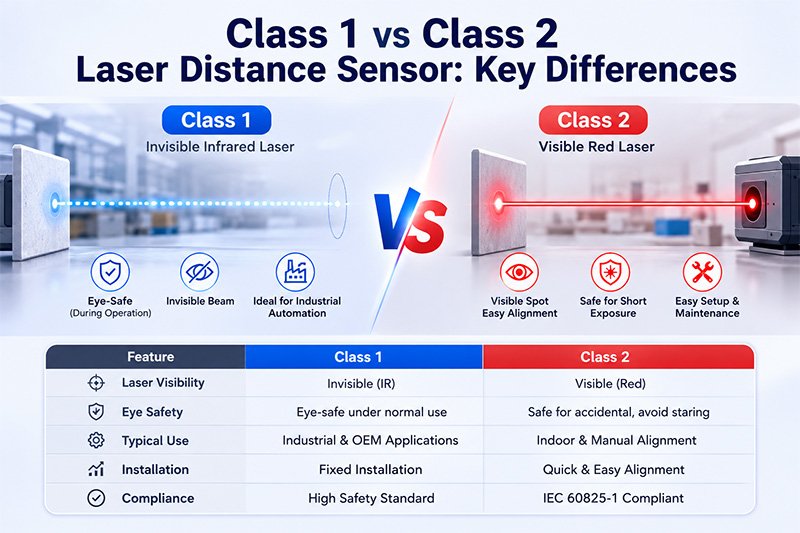
Laser Visibility
The most noticeable difference is the laser beam itself.
A Class 1 laser distance sensor generally uses an invisible infrared laser, while a Class 2 laser distance sensor projects a visible red laser spot that allows users to identify the measuring location immediately.
Göz Güvenliği
A Class 1 laser distance sensor is designed to remain eye-safe during normal operation, making it suitable for continuous industrial environments.
A Class 2 laser distance sensor is also considered safe for accidental short-term exposure, but users should avoid intentional viewing of the laser beam.
Installation
When installing industrial equipment, visible lasers often reduce setup time.
Engineers can align a Class 2 laser distance sensor within seconds because the measuring point is visible.
By comparison, installing a Class 1 laser distance sensor may require alignment tools or predefined mounting positions.
Industrial Applications
Large-scale automation projects usually prioritize long-term operational safety.
As a result, many manufacturers integrate Class 1 laser distance sensors into OEM equipment, AGVs, robotic systems, and automated production lines.
Meanwhile, Class 2 laser distance sensors are widely adopted in engineering projects that require frequent adjustment or manual alignment.
Does Laser Class Affect Measurement Accuracy?
One common misconception is that laser class determines measurement accuracy.
In reality, laser classification and measurement performance are independent characteristics.
A high-quality Class 1 laser distance sensor can achieve millimeter-level accuracy, just as a Class 2 laser distance sensor can provide highly precise distance measurements.
Accuracy depends on factors such as:
- Optical design
- Signal processing algorithms
- Detector quality
- Environmental conditions
- Target surface reflectivity
- Calibration methods
Therefore, selecting between Class 1 and Class 2 should primarily be based on safety requirements, installation conditions, and application needs rather than expected accuracy alone.
For example, a warehouse automation system operating around the clock may prioritize the enhanced operational safety of a Class 1 device, while a laboratory test bench may benefit from the visible aiming capability of a Class 2 sensor. Understanding the operating environment helps engineers choose the most practical solution while maintaining reliable measurement performance and compliance with applicable safety standards.