How Conveyor Position Sensors Improve Industrial Conveyor Accuracy
Conveyor systems are a critical part of modern manufacturing, logistics, warehousing, and packaging operations. As factories continue to adopt automation and Industry 4.0 technologies, accurate conveyor positioning has become more important than ever. Whether products are being sorted, inspected, assembled, or transferred between workstations, precise position feedback is essential for maintaining efficiency and reducing production errors.
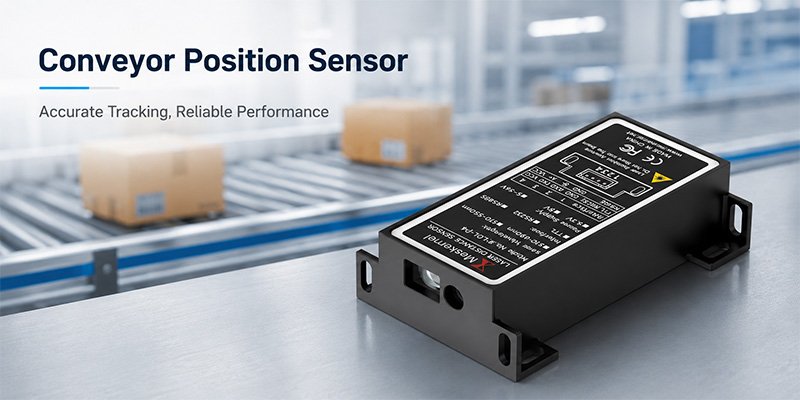
A modern conveyor position sensor helps manufacturers monitor the exact location of products, pallets, or moving equipment on a conveyor line. Compared with traditional sensing technologies, laser-based measurement solutions provide higher precision, longer service life, and more reliable performance in demanding industrial environments.
This article explores how a conveyor position sensor works, the challenges of conventional positioning methods, and why laser distance measurement technology is becoming the preferred choice for conveyor automation.
Why Conveyor Positioning Matters
In automated production lines, every process depends on accurate positioning. A product arriving a few millimeters too early or too late can affect downstream operations, leading to quality issues and reduced productivity.
Common conveyor applications requiring precise positioning include:
- Robotic pick-and-place systems
- Automated packaging machines
- Warehouse sorting systems
- Material handling equipment
- Assembly lines
- Quality inspection stations
Without accurate position information, robotic arms may fail to pick products correctly, scanners may miss labels, and automated machinery may experience synchronization problems.
This is why selecting the right conveyor position sensor is a key consideration for automation engineers.
Limitations of Traditional Conveyor Positioning Technologies
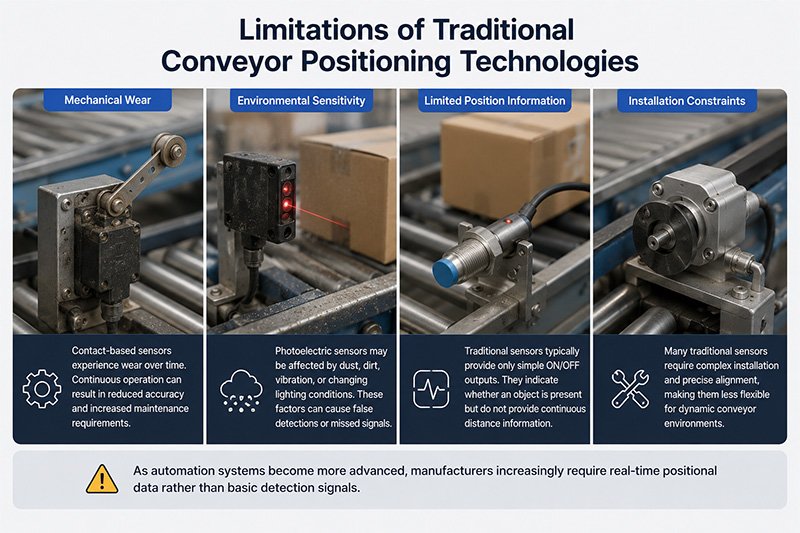
Many conveyor systems still rely on photoelectric sensors, proximity switches, or mechanical limit switches. While these technologies are widely used, they often face challenges in modern high-speed production environments.
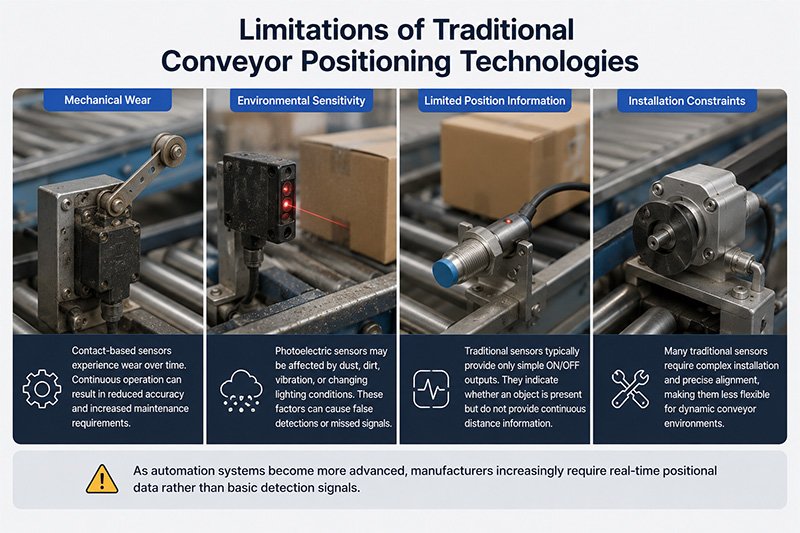
Mechanical Wear
Contact-based sensors experience wear over time. Continuous operation can result in reduced accuracy and increased maintenance requirements.
Environmental Sensitivity
Photoelectric sensors may be affected by dust, dirt, vibration, or changing lighting conditions. These factors can cause false detections or missed signals.
Limited Position Information
Traditional sensors typically provide only simple ON/OFF outputs. They indicate whether an object is present but do not provide continuous distance information.
As automation systems become more advanced, manufacturers increasingly require real-time positional data rather than basic detection signals.
How Laser Distance Sensors Improve Conveyor Positioning
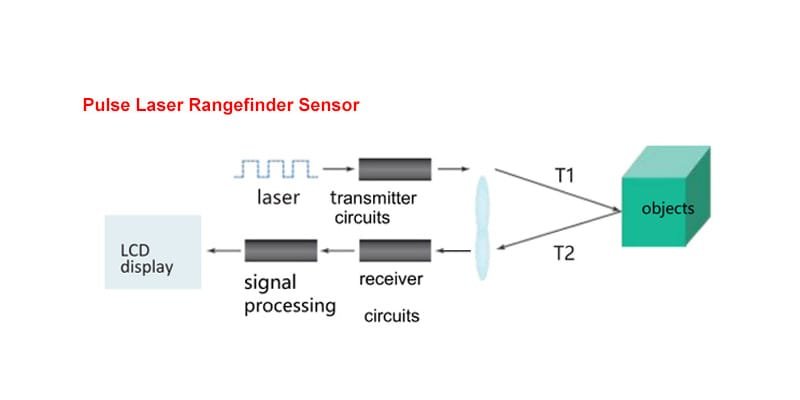
A laser-based conveyor position sensor measures the distance between the sensor and a target surface using non-contact optical technology.
Unlike conventional sensors, a laser sensor continuously reports distance measurements, allowing control systems to calculate object position with exceptional precision.
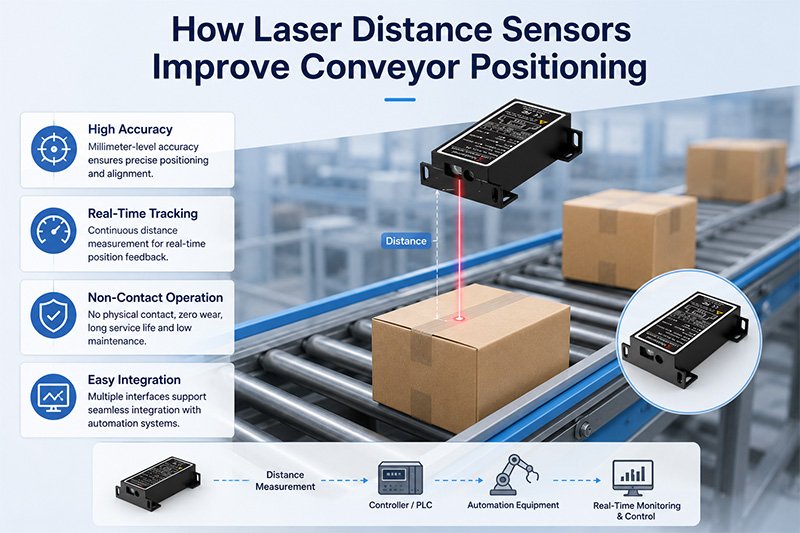
This capability makes laser technology ideal for high accuracy conveyor positioning applications.
Continuous Real-Time Feedback
A laser sensor for conveyor systems continuously tracks moving objects as they travel along the production line.
This enables:
- Dynamic position monitoring
- Real-time process control
- Improved synchronization between machines
- More accurate robotic operations
Instead of detecting only when a product passes a fixed point, the sensor provides ongoing position updates throughout the movement process.
Milimetre Seviyesinde Doğruluk
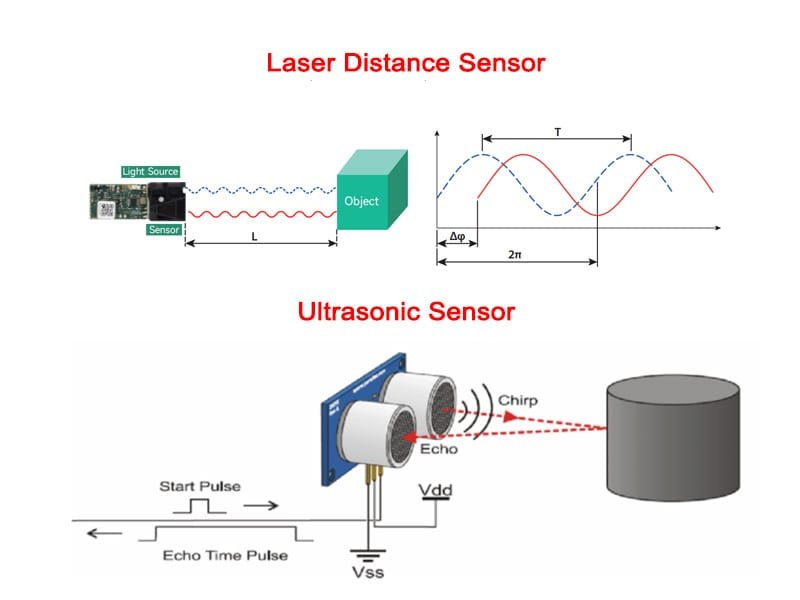
Modern phase-shift laser sensors can achieve measurement accuracy up to ±1 mm.
For conveyor applications, this level of precision allows:
- Accurate product alignment
- Reliable robotic gripping
- Precise packaging operations
- Improved inspection performance
A high-quality distance sensor for conveyor belt monitoring can significantly reduce positioning errors that impact production quality.
Temassız Çalışma
Because laser sensors operate without physical contact, there is no mechanical wear during normal operation.
Benefits include:
- Reduced maintenance costs
- Longer operational life
- Improved reliability
- Lower system downtime
These advantages make laser measurement particularly attractive for facilities operating around the clock.
Common Applications of Conveyor Position Sensors
Automated Warehousing
Modern distribution centers rely heavily on automation to process large volumes of products efficiently.
A conveyor belt position sensor helps track cartons, pallets, and packages as they move through sorting and fulfillment systems.
Accurate position information ensures products reach the correct destination while minimizing processing delays.
Robotic Pick-and-Place Systems
Industrial robots require precise location data to perform accurate picking operations.
An industrial conveyor tracking sensor enables robots to identify the exact position of moving objects and adjust their movements accordingly.
This improves:
- Picking accuracy
- Cycle time
- Production throughput
Robotic automation systems in electronics, automotive, and consumer goods manufacturing frequently depend on laser positioning technology.
Packaging Lines
Packaging machinery often requires products to stop at specific locations before labeling, sealing, weighing, or inspection.
A conveyor position sensor provides accurate feedback that allows packaging equipment to operate consistently and efficiently.
The result is reduced product waste and improved package quality.
Quality Inspection Systems
Vision systems and automated inspection equipment require precise product positioning to capture reliable images and measurements.
Laser-based positioning sensors help ensure products remain within the inspection zone, improving defect detection rates and reducing false rejects.
Key Advantages of Laser Sensors for Conveyor Systems
Daha Yüksek Doğruluk
Laser measurement technology provides significantly greater accuracy than many traditional sensing methods.
For manufacturers seeking high accuracy conveyor positioning, this advantage directly contributes to improved product quality and process consistency.
Faster Response Times
Modern lazer sensörleri can provide measurement updates at high frequencies, making them suitable for fast-moving conveyor applications.
Rapid data updates enable control systems to respond quickly to changing production conditions.
Improved Process Efficiency
Accurate positioning helps eliminate unnecessary delays, reducing cycle times and increasing overall productivity.
Production equipment can operate more efficiently when reliable position information is continuously available.
Enhanced Integration
Many laser sensors support industrial communication protocols such as:
- UART
- RS232
- RS485
- Modbus
These interfaces simplify integration with PLCs, industrial computers, and automation controllers.
Selecting the Right Conveyor Position Sensor
Several factors should be evaluated when choosing a conveyor position sensor.
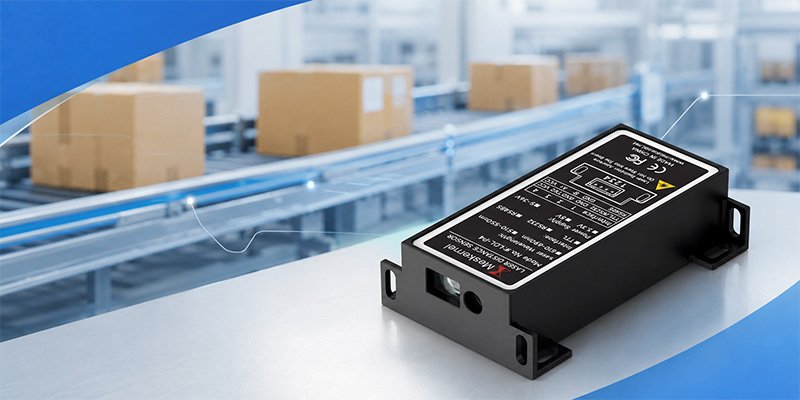
Ölçüm Aralığı
The sensor’s operating range should match the dimensions of the conveyor system while maintaining the required accuracy.
Accuracy Requirements
Applications such as robotic assembly or precision packaging may require millimeter-level measurement performance.
Measurement Frequency
High-speed conveyor systems often benefit from sensors capable of providing rapid measurement updates.
Environmental Conditions
Dust, vibration, humidity, and temperature variations should be considered when selecting a sensor for industrial use.
Choosing a robust sensor designed for industrial environments helps ensure long-term reliability.
Future Trends in Conveyor Position Measurement
As smart manufacturing continues to evolve, conveyor systems are becoming increasingly intelligent.
Emerging trends include:
- AI-driven production optimization
- Autonomous material handling
- Smart logistics systems
- Digital twin technology
- Predictive maintenance
These technologies rely on accurate real-time data, making advanced positioning sensors even more important.
Laser-based conveyor position sensors are well suited for these next-generation applications because they provide precise, continuous, and reliable measurement data.
As automation requirements continue to increase, laser distance measurement technology is expected to play an increasingly important role in conveyor control and industrial process optimization.
Sonuç
Accurate positioning is essential for efficient conveyor operation in modern manufacturing and logistics environments. A conveyor position sensor based on laser distance measurement technology provides a powerful solution for tracking moving products with exceptional precision.
Compared with conventional sensing methods, laser sensors offer higher accuracy, continuous position feedback, non-contact operation, and improved reliability. Whether used in robotic automation, packaging lines, warehouse systems, or quality inspection applications, a laser sensor for conveyor systems can help manufacturers improve productivity while reducing downtime and maintenance costs.
As industrial automation advances, the demand for high accuracy conveyor positioning solutions will continue to grow, making laser-based sensing technology a valuable investment for future-ready production facilities.