How Does Temperature Affect Laser Distance Sensor Accuracy?
A laser distance sensor can deliver highly repeatable measurements in a controlled laboratory environment, but the same sensor may behave differently when installed inside a machine, exposed to direct sunlight, or used outdoors through large temperature changes. For engineers working with precision measurement, understanding how temperature affect laser distance sensor accuracy is important before selecting a sensor for a real application.
Temperature does not usually affect measurement through one single mechanism. Changes in the laser source, optical components, electronic circuits, mechanical structure, and installation environment can all contribute to measurement drift. The actual effect depends on the sensor principle, construction, measurement range, target characteristics, and operating conditions.
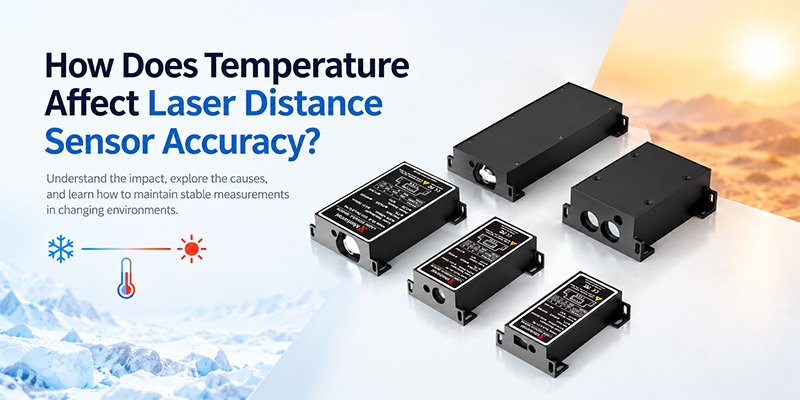
For this reason, temperature should be considered together with accuracy, repeatability, measurement range, and environmental specifications when evaluating a laser distance sensor.
Why Does Temperature Affect Laser Distance Sensor Accuracy?
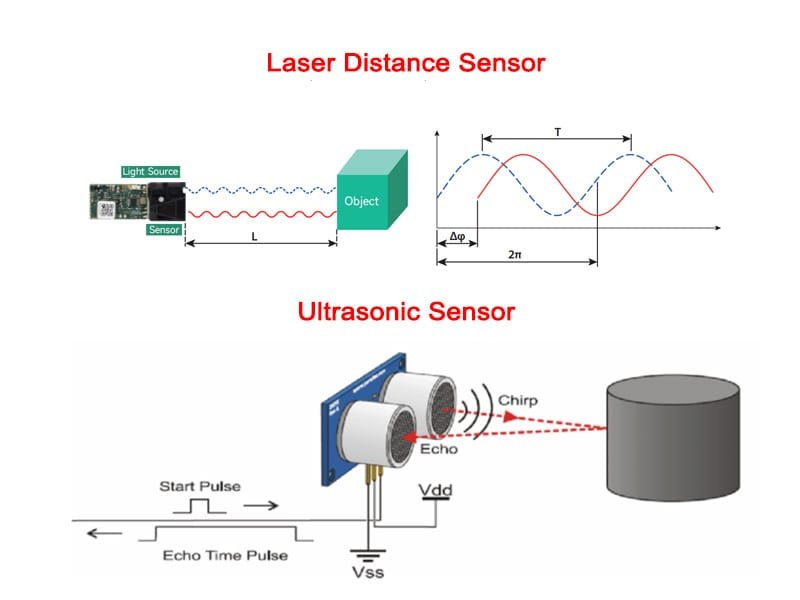
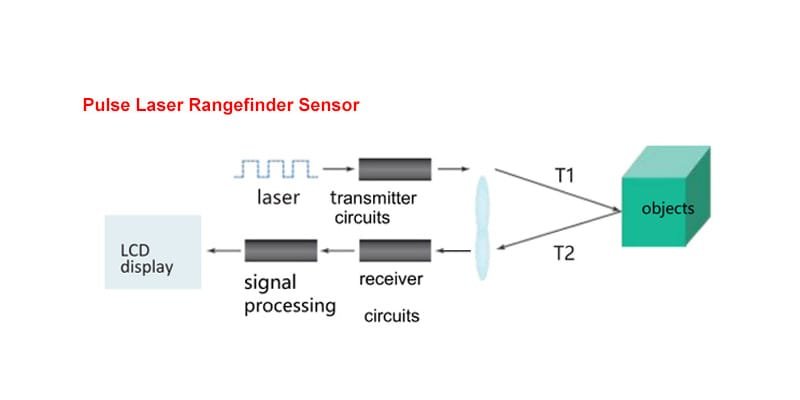
A laser distance sensor determines the position of a target by transmitting laser light and analyzing the returned signal. Depending on the design, the measurement may be based on phase, time of flight, triangulation, or another optical method.
All of these systems contain components whose characteristics can change with temperature.
For example, the optical wavelength and output characteristics of a laser source can vary as its temperature changes. Electronic components can also exhibit temperature-dependent changes in their electrical characteristics. At the same time, the mechanical structure supporting the optical components can expand or contract.
These effects may be very small in absolute terms. However, when the required measurement accuracy is in the millimeter or sub-millimeter range, small changes can become relevant.
This is one reason why the specification for a sensor should not be interpreted as a single number that applies under every environmental condition. A stated accuracy is normally associated with defined test conditions, including temperature, target characteristics, measurement distance, and other factors.
How Temperature Changes the Laser Measurement System
When considering temperature effects on laser distance measurement, engineers should look at the complete measurement chain rather than focusing only on the laser diode.
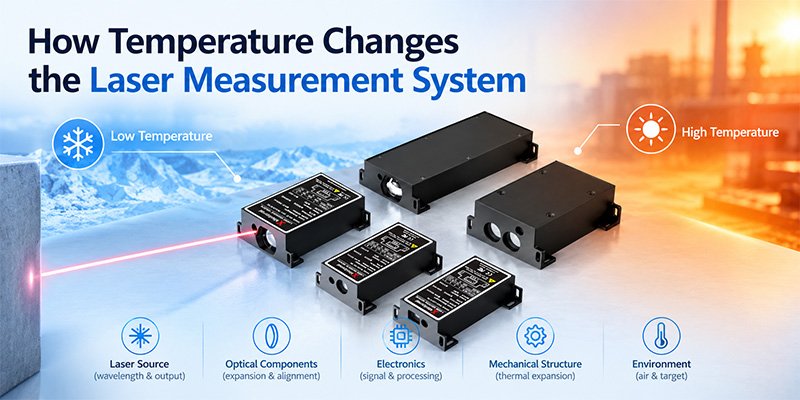
Laser Source
The laser source is one potential source of thermal drift. Semiconductor laser characteristics can change with temperature, including wavelength and output behavior.
In some measurement architectures, these changes can influence the relationship between the transmitted signal and the received signal used to calculate distance.
The magnitude of the effect depends heavily on the sensor design. A system designed with appropriate calibration and compensation can reduce the impact considerably.
Optical Components
Lenses, optical mounts, filters, and other components may also respond to temperature.
Materials expand or contract at different rates. If the relative position of optical components changes, the optical path or imaging geometry can change as well.
This is particularly important for precision optical measurement systems. A mechanical change that would be insignificant for a general-purpose sensor may matter when the application requires very high repeatability.
Electronic Circuits
The receiver and signal-processing circuits are another consideration.
A laser distance sensor relies on electronic components to detect and process the reflected optical signal. Their characteristics are not perfectly independent of temperature. Changes in detector response, reference circuits, timing electronics, or signal conditioning can contribute to measurement drift.
Modern sensor designs can compensate for predictable behavior, but compensation itself depends on calibration and system design.
Mechanical Structure
The sensor housing and internal mounting structure can expand or contract when the temperature changes.
Consider a sensor mounted to a machine frame. If the sensor body, mounting bracket, and machine structure have different thermal expansion characteristics, their relative positions can change as the system heats or cools.
In a high-precision installation, this mechanical movement can become part of the overall measurement error.
What Happens When a Laser Distance Sensor Gets Hot?
A common assumption is that higher temperature simply causes the sensor to become less accurate. In practice, the situation is more complicated.
When the temperature rises, the sensor may experience a combination of electronic, optical, and mechanical changes. The measurement output may shift gradually as the internal components approach a new thermal equilibrium.
This is especially relevant in industrial equipment where the ambient temperature may remain relatively stable but the sensor itself is exposed to heat generated by motors, power electronics, control cabinets, or production processes.
For example, a sensor installed near a motor may experience a significantly different temperature profile from a sensor installed in an open laboratory.
This is why laser distance sensor operating temperature should be evaluated based on the actual installation rather than simply the general room temperature.
The same principle applies to outdoor applications. A sensor mounted on a metal structure can experience rapid heating under direct sunlight, followed by significant cooling after sunset. The ambient air temperature alone may not describe the actual thermal conditions experienced by the sensor.
Can Low Temperature Also Cause Measurement Drift?
Yes.
Low temperatures can also affect the optical, electronic, and mechanical characteristics of a measurement system.
When the temperature falls, materials contract and electronic characteristics may change. If the sensor moves between a warm indoor environment and a cold outdoor environment, the measurement output may change during the transition period.
For this reason, temperature-related behavior should be evaluated across the complete temperature range expected during operation.
An application that operates between 20°C and 30°C may have very different requirements from one operating between -20°C and 60°C.
When selecting an промышленный лазерный датчик расстояния, engineers should therefore check the specified operating range rather than assuming that the nominal accuracy applies equally at every temperature.
What Is Temperature Compensation in a Laser Distance Sensor Accuracy?
Laser distance sensor temperature compensation is a method used to reduce predictable measurement errors caused by temperature changes.
A sensor can monitor its internal temperature and use calibration information or correction algorithms to compensate for known thermal behavior. Depending on the architecture, compensation can be implemented through firmware, calibration tables, mathematical models, hardware design, or a combination of these methods.
The objective is not necessarily to eliminate every temperature-related effect. Instead, the system attempts to characterize predictable drift and reduce its influence on the measurement result.
This distinction is important.
Temperature compensation does not automatically mean that a sensor will maintain its stated accuracy under every possible temperature condition. Engineers still need to examine how the accuracy specification was obtained and whether the sensor has been tested under conditions similar to the intended application.
A sensor with temperature compensation can be useful in applications where environmental temperature changes significantly, but the quality of the compensation depends on the sensor’s design, calibration process, temperature measurement, and operating range.
Temperature and Measurement Accuracy Are Not the Same as Repeatability
When discussing laser distance sensor accuracy, it is also important to distinguish accuracy from repeatability.
Laser distance measurement accuracy describes how close the measured value is to the actual or reference distance. Repeatability describes how consistently the sensor produces the same result under repeated measurements.
Temperature changes can affect both.
For example, a industrial laser distance sensor may repeatedly report nearly the same value after it reaches thermal stability, but that value may have shifted slightly from the reference distance because of thermal drift.
Therefore, a sensor can have good repeatability while still showing a temperature-dependent measurement offset.
This distinction becomes important during product evaluation. A short laboratory test may demonstrate excellent repeatability while failing to reveal thermal drift that appears after the sensor has been exposed to a different temperature for several hours.
How to Test Temperature-Related Measurement Errors
For demanding applications, engineers should test the industrial laser distance sensor under representative environmental conditions.
One practical approach is to use a fixed target at a known distance and record the sensor output at different temperatures.
The test should keep other variables as consistent as possible, including target position, target material, measurement angle, and electrical configuration.
A simple test can compare measurements at several temperature points, for example:
- Low operating temperature
- Normal room temperature
- Elevated operating temperature
The important result is not necessarily one specific error value. The engineer should look for a repeatable relationship between temperature and measurement output.
If the measurement gradually shifts as temperature changes and returns toward its original value when the temperature returns to the starting point, the behavior may indicate thermal drift.
For applications requiring high accuracy, this type of environmental validation can be more informative than relying only on a nominal accuracy specification.
How to Improve Laser Distance Measurement Accuracy in Changing Temperatures
There is no single solution for every application, but several practical measures can reduce temperature-related problems.
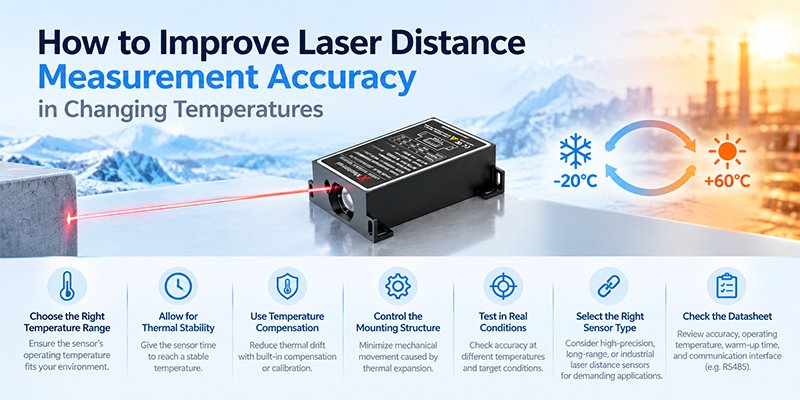
Select the Correct Operating Temperature Range
The first step is to choose a sensor whose specified operating range covers the real environment.
Do not select a sensor based only on its maximum measurement distance or nominal accuracy.
Allow the Sensor to Reach Thermal Stability
If the application requires stable measurements, allow sufficient time for the sensor to reach a relatively stable internal temperature before using its output as a precision reference.
This is especially important when the sensor is switched on after a significant temperature change.
Consider Temperature Compensation
For applications exposed to substantial temperature variation, check whether the sensor provides a temperature compensation function and how it is specified.
The presence of compensation is useful information, but engineers should also consider the temperature range over which the compensation has been characterized.
Control the Mounting Structure
The sensor itself may not be the only source of thermal movement.
A mounting bracket or machine frame can expand as it heats. In a precision positioning application, this mechanical movement can appear as a measurement change even when the sensor’s internal measurement electronics are functioning normally.
Test the Complete System
The most reliable validation is performed under conditions close to the final installation.
If the sensor will measure a moving metal component inside a factory, testing only a stationary target in an air-conditioned laboratory may not represent the final application.
Temperature Should Be Included in Sensor Selection
When engineers compare different лазерные датчики расстояния, temperature should be treated as part of the measurement specification rather than as an afterthought.
A useful evaluation should include:
- Measurement accuracy
- Repeatability
- Measurement range
- Рабочая температура
- Temperature compensation
- Measurement frequency
- Target reflectivity
- Installation conditions
- Warm-up behavior
- Интерфейс связи
For example, a sensor intended for indoor positioning may have relatively stable environmental conditions, while a sensor used for outdoor monitoring may experience substantial daily temperature changes.
Likewise, an automation system installed close to a heat source may require different thermal characteristics from a sensor mounted on a production line in a controlled environment.
Understanding the application first makes it easier to determine which sensor specifications actually matter.
Choosing a Laser Distance Sensor for Real Applications
The effect of temperature is only one part of the sensor selection process.
Engineers should also consider the required measurement range, target surface, response speed, communication interface, installation space, and environmental protection.
For applications that require stable digital communication with a controller, a laser distance sensor with RS485 can be considered where the interface and cable requirements are suitable.
For applications requiring longer measurement distances, long-range laser distance sensors may be more appropriate, but their performance should still be evaluated against the target reflectivity and environmental conditions.
For high-precision applications, engineers can also review high-precision laser distance sensors and compare their accuracy specifications under the temperatures relevant to the final installation.
The key is to evaluate the complete application rather than selecting a sensor from one specification alone.
Заключение
Temperature can influence laser distance measurement through several paths, including changes in the laser source, electronics, optical components, mechanical structure, and installation environment.
The impact is not identical for every sensor. Measurement principle, optical design, calibration, compensation method, temperature range, and application conditions all affect the final result.
For engineers, the practical question is therefore not simply whether temperature affects a sensor. The more useful question is how much thermal drift can occur under the actual operating conditions and whether the sensor design provides sufficient compensation and stability.
By considering operating temperature, thermal compensation, warm-up behavior, mounting structure, and application-specific testing during sensor selection, it becomes easier to achieve consistent laser distance measurement accuracy in real industrial environments.
FAQ: Temperature and Laser Distance Sensor Accuracy
Does temperature affect laser distance sensor accuracy?
Yes. Temperature can affect the laser source, electronics, optical components, and mechanical structure of a sensor. The actual measurement drift depends on the sensor design and operating conditions.
What is laser distance sensor temperature compensation?
Laser distance sensor temperature compensation is a method for reducing predictable measurement drift caused by temperature changes. It may use temperature measurements, calibration data, firmware, or correction algorithms.
What is the operating temperature of a laser distance sensor?
The operating temperature varies by sensor model. Engineers should check the manufacturer’s datasheet and compare the specified range with the temperature conditions expected in the final installation.
Does a laser distance sensor need warm-up time?
For precision applications, allowing the sensor to reach thermal stability can help improve measurement consistency. The appropriate warm-up period depends on the specific sensor and application.
How can I improve laser distance sensor accuracy?
Use a sensor designed for the required temperature range, consider temperature compensation, allow sufficient thermal stabilization, control mounting-related movement, and validate the sensor under representative operating conditions.
Does temperature affect long-range laser distance measurement?
It can. At longer measurement distances, environmental conditions and small changes in the measurement system can become more significant. Long-range applications should therefore be tested under the actual temperature and target conditions expected during operation.