7 Factors That Affect Laser Distance Sensor Accuracy
In modern automation, robotics, surveying, and industrial monitoring, laser distance sensors are widely used because they provide fast and non-contact measurements. However, even the best sensor can deliver inconsistent results if the measurement conditions are not ideal. Understanding the factors that influence laser distance sensor accuracy is essential for selecting the right device and achieving reliable performance in real-world applications.
This article explains the seven most important factors that affect accuracy and offers practical ways to improve laser measurement accuracy in demanding environments.
Why Laser Distance Sensor Accuracy Matters
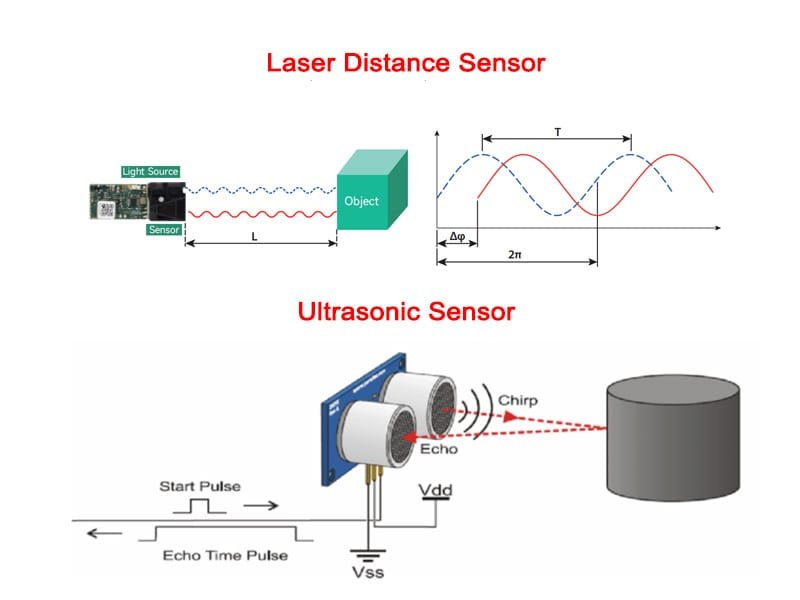
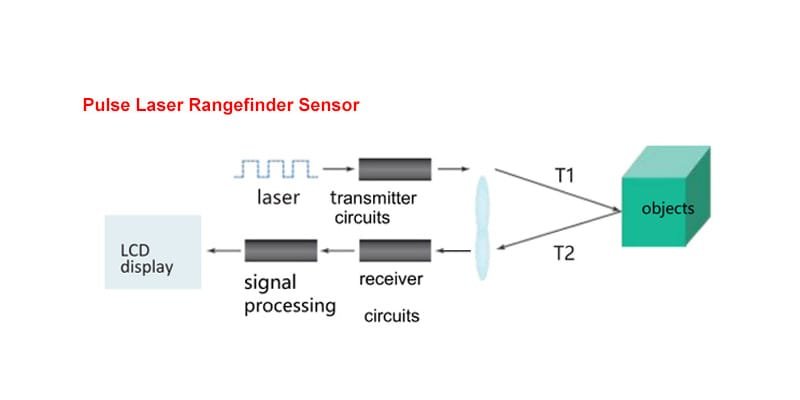
A laser distance sensor works by emitting a laser beam toward a target and calculating the distance based on the reflected signal. The technology may use phase-shift measurement, time-of-flight (ToF), or triangulation, but all methods rely on detecting a clean and stable reflection.
In industrial systems, small measurement errors can lead to:
- Misaligned robotic arms
- Incorrect positioning on conveyor systems
- Reduced product quality
- Navigation errors in AGVs or drones
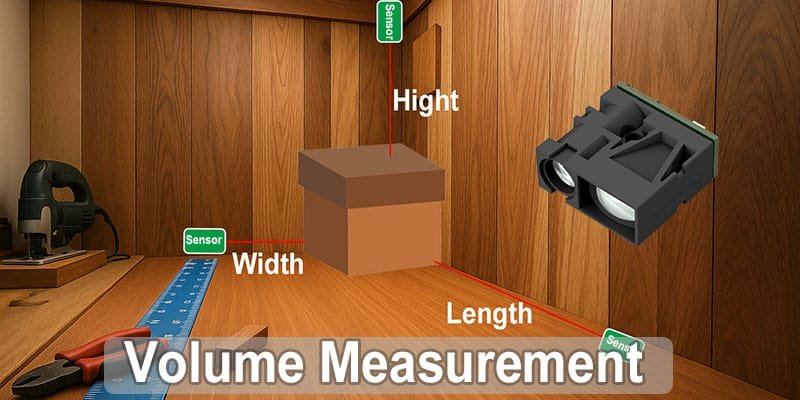
- Inaccurate level or volume measurements
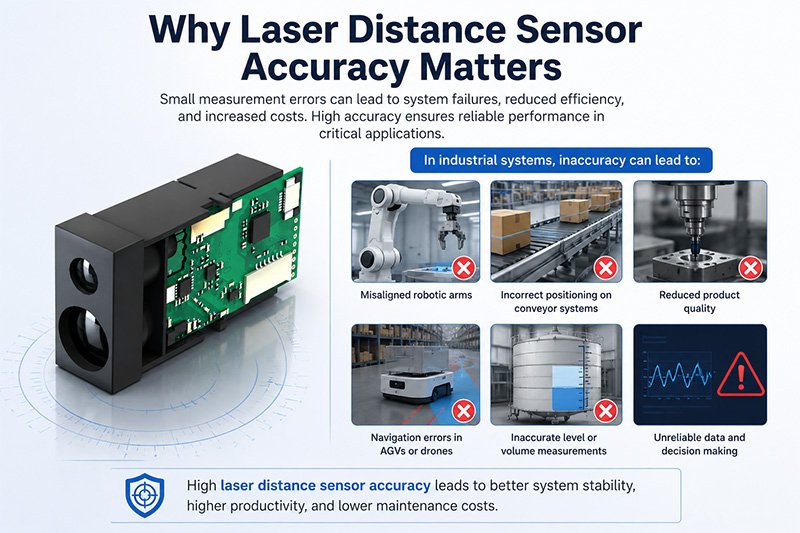
For applications requiring millimeter-level precision, choosing a high precision distance sensor and controlling environmental conditions are equally important.
1. Target Surface Reflectivity
The surface characteristics of the target have a major impact on measurement performance. Laser sensors depend on reflected light, so surfaces that absorb or scatter the beam can reduce signal quality.
High reflectivity surfaces
Materials such as white plastic, painted metal, or reflective tape return a strong signal and generally produce the best results.
Low reflectivity surfaces
Dark rubber, matte black materials, or rough surfaces absorb more light, making it harder for the sensor to detect the return signal accurately.
How to improve accuracy
- Use a sensor designed for low-reflectivity targets.
- Reduce the measurement distance when possible.
- Add reflective markers or targets in critical measurement points.
2. Measurement Distance
Accuracy often changes as the distance to the target increases. At longer ranges, the laser beam spreads slightly, and the returned signal becomes weaker.
For example, a sensor with ±1 mm accuracy at 10 m may have lower precision near its maximum range.
Why distance matters
- Beam divergence increases spot size.
- Signal strength decreases over distance.
- Atmospheric disturbances have more influence.
Best practices
- Select a sensor with a comfortable margin above your required range.
- Avoid operating continuously at the sensor’s maximum distance.
- Use optical alignment to keep the beam centered on the target.
3. Ambient Light Conditions
Strong ambient light, especially sunlight or high-intensity industrial lighting, can interfere with the sensor’s receiver and reduce laser measurement accuracy.
Outdoor installations are particularly challenging because sunlight contains a broad spectrum of infrared energy that may overlap with the sensor’s wavelength.
Effects of ambient light
- Reduced signal-to-noise ratio
- Intermittent readings
- Shorter effective measurement range
Решения
- Use sensors with optical filters and ambient light suppression.
- Install shading or protective housings outdoors.
- Choose wavelengths less affected by sunlight when possible.
4. Environmental Conditions
Temperature, humidity, dust, fog, and smoke can all affect laser propagation and reflection.
Temperature
Extreme temperatures may change internal electronics or slightly alter the speed of light in air, affecting calibration.
Dust and particles
Airborne particles scatter the laser beam and weaken the return signal.
Fog, steam, and smoke
These conditions absorb and scatter light, making long-range measurements unreliable.
Improvement tips
- Use sensors rated for the operating temperature range.
- Keep the optical window clean.
- Install air purging or protective enclosures in dusty environments.
5. Sensor Alignment and Mounting Stability
Even a high precision distance sensor cannot compensate for poor mechanical installation. Misalignment or vibration can cause the laser spot to move across the target, leading to fluctuating readings.
Common issues
- Sensor not perpendicular to the target
- Loose mounting brackets
- Machine vibration or movement
How to optimize installation
- Mount the sensor rigidly on a stable surface.
- Align the beam perpendicular to the target whenever possible.
- Use vibration-damping mounts in dynamic machinery.
6. Laser Spot Size and Target Geometry
Сайт laser spot is not infinitely small. As distance increases, the spot diameter grows. If the target is smaller than the spot or has complex geometry, the sensor may average reflections from multiple surfaces.
Examples
- Measuring thin wires or edges
- Scanning irregular or curved surfaces
- Targets with holes or gaps
Best practices
- Ensure the target is larger than the laser spot.
- Use sensors with smaller beam divergence for fine targets.
- Position the sensor to avoid edges and discontinuities.
7. Sensor Calibration and Signal Processing
Over time, calibration drift, electronic noise, or incorrect configuration can reduce laser distance sensor accuracy.
Calibration factors
- Aging components
- Temperature cycling
- Mechanical shock
Signal processing factors
Settings such as averaging, sampling rate, and filtering affect both stability and responsiveness.
Recommendations
- Follow the manufacturer’s calibration schedule.
- Use averaging for noisy environments, but avoid excessive filtering when fast response is required.
- Regularly verify accuracy with a known reference target.
Choosing the Right High Precision Distance Sensor
When selecting a sensor, consider more than just the advertised accuracy specification. Evaluate the complete operating environment and application requirements.
Key selection criteria
| Factor | Why It Matters |
|---|---|
| Measurement range | Determines usable distance and precision stability |
| Target material | Affects reflectivity and signal strength |
| Ambient conditions | Influences interference and reliability |
| Required response speed | Impacts filtering and update rate |
| Mounting environment | Determines vibration and alignment needs |
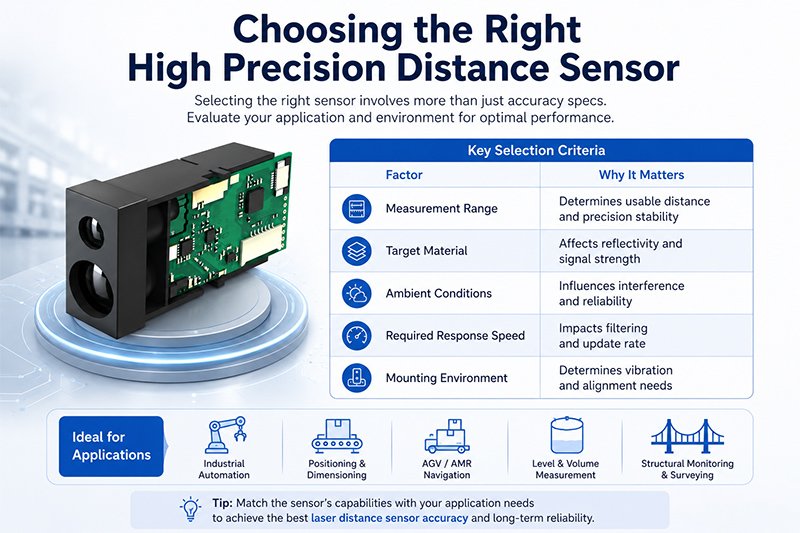
For industrial automation, sensors with millimeter-level precision, fast update rates, and robust interfaces such as RS485 or Ethernet are often preferred.
Practical Tips to Improve Laser Measurement Accuracy
Here are some actionable steps to maximize performance in real applications:
- Use the correct sensor technology: phase-shift sensors are excellent for high precision at medium ranges, while ToF sensors are better for long-range measurements.
- Keep optics clean: dust or fingerprints on the lens can noticeably reduce signal quality.
- Control the environment: minimize vibration, stray light, and airborne particles.
- Optimize target positioning: measure flat, stable surfaces whenever possible.
- Validate periodically: compare readings against a calibrated reference to detect drift early.
Заключение
Achieving excellent laser distance sensor accuracy depends on much more than the sensor’s datasheet specification. Target reflectivity, distance, ambient light, environmental conditions, mounting stability, spot size, and calibration all play critical roles in determining real-world performance.
By understanding these factors and applying the recommended best practices, engineers can significantly improve laser measurement accuracy and get the most from a high precision distance sensor in industrial, robotic, and outdoor applications.