What Affects Laser Rangefinder Module Accuracy?
Accuracy is one of the first specifications engineers check when selecting a laser rangefinder module. However, the accuracy stated on a datasheet is normally measured under defined laboratory conditions. In an actual installation, the result can be influenced by the target, environment, optical alignment, operating temperature, measurement distance, and even the way the module is mounted.
Understanding these factors is essential when a laser rangefinder module is being integrated into UAVs, industrial equipment, robotics, surveying instruments, thermal imaging systems, or other distance-measurement devices.
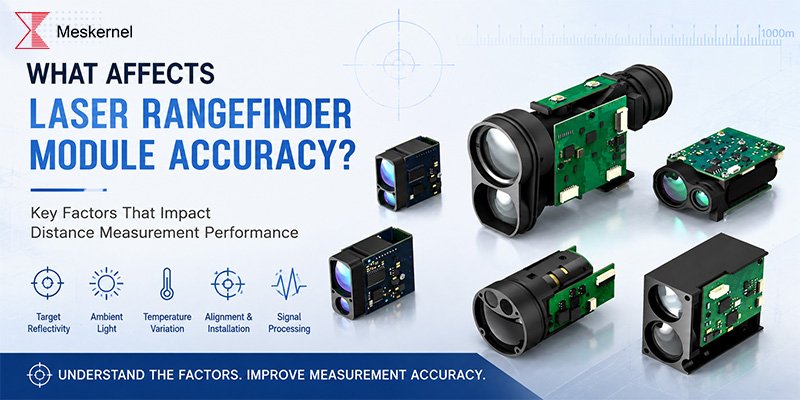
In practical applications, Laser Rangefinder Module Accuracy should therefore be considered as a system-level performance rather than simply a number printed on a specification sheet.
1. Target Surface Reflectivity
The target is one of the most important variables affecting measurement performance.
Laser rangefinder modules work by transmitting laser energy toward an object and analyzing the reflected signal. A bright, diffuse surface generally returns more usable optical energy than a dark or highly absorptive surface. When the reflected signal becomes weak, the receiver has less information to determine the precise arrival time or position of the optical signal.
Black rubber, dark fabric, vegetation, and other low-reflectivity materials can therefore reduce effective measurement performance, particularly at longer distances.
On the other hand, highly reflective or polished surfaces can also create problems. Specular surfaces may reflect the laser away from the receiver or generate unwanted secondary reflections. Industrial sensor documentation also identifies reflectivity and surface characteristics as important variables in reliable distance detection.
For this reason, a module that achieves excellent accuracy on a standard white target may produce different results when measuring black, glossy, textured, or irregular surfaces.
2. Measurement Distance
Distance itself can influence practical accuracy.
As the target moves farther away, the laser signal travels a longer optical path and the returning energy becomes weaker. At the same time, the laser beam generally expands with distance. This means that a small target may no longer completely fill the measurement spot.
Beam expansion is particularly important in long-range applications. SICK documentation notes that laser beam diameter increases as the distance from the sensor increases, while target size, incidence angle, remission, and surface characteristics can all affect detection.
This is why engineers should evaluate not only the maximum range of a module, but also the expected target size and required accuracy at the actual operating distance.
3. Beam Divergence and Spot Size
Beam divergence is closely related to target size and measurement accuracy.
A laser rangefinder module with a narrow beam can concentrate optical energy onto a smaller area. This is useful when the application requires measurement of a specific object or when multiple objects are located close together.
With greater beam divergence, the spot becomes larger as distance increases. If the laser spot covers two surfaces at different distances, the receiver may receive energy from both surfaces. Depending on the optical design and signal-processing algorithm, this can create unstable or unexpected readings.
For long-range systems, optical design therefore becomes particularly important. Beam divergence should be evaluated together with target dimensions, mounting distance, and the required measurement field.
4. Ambient Light and Outdoor Conditions
Strong ambient light is another factor that can influence laser measurement.
Sunlight contains a broad range of optical energy, including wavelengths that may overlap with the receiver’s sensitivity. Direct sunlight entering the receiving optics can increase background noise and reduce the signal-to-noise ratio.
This effect can become more noticeable when measuring dark targets or operating at long distances, where the returning laser signal is already relatively weak.
Industrial distance-sensor documentation confirms that direct sunlight and strong ambient light can affect measurement accuracy, while optical filtering, suitable installation, and shielding can reduce interference.
For outdoor equipment, engineers should therefore evaluate the module under the actual lighting conditions rather than relying only on indoor test results.
5. Temperature and Electronic Stability
Temperature can influence both optical and electronic components.
Laser diodes, photodetectors, timing circuits, oscillators, and other electronic components may experience small changes in characteristics as temperature changes. Mechanical structures can also expand or contract.
For high-precision applications, these changes may become significant enough to affect measurement consistency.
A well-designed laser rangefinder module typically includes appropriate compensation and calibration strategies. However, system designers should still check the specified operating temperature range and understand under which conditions the published accuracy is guaranteed.
This is especially important for equipment installed outdoors, on UAVs, inside vehicles, or near industrial machinery where temperature can change rapidly.
6. Sensor Alignment and Installation Angle
Mechanical installation is often overlooked when investigating measurement errors.
The laser should be correctly aligned with the intended target. If the module is mounted at an unsuitable angle, the reflected energy may not return efficiently to the receiving optics.
The target’s angle matters as well. Diffuse surfaces are generally more forgiving, while highly reflective surfaces can produce strong directional reflections.
Industry-leading company notes that differences in target material and color can increase measurement errors and that installation geometry should be considered carefully when positioning a laser sensor.
For this reason, an accurate module can still deliver poor field results if the mechanical installation is poorly designed.
7. Target Shape and Size
A laser rangefinder does not measure an abstract point. It measures the optical signal returned from the area illuminated by the laser.
If the target is too small compared with the laser spot, part of the emitted energy may miss the target. Nearby objects, edges, walls, vegetation, or other surfaces can then contribute to the received signal.
This becomes increasingly important at longer distances because the beam expands.
For applications involving small moving targets, designers should consider beam divergence, target dimensions, measurement distance, and mounting stability together rather than evaluating each specification independently.
8. Signal Processing and Measurement Algorithms
Optical hardware is only one part of a laser rangefinder module.
After receiving the reflected signal, the electronics must identify the valid measurement signal from noise and unwanted reflections. Timing resolution, filtering, averaging, echo selection, signal-strength evaluation, and other processing techniques can all influence the final result.
A module may therefore have excellent optical components but still perform poorly if the signal-processing strategy is not optimized for the intended application.
This is particularly important when measuring through complex environments or around multiple objects. Glass, for example, can produce multiple reflections and potentially lead to incorrect measurement points depending on the echo-processing strategy.
9. Vibration and Target Movement
Mechanical vibration can introduce another source of error.
If either the sensor or target moves during the measurement interval, the measured distance may not represent a perfectly static position. On UAVs, robots, vehicles, and industrial machines, vibration can also change the angle between the laser and the target.
The effect becomes more noticeable when the required accuracy is high or when the target is far away.
A rigid mounting structure, appropriate damping, and a suitable measurement frequency can help improve overall system stability.
10. Power Supply and Electrical Interference
Stable electrical performance is also important.
Laser rangefinder modules contain optical transmitters, receivers, timing circuits, processors, and communication interfaces. Voltage fluctuations or electrical interference can potentially affect measurement stability or communication reliability.
When integrating a module into a larger system, designers should provide a clean power supply and follow the manufacturer’s recommendations for grounding, wiring, shielding, and interface connections.
This is especially relevant in industrial environments containing motors, inverters, relays, and other sources of electromagnetic interference.
How to Improve Laser Rangefinder Module Accuracy
Improving measurement accuracy does not always require selecting a more expensive module. In many cases, better system integration can make a significant difference.
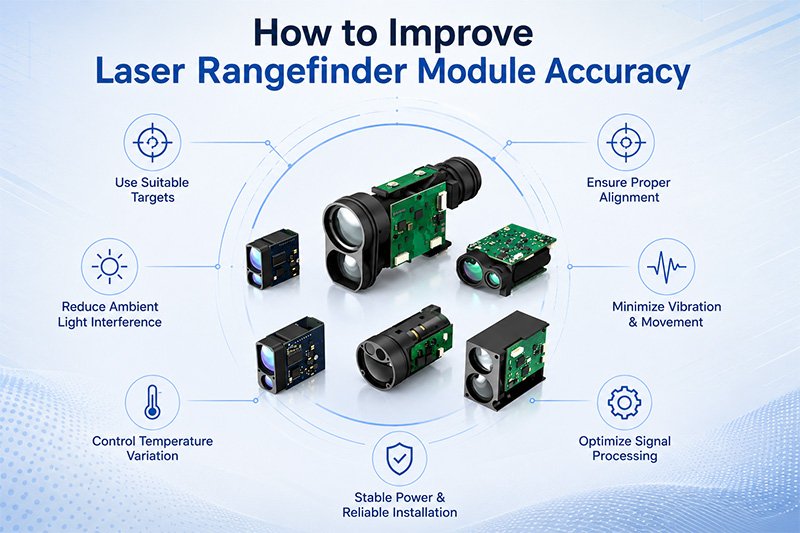
A practical approach includes:
- Select a module according to the actual target reflectivity and measurement distance.
- Check beam divergence when measuring small or distant targets.
- Avoid direct sunlight entering the receiving optics whenever possible.
- Keep the laser path clear of vegetation, dust, rain, and other temporary obstructions.
- Mount the module securely to minimize vibration.
- Maintain correct alignment between the laser and target.
- Test the module using the actual target material rather than only a standard laboratory target.
- Evaluate performance across the expected temperature range.
- Use appropriate signal filtering and averaging when application dynamics allow it.
- Validate accuracy under real operating conditions before finalizing the system design.
The key point is that Laser Rangefinder Module Accuracy is determined by the interaction between the module and its operating environment. A specification such as ±1 m or ±2 mm is meaningful only when the testing conditions and application requirements are understood.
Accuracy vs. Repeatability: What Is the Difference?
Accuracy and repeatability are sometimes treated as the same specification, but they describe different aspects of performance.
Accuracy indicates how close a measured value is to the actual distance.
Repeatability describes how consistently the module produces similar measurements when the same target is measured repeatedly under the same conditions.
A system can therefore have good repeatability but poor absolute accuracy. For example, if a module consistently measures a reference target 20 mm farther than its actual position, the readings may be highly repeatable but not highly accurate.
This distinction is important when selecting a module for positioning, inspection, robotics, or closed-loop control.
Choosing a Laser Rangefinder Module for a Real Application
When evaluating a laser rangefinder module, engineers should look beyond the maximum measuring range and nominal accuracy.
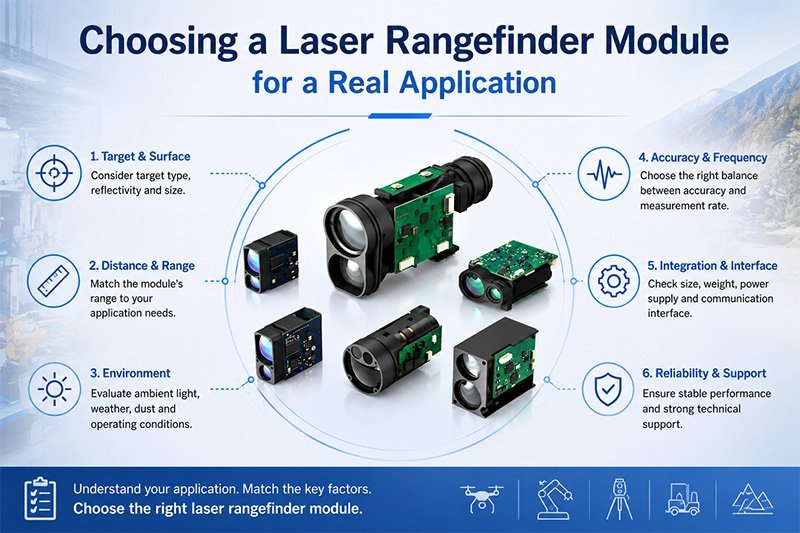
A better evaluation considers at least six questions:
- What is the actual target material?
- How far away is the target?
- How large is the target compared with the laser spot?
- What ambient lighting conditions will exist?
- Is the sensor or target moving?
- What accuracy and repeatability are actually required?
For example, a short-range industrial positioning application may prioritize millimeter-level accuracy and high measurement frequency. A UAV application may instead prioritize long range, low weight, stable performance outdoors, and reliable detection of relatively small targets.
The best laser rangefinder module is therefore not necessarily the one with the smallest accuracy number on its datasheet. It is the one whose optical performance, ranging technology, signal processing, environmental tolerance, and mechanical design match the application.
Conclusion
Laser Rangefinder Module Accuracy depends on much more than the laser source itself. Target reflectivity, measurement distance, beam divergence, ambient light, temperature, alignment, target geometry, vibration, electrical stability, and signal processing can all influence the final measurement.
For engineers developing a new product, laboratory specifications should be treated as a starting point rather than a guarantee of field performance. Testing the module with the actual target, installation geometry, and environmental conditions is one of the most reliable ways to determine whether the expected accuracy can be achieved.
A carefully selected module combined with proper optical alignment, mechanical installation, environmental protection, and system-level calibration can deliver significantly more consistent distance measurements in real-world applications.
FAQ
What is Laser Rangefinder Module Accuracy?
Laser Rangefinder Module Accuracy describes how close the measured distance is to the actual distance. The specified value is normally obtained under defined test conditions and may vary depending on the target and environment.
What factors affect laser rangefinder accuracy the most?
The most common factors include target reflectivity, measurement distance, beam divergence, ambient light, target angle, temperature, vibration, and signal-processing conditions.
Does a black target reduce laser rangefinder accuracy?
It can. Dark surfaces generally return less optical energy, which can reduce the signal available to the receiver, particularly at longer distances. The actual effect depends on the module’s optical and signal-processing design.
Does sunlight affect laser distance measurement?
Strong direct sunlight can increase optical background noise and make it more difficult for the receiver to distinguish the laser signal. Proper optical filtering, installation, and shielding can help reduce the effect.
How can I improve laser rangefinder measurement accuracy?
Start by selecting a module appropriate for the target distance and surface. Then optimize mounting alignment, reduce vibration and unwanted reflections, control ambient-light interference, and validate performance under actual operating conditions.
Is higher range always better for accuracy?
No. Maximum range and accuracy are different specifications. A module may reach a long distance under favorable conditions while achieving its best accuracy at a shorter range or on a more reflective target.
What is more important, accuracy or repeatability?
It depends on the application. Absolute positioning applications may require high accuracy, while monitoring and control applications may place greater emphasis on repeatability and stable measurements.