How Beam Divergence Affects Laser Rangefinder Module Performance
When engineers evaluate a laser rangefinder module, specifications such as measurement range, accuracy, wavelength, operating frequency, and interface usually receive most of the attention. One optical parameter is often overlooked until the system is tested in a real environment: beam divergence.
Beam divergence determines how quickly the laser spot expands as the measurement distance increases. That seemingly simple characteristic has a direct influence on the amount of laser energy reaching the target, the reflected signal received by the detector, the ability to distinguish one target from another, and ultimately the reliability of the measured distance.
For short-range applications involving large, flat targets, beam divergence may not create an obvious problem. The situation changes significantly when a laser rangefinder module is expected to measure small objects, distant targets, narrow structures, or targets surrounded by other objects.

Understanding beam divergence is therefore important when selecting or designing a laser rangefinder module for UAVs, robotics, industrial automation, surveying equipment, security systems, and other long-distance measurement applications.
What Is Laser Beam Divergence?
Laser beam divergence describes the gradual expansion of a laser beam as it travels away from the emitter. It is commonly specified in milliradians (mrad).
A perfectly parallel laser beam would theoretically maintain the same diameter indefinitely. Real optical systems cannot achieve this because of diffraction, laser characteristics, optical components, and alignment tolerances. As a result, the beam gradually becomes wider with distance.
For engineering purposes, the relationship can be simplified as:
Spot size ≈ beam divergence × measurement distance
For example, ignoring the initial beam diameter:
- A 0.5 mrad beam produces approximately a 0.5 m spot at 1,000 m.
- A 1 mrad beam produces approximately a 1 m spot at 1,000 m.
- A 2 mrad beam produces approximately a 2 m spot at 1,000 m.
The difference may appear small at 10 or 20 meters, but it becomes substantial at several hundred meters or kilometers. This is why beam divergence becomes increasingly important as the required measurement range increases.
Why Beam Size Matters to a Laser Rangefinder Module
The most direct consequence of divergence is the growth of the laser spot.
Consider a laser rangefinder module measuring a narrow pole at 800 meters. If the laser spot is significantly smaller than the pole, most of the transmitted energy remains on the intended target.
If the spot becomes larger than the target, part of the laser energy may fall onto the background, ground, vegetation, buildings, or other nearby objects.
This changes the ranging problem.
A laser rangefinder does not simply ask, “How far away is the target?” It must first obtain a usable reflected signal and determine which return corresponds to the intended target. When the illuminated area contains multiple surfaces at different distances, the received signal can become more complicated.
This is particularly important for:
- Utility poles and cables
- Roadside structures
- Small industrial components
- UAV targets
- Pipeline markers
- Building edges
- Machinery components
- Objects surrounded by vegetation
- Narrow targets at long distances
Research on laser ranging systems has also demonstrated that transmitted beam divergence affects the detected optical power, particularly when the illuminated spot becomes larger than the target.
Beam Divergence and Rangefinder Accuracy
Rangefinder accuracy is not determined by beam divergence alone. However, divergence can become an important source of measurement uncertainty when the spot size approaches or exceeds the target dimensions.
A wide beam can illuminate multiple surfaces simultaneously. Suppose a laser rangefinder module is aimed at a wall, but a nearby object is positioned in front of the wall. If the beam covers both objects, the receiver may detect reflected energy from both distances.
Depending on the ranging architecture, signal processing, target reflectivity, and return strength, the system may produce:
- A stable measurement to the intended target
- A measurement biased toward the closer object
- An unstable reading
- A measurement that changes as the beam moves
- No valid measurement when the return signal becomes insufficient
This explains why a module that performs very well on a large white wall at 500 meters may behave differently when measuring a narrow dark target at the same distance.
The issue is not necessarily a failure of the ranging electronics. The optical footprint has changed the measurement conditions.
Narrower Divergence Is Not Always Better
It is tempting to assume that the smallest possible divergence always produces the best laser rangefinder module.
In practice, the answer is more complicated.
A narrow beam provides a smaller spot at long distances and concentrates optical energy more effectively. This can be advantageous for small targets and long-range measurements.
However, a very narrow beam also increases the alignment requirements.
For a handheld device, UAV, vehicle, or robotic platform, mechanical vibration and angular movement can cause the beam to move away from the intended target. A slightly wider beam can sometimes provide better practical usability because it gives the system more tolerance to pointing errors.
This creates an engineering trade-off:
Smaller divergence → smaller spot → better target discrimination
but also:
Smaller divergence → greater pointing sensitivity
The optimal specification therefore depends on the application rather than simply choosing the lowest available divergence.
For example, a tripod-mounted industrial measurement system may benefit from a tightly collimated beam because the optical axis is stable. A handheld system operating on moving targets may require a different balance between beam concentration and pointing tolerance. Similar considerations apply to UAV-mounted laser rangefinder modules, where platform vibration and attitude changes can affect target alignment.
Beam Divergence and Effective Measurement Range
Beam divergence also affects practical measurement range.
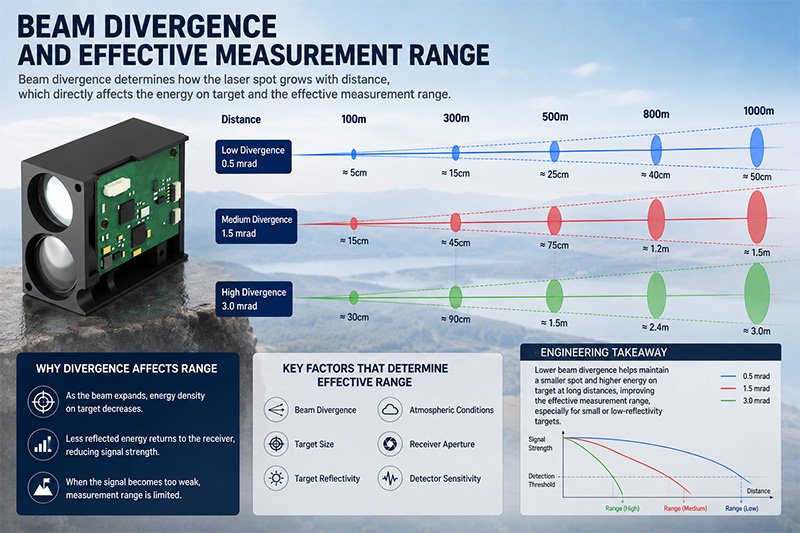
As the beam spreads, its energy is distributed over a larger area. If the target remains the same size, a smaller portion of the transmitted energy may interact with the target.
At the same time, the reflected energy available to the receiver depends on target reflectivity, atmospheric transmission, receiver aperture, optical efficiency, detector sensitivity, and other system parameters.
Therefore, it is incorrect to judge a laser rangefinder module’s maximum range from divergence alone.
However, divergence can become a limiting factor when the target is small relative to the beam spot.
For long-range applications, engineers should evaluate at least four parameters together:
- Beam divergence
- Target size
- Target reflectivity
- Required measurement distance
A long-range specification without corresponding optical information does not provide the complete picture of real-world performance.
Target Size Should Be Considered Together With Beam Size
One of the most useful ways to evaluate divergence is to compare the expected beam size with the actual target.
Imagine two applications.
Application A: Large Building
A laser rangefinder module measures a large building facade from 300 meters.
Even with a relatively large spot, the entire illuminated area may remain on the same surface. The ranging system has a relatively simple optical target.
Application B: Narrow Pole
The same module measures a 20 cm wide pole from 300 meters.
If the beam spot is comparable to or larger than the pole, small changes in pointing angle can cause part of the beam to move onto the background.
The second application places much greater demands on beam size, pointing stability, and rangefinder accuracy.
This is why engineers should never evaluate beam divergence independently from the target geometry.
Beam Divergence in UAV Laser Rangefinder Applications
UAV applications are a particularly good example of why optical design matters.
A UAV-mounted laser rangefinder module may be used for terrain measurement, altitude detection, obstacle detection, infrastructure inspection, or target distance measurement.
The platform introduces several additional challenges:
- Continuous vibration
- Small angular movements
- Changing flight attitude
- Long measurement distances
- Outdoor sunlight
- Variable target reflectivity
- Atmospheric interference
A narrow beam can improve target discrimination at long distances, but the system must also maintain sufficient mechanical and optical stability.
For a UAV application, engineers should therefore evaluate beam divergence together with:
- Mounting stability
- Laser wavelength
- Receiver field of view
- Measurement frequency
- Detection sensitivity
- Target reflectivity
- Required range
- Weight and power consumption
The best laser rangefinder module is not necessarily the one with the smallest divergence. It is the one whose optical characteristics match the complete UAV measurement system.
How Optical Design Influences Beam Divergence
Beam divergence is strongly connected to the laser source and optical design.
Collimation optics are used to control the expansion of the emitted laser beam. Lens quality, optical aperture, focal length, alignment accuracy, and mechanical structure all contribute to the final beam characteristics.
A larger optical aperture can generally help reduce diffraction-related divergence, while optical misalignment or imperfect components can introduce additional beam spreading.
The quality of the optical path therefore matters as much as the nominal laser source specification.
For manufacturers and system integrators, this means that beam divergence should be treated as a system-level parameter rather than simply a number printed on a product datasheet.
How to Choose the Right Beam Divergence
There is no universal divergence value that is ideal for every laser rangefinder module.
Instead, start with the application requirements.
For short-distance measurement
If the target is large and the measurement distance is relatively short, moderate divergence may be acceptable. Ease of alignment and compact optical design may be more important.
For long-distance measurement
As the measurement distance increases, beam divergence becomes increasingly important because spot size grows proportionally with distance.
A lower divergence is generally advantageous when measuring small or distant targets.
For small targets
When the target occupies only a small area in the field of view, a smaller beam size can reduce the possibility of illuminating surrounding objects.
For moving platforms
For UAVs, vehicles, handheld equipment, and robots, pointing stability must be considered together with divergence. An extremely narrow beam may require more precise mechanical stabilization.
What Engineers Should Check in a Laser Rangefinder Module Datasheet
When comparing different laser rangefinder modules, do not look only at the maximum range.
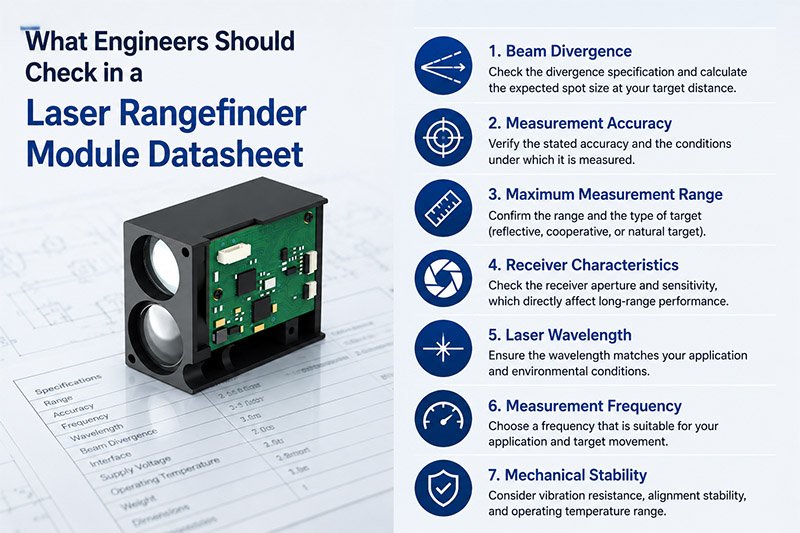
A more useful evaluation should include:
1. Beam divergence
Check the divergence specification and determine the expected spot size at the intended measurement distance.
2. Measurement accuracy
Verify whether the stated accuracy applies to a specific target type and measurement condition.
3. Maximum measurement range
Determine whether the range is specified for reflective, cooperative, or natural targets.
4. Receiver characteristics
A good transmitter alone cannot guarantee long-range performance. Receiver aperture and detection sensitivity also matter.
5. Laser wavelength
Wavelength influences atmospheric transmission, detector response, optical design, and system performance.
6. Measurement frequency
Applications involving moving platforms may require higher update rates.
7. Mechanical stability
For UAVs, robotics, and mobile equipment, optical alignment must remain stable under vibration and temperature changes.
A proper comparison considers all these parameters rather than selecting a module based on a single specification.
Final Thoughts
Beam divergence is one of the optical parameters that can quietly determine whether a laser rangefinder module performs well in the field.
A smaller divergence keeps the laser beam more concentrated over distance, helping maintain a smaller spot and improving target discrimination. However, an excessively narrow beam can increase sensitivity to pointing errors and platform movement.
The correct engineering approach is therefore not simply “smaller divergence is better.”
Instead, beam divergence should be matched to the measurement distance, target size, target reflectivity, platform stability, receiver characteristics, and required accuracy.
For engineers selecting a laser rangefinder module, understanding this relationship can prevent a common mistake: choosing a module based on its advertised maximum range while overlooking whether its optical beam can actually cover the intended target under real operating conditions.
In long-range laser measurement, the question is not only how far the laser can travel. It is how much useful optical energy reaches the right target and how reliably the system can identify its return.
FAQ
What is beam divergence in a laser rangefinder module?
Beam divergence describes how quickly the emitted laser beam expands as it travels away from the module. It is commonly expressed in milliradians (mrad). A smaller divergence generally produces a smaller spot at long distances.
Does lower beam divergence improve laser rangefinder accuracy?
It can improve practical measurement performance, particularly when measuring small or distant targets. A smaller spot reduces the probability that the laser simultaneously illuminates the intended target and surrounding objects. However, pointing stability and target characteristics must also be considered.
How does beam divergence affect measurement range?
Higher divergence spreads the laser energy over a larger area as distance increases. This can reduce energy density on a small target and weaken the returned signal, potentially reducing the practical measurement range.
What beam divergence is suitable for UAV laser rangefinder modules?
There is no single value suitable for every UAV. The appropriate divergence depends on flight stability, measurement distance, target size, required accuracy, laser power, receiver sensitivity, and the intended application.
Is a smaller laser spot always better?
No. A smaller spot improves target discrimination but requires more accurate pointing. For handheld or unstable platforms, an excessively narrow beam can make target acquisition more difficult. The best design balances spot size and pointing tolerance.