Long Range vs Short Range Laser Distance Sensor Guide
Введение
Choosing the correct laser sensor measuring range is one of the most important decisions in industrial automation and distance measurement projects. After working with laser measurement systems across factory automation, robotics, intelligent transportation, warehousing, UAV platforms, and infrastructure monitoring, I have found that many engineers initially focus on accuracy specifications while overlooking the measuring range requirements of the actual application.
In reality, selecting the wrong measuring range can increase project costs, reduce measurement reliability, and create unnecessary integration challenges. The decision between a short range laser distance sensor и лазерный датчик расстояния большой дальности should be based on application requirements rather than simply selecting the sensor with the greatest advertised distance.

This guide explains the practical differences between short-range and long-range laser measurement technologies and provides a structured approach for selecting the most appropriate solution.
What Is Laser Sensor Measuring Range?
Laser sensor measuring range refers to the minimum and maximum distance over which a sensor can reliably detect and calculate a target position.
Depending on the measurement principle and optical design, sensors can be categorized into several groups:
| Sensor Category | Typical Measuring Range |
|---|---|
| Лазерный датчик расстояния малого радиуса действия | 0.03m–80m |
| Mid-Range Laser Sensor | 80m–300m |
| Лазерный датчик расстояния большой дальности | 300m–4000m+ |
Although these ranges may overlap, the optimal choice depends on environmental conditions, target characteristics, required accuracy, and system response time.
For most factory automation projects, a short range laser distance sensor provides better performance than a long-range alternative.
Advantages of a Short Range Laser Distance Sensor
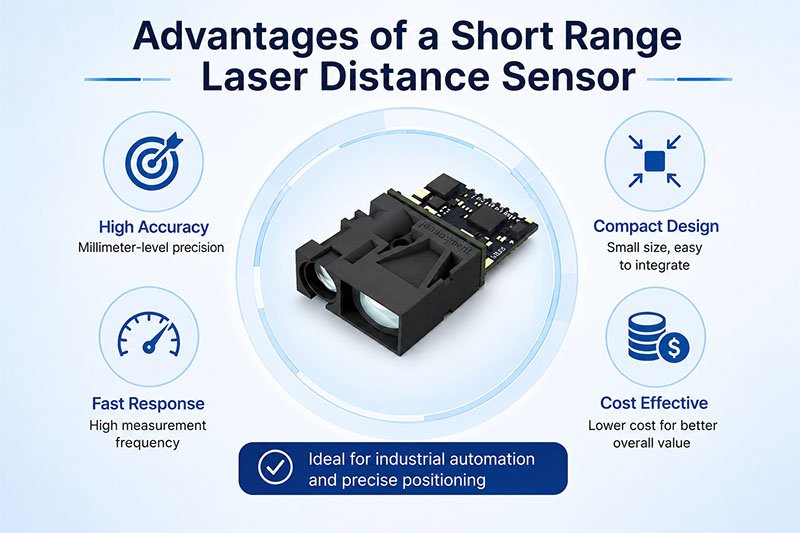
A short range laser distance sensor is specifically designed for high-precision measurements within limited distances.
Because the reflected laser signal remains relatively strong, these sensors can deliver exceptional accuracy and repeatability.
Higher Measurement Accuracy
Many industrial automation applications require precise positioning rather than extreme measuring distance.
Typical examples include:
- Robotic arm positioning
- Automated assembly equipment
- Packaging machinery
- CNC systems
- AGV docking stations
In these environments, millimeter-level measurement performance is often more important than maximum range.
A high-quality short range laser distance sensor can achieve:
- Точность ±1 мм
- Excellent repeatability
- Stable long-term performance
Faster Response Time
Industrial systems increasingly operate at high speeds.
Modern automation equipment requires real-time feedback for motion control and positioning.
A short range laser distance sensor typically supports higher measurement frequencies than long-range systems, allowing faster response to moving targets.
Compact Design
Space constraints are common in industrial equipment.
Short-range sensors generally feature:
- Smaller optics
- Lower power consumption
- Easier installation
- Reduced system complexity
These advantages make them particularly attractive for embedded industrial applications.
When a Long Range Laser Distance Sensor Is Necessary
While short-range solutions dominate factory automation, certain industries require significantly longer measurement distances.
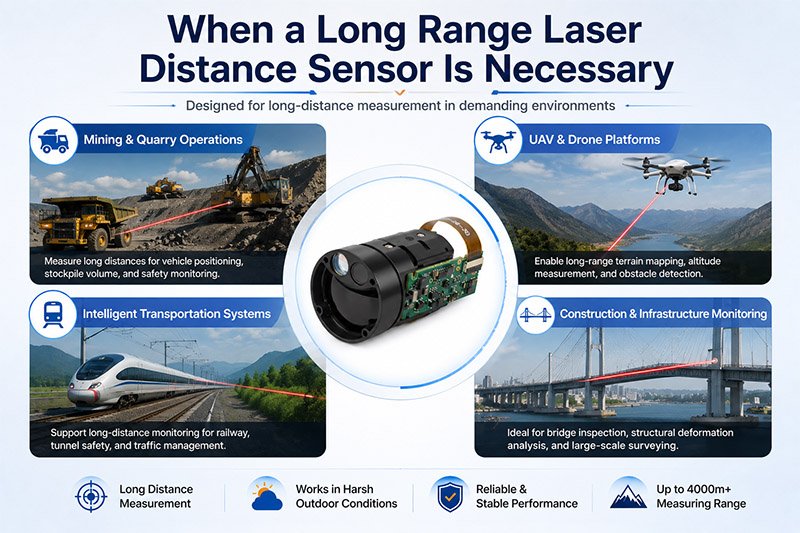
A лазерный датчик расстояния большой дальности becomes essential when the target exceeds the practical limits of conventional industrial sensors.
Горные и карьерные работы
Mining facilities often require measurements across hundreds or thousands of meters.
Applications include:
- Vehicle positioning
- Stockpile volume estimation
- Equipment collision prevention
UAV and Drone Platforms
Many aerial systems rely on long-distance measurement capabilities.
Typical use cases include:
- Terrain mapping
- Altitude monitoring
- Surveying missions
- Infrastructure inspection
Intelligent Transportation Systems
Transportation infrastructure frequently involves large measurement areas.
Examples include:
- Railway monitoring
- Tunnel safety systems
- Traffic management systems
Мониторинг строительства и инфраструктуры
Large-scale engineering projects often require long-distance measurements for:
- Bridge inspection
- Dam monitoring
- Structural deformation analysis
These applications justify the higher cost and complexity of long-range measurement systems.
Why Choosing Excessive Range Can Be a Mistake
A common misconception is that a sensor with a longer range automatically provides better performance.
In practice, this assumption often leads to unnecessary expenses.
Higher Equipment Costs
A лазерный датчик расстояния большой дальности generally requires:
- More powerful laser emitters
- Larger optical assemblies
- Advanced signal processing electronics
As a result, procurement costs are significantly higher.
Larger Physical Dimensions
Long-distance optical systems require more installation space.
This can complicate equipment design and integration.
Reduced Cost Efficiency
If the maximum target distance is only 20 meters, selecting a sensor capable of measuring several kilometers provides little practical value.
The most cost-effective solution is usually the sensor whose range closely matches the application’s actual requirements.
Environmental Factors That Affect Measuring Range
When evaluating a laser sensor measuring range, engineers should consider real-world operating conditions rather than laboratory specifications.
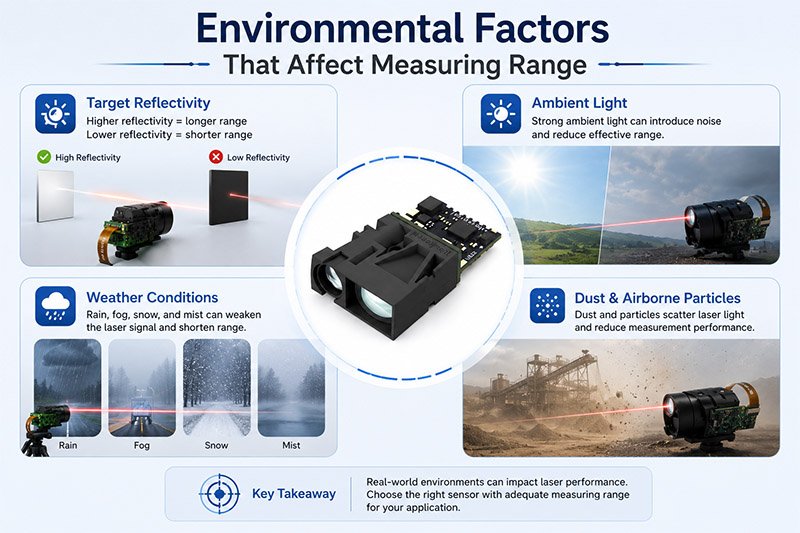
Target Reflectivity
Target surface properties directly influence sensor performance.
Higher reflectivity generally results in greater effective measuring distance.
Examples of highly reflective targets include:
- White painted surfaces
- Reflective metal plates
- Retroreflective materials
Low-reflectivity targets include:
- Black rubber
- Matte plastic
- Dark composite materials
Ambient Light
Outdoor environments introduce significant optical interference.
Strong sunlight can reduce signal quality and shorten effective measurement distance.
Dust and Airborne Particles
Factories, mines, and construction sites frequently contain airborne contaminants.
Dust can scatter laser energy and reduce sensor performance.
Weather Conditions
For outdoor applications, engineers should consider:
- Rain
- Snow
- Fog
- Mist
- Smoke
These factors become increasingly important as measurement distance increases.
Long Range vs Short Range Laser Distance Sensor Comparison
| Характеристика | Лазерный датчик расстояния малого радиуса действия | Лазерный датчик расстояния большой дальности |
|---|---|---|
| Диапазон измерений | 0.03m–80m | 300m–4000m+ |
| Точность | Very High | Высокий |
| Measurement Speed | Fast | Умеренный |
| Sensor Size | Compact | Larger |
| Стоимость | Lower | Выше |
| Installation Complexity | Низкий | Moderate to High |
| Типовые применения | Robotics, Automation, AGV | UAV, Mining, Surveying |
This comparison demonstrates that neither technology is universally superior. The best choice depends entirely on application requirements.
How to Choose the Right Measuring Range
Before selecting an промышленный лазерный датчик расстояния, engineers should evaluate five key factors.
1. Maximum Required Distance
Determine the furthest target position expected during operation.
2. Required Accuracy
Higher precision applications often benefit from a short range laser distance sensor.
3. Environmental Conditions
Indoor and outdoor installations have significantly different performance requirements.
4. Measurement Frequency
Fast-moving systems may require higher update rates.
5. System Budget
Cost optimization remains an important consideration in large-scale deployments.
By balancing these factors, engineers can identify the most appropriate laser sensor measuring range for their project.
Заключение
The choice between a short range laser distance sensor и лазерный датчик расстояния большой дальности should always be driven by application requirements rather than maximum advertised specifications.
For robotics, factory automation, conveyor systems, AGVs, and positioning equipment, a short range laser distance sensor typically offers the best combination of accuracy, speed, compact size, and cost efficiency.
For mining, UAV operations, infrastructure monitoring, and large-scale outdoor projects, a лазерный датчик расстояния большой дальности provides the measuring capability needed to operate reliably over extended distances.
Understanding your actual лазерный датчик расстояния requirements is the most effective way to improve system performance, reduce project costs, and ensure long-term measurement reliability.