UART vs RS485 vs RS232: How to Choose the Right Laser Distance Sensor Interface
Escolhendo o caminho certo laser distance sensor interface is essential for building reliable measurement systems in industrial automation, robotics, and embedded applications. A laser distance sensor can provide highly accurate distance data, but the communication method determines how efficiently the information is transferred to controllers, PLCs, computers, and other devices.
Different projects require different communication solutions. A compact embedded device may need a simple UART connection, while an industrial production line may require RS485 communication for long-distance transmission and multi-device networking. RS232 remains a practical choice for applications requiring direct connection with computers or industrial equipment.
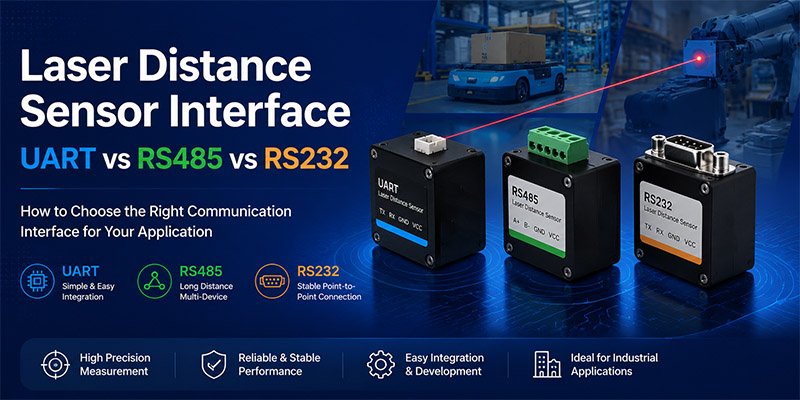
Understanding the differences between UART, RS485, and RS232 helps engineers select the most suitable laser sensor communication interface and improve system reliability, installation efficiency, and long-term performance.
Why Communication Interface Matters for Laser Distance Sensors
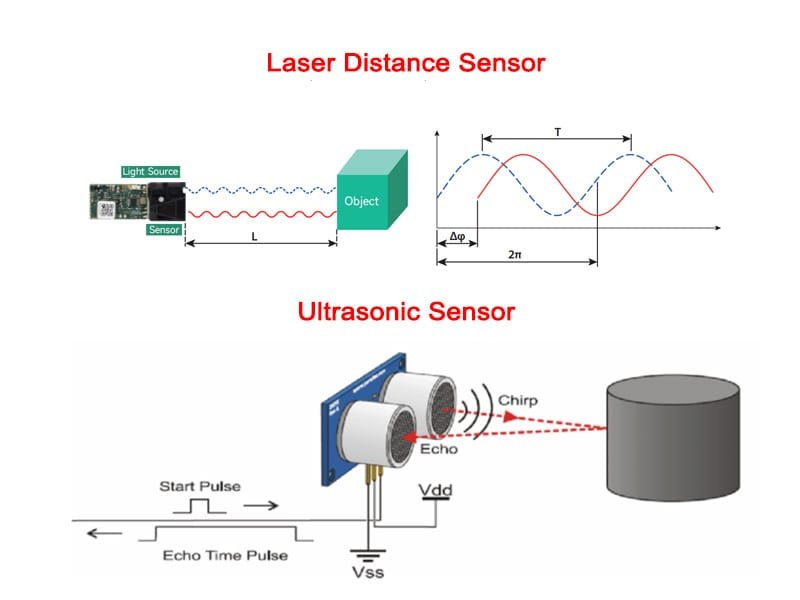
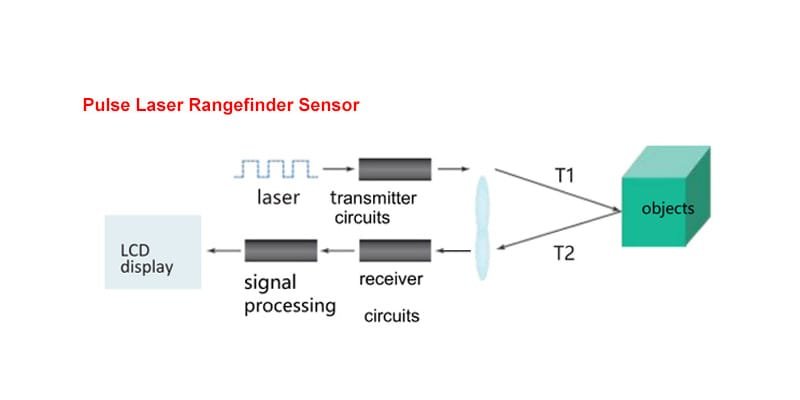
A laser distance sensor measures the distance between the sensor and a target by transmitting laser signals and analyzing the reflected light. After measurement, the collected data needs to be transferred to a control system for monitoring, calculation, or automation.
The communication interface directly affects:
- Data transmission stability
- Maximum communication distance
- Wiring complexity
- System compatibility
- Resistance to electromagnetic interference
- Network expansion capability
For example, a robotic arm inside a factory may require continuous distance feedback through an industrial network, while a handheld measurement device may only need a simple connection with a microcontroller.
Therefore, selecting the correct laser distance sensor interface during the early design stage can significantly reduce integration difficulties.
For more information about sensor solutions, visit: Laser Distance Sensor Modules
UART Interface: Simple and Flexible Communication
UART (Universal Asynchronous Receiver-Transmitter) is one of the most commonly used serial communication methods in embedded systems. Because of its simple structure and easy integration, UART is widely adopted in compact electronic devices and measurement equipment.
A UART laser distance sensor usually communicates through TX and RX signal lines. The connection method is straightforward and requires minimal hardware components.
Advantages of UART:
- Simple wiring
- Low development cost
- Easy programming
- Suitable for embedded controllers
- Fast integration with microcontrollers
UART is commonly used in applications such as:
- Arduino-based projects
- Raspberry Pi systems
- Portable measurement tools
- Dispositivos inteligentes
- Embedded equipment
However, UART communication also has limitations. It is mainly designed for short-distance point-to-point communication and is not ideal for complex industrial environments where multiple devices need to share the same communication network.
For applications requiring longer transmission distances or stronger interference resistance, engineers usually consider RS232 or RS485.
Learn more about UART products: UART Laser Distance Sensor
RS232 Interface: Reliable Point-to-Point Communication
RS232 is a traditional serial communication standard that has been widely used in computers, testing instruments, and industrial equipment.
A RS232 laser distance sensor provides stable point-to-point communication between the sensor and a host device. It is especially suitable when a direct connection is required without complex networking.
Key advantages of RS232:
- Excellent compatibility with existing equipment
- Stable direct communication
- Simple connection method
- Suitable for computer-based systems
RS232 is often found in laboratory instruments, industrial measurement systems, and equipment that communicates directly with a PC.
However, RS232 has some limitations. Compared with RS485, it has shorter communication distance and weaker resistance to electrical interference. Therefore, it may not be the best option for large factories or complex automation systems.
When engineers need reliable communication over longer distances, an RS485 solution is usually preferred.
RS485 Interface: The Best Choice for Industrial Automation
For many industrial applications, RS485 has become the preferred communication standard because of its excellent reliability and networking capability.
Um RS485 laser distance sensor is designed for applications requiring:
- Long-distance communication
- Strong noise resistance
- Multiple sensor connections
- Stable industrial operation
Unlike UART and RS232, RS485 supports multi-device communication on the same bus. This makes it ideal for applications such as factory automation, warehouse monitoring, AGV navigation, and large-scale measurement systems.
For example, multiple sensors installed on an automated production line can transmit measurement data through an RS485 network to a PLC controller.
Many industrial systems also combine RS485 with Modbus RTU protocol, creating a standardized communication method between sensors and control devices.
Related products: RS485 Laser Distance Sensor
For engineers looking for a reliable laser distance sensor with RS485 communication, this interface is often the preferred solution.
UART vs RS485 vs RS232 Comparison
| Interface | Communication Distance | Main Advantages | Aplicações típicas |
|---|---|---|---|
| UART | Short distance | Simple and low cost | Sistemas incorporados |
| RS232 | Medium distance | Direct device connection | Computers and instruments |
| RS485 | Long distance | Industrial reliability and networking | Automation systems |
There is no single best communication interface for every application. The correct choice depends on installation conditions, system architecture, and future expansion requirements.
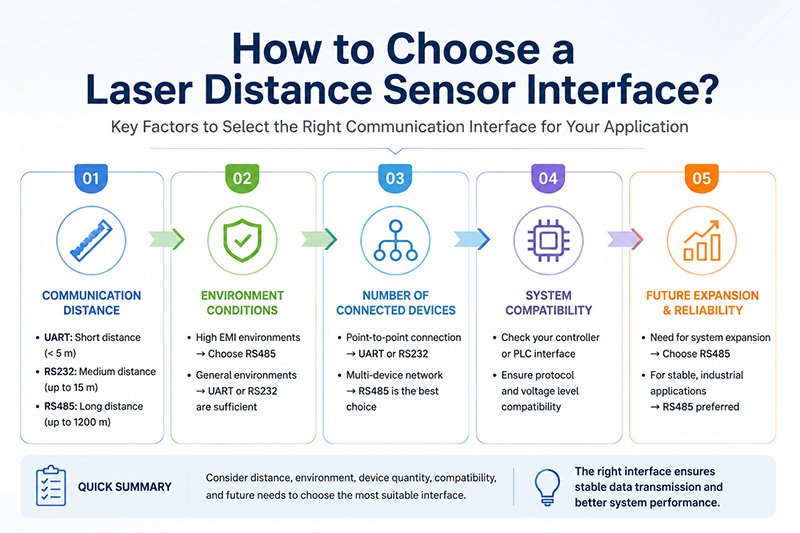
How to Choose a Laser Distance Sensor Interface?
When selecting a communication solution, engineers should consider several important factors.
1. Distance Between Sensor and Controller
For short-distance connections, UART is usually sufficient.
For installations where the sensor is located far away from the controller, RS485 provides better signal stability and longer transmission capability.
2. Working Environment
Industrial environments often contain motors, electrical equipment, and other sources of electromagnetic interference.
In these conditions, an industrial laser distance sensor with RS485 communication can provide better reliability compared with traditional serial solutions.
3. Number of Connected Devices
If a system requires multiple sensors, RS485 offers better scalability.
A single communication bus can connect multiple devices, reducing wiring complexity and improving system management.
Applications of Different Laser Sensor Interfaces
Different communication interfaces allow laser measurement technology to be used in various industries.
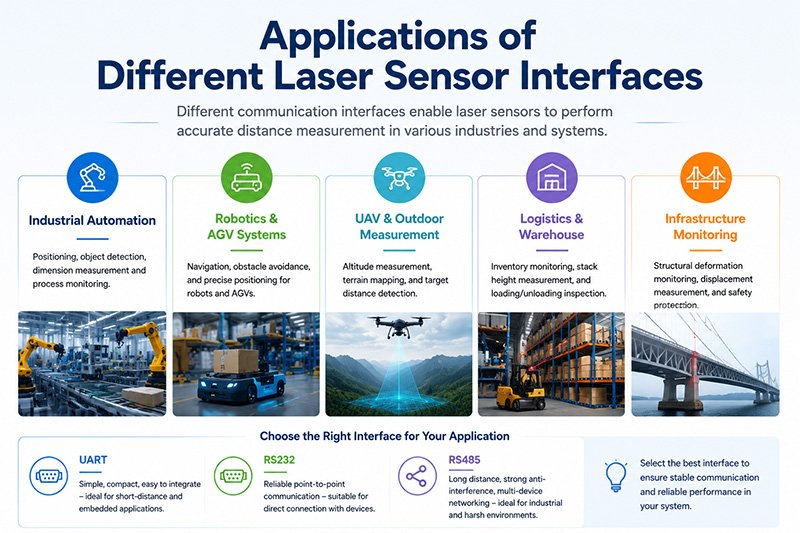
Automação industrial
Factories use laser sensors for:
- Position measurement
- Detecção de objetos
- Machine alignment
- Monitoramento de processos
More industrial solutions: Sensor de distância a laser industrial
Robótica e sistemas AGV
Robotic systems require accurate distance feedback for navigation and positioning.
Compact robots may use UART communication, while industrial robots and AGV systems often prefer RS485 because of its stability.
UAV and Outdoor Measurement
A lightweight Módulo de telêmetro a laser used in UAV applications usually requires efficient communication with flight controllers.
UART is commonly selected because of its compact design and easy integration.
Learn more: Módulo de telêmetro a laser
Why Multi-Interface Laser Sensors Are Becoming More Popular
Modern engineering projects require more flexibility. A sensor supporting multiple communication options allows customers to use the same hardware platform in different applications.
Por exemplo:
- UART can simplify product development and testing.
- RS232 can connect with existing equipment.
- RS485 can support industrial deployment.
A flexible laser sensor communication interface reduces development time and helps system integrators create customized solutions more efficiently.
Many advanced measurement systems now require sensors supporting multiple interfaces, including UART, RS232, RS485, and Modbus RTU.
Related information: Modbus RTU Laser Sensor
Conclusão
Selecting the correct laser distance sensor interface is a key factor in developing reliable measurement systems. UART provides simplicity for embedded applications, RS232 offers stable direct communication, and RS485 delivers excellent performance for industrial automation.
When deciding how to choose a laser distance sensor interface, engineers should evaluate communication distance, environmental conditions, networking requirements, and system compatibility.
Meskernel provides laser distance sensors and laser rangefinder modules with flexible communication options, including UART, RS232, RS485, and customized solutions for industrial measurement applications.
The right communication interface not only improves data transmission reliability but also simplifies integration and helps create more efficient automation systems.