Laser Distance Sensor I2C vs UART: Which Interface Is Right for Your Project?
Selecting the right communication interface is an important step when integrating a laser distance sensor into an embedded system. Two of the most common options are laser distance sensor I2C and UART. Both interfaces provide reliable digital communication, but they differ in wiring, scalability, software implementation, and application scenarios.

For engineers developing robotics, industrial automation equipment, smart devices, or IoT products, understanding these differences helps simplify system design and improve long-term reliability. This article compares the two interfaces and explains which solution is better for different embedded applications.
What Is a Laser Distance Sensor I2C?
A laser distance sensor I2C communicates with a microcontroller through the Inter-Integrated Circuit (I2C) protocol. Instead of using multiple signal lines, it requires only two communication wires: SDA (data) and SCL (clock). This simple architecture makes I2C one of the most popular interfaces for compact electronic products.
Because multiple devices can share the same communication bus, a laser distance sensor I2C is especially suitable for embedded systems that also include sensors such as IMUs, temperature sensors, displays, or EEPROM memory.
What Is a UART Laser Distance Sensor?
UART (Universal Asynchronous Receiver/Transmitter) is another widely used digital communication protocol. It uses separate TX and RX pins for data transmission and reception, making it a straightforward point-to-point communication method.
UART sensors are easy to debug with serial terminals and are commonly used in industrial equipment, PLCs, measurement instruments, and legacy embedded systems. Many developers choose UART because of its simplicity and broad software support.
Laser Distance Sensor I2C vs UART
| 特徴 | Laser Distance Sensor I2C | UART |
|---|---|---|
| Wiring | Two-wire bus (SDA/SCL) | TX/RX |
| Device Support | Multiple devices | One-to-one communication |
| PCB Design | Simple | 中程度 |
| Expansion | 素晴らしい | Limited |
| Debugging | 中程度 | Very Easy |
| 代表的なアプリケーション | Embedded systems, IoT | Industrial equipment |
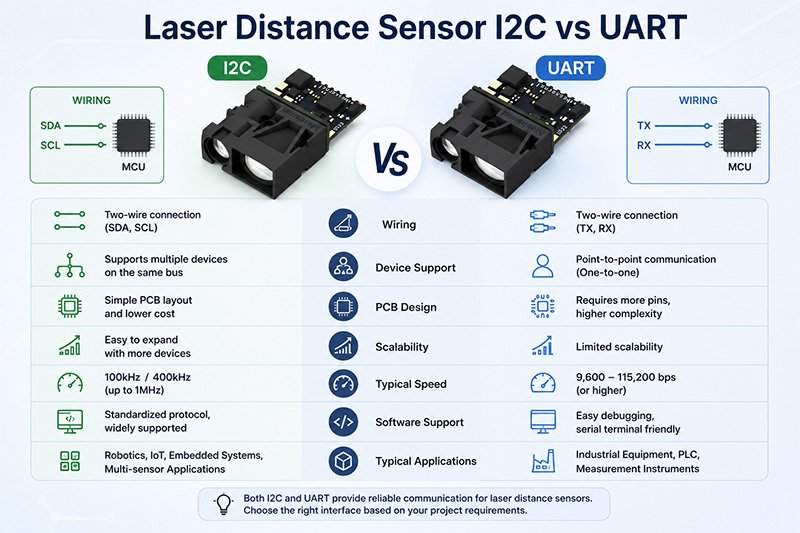
Both interfaces can provide stable communication for a digital laser distance sensor, but their advantages depend on the overall system architecture.
Wiring and Hardware Design
One of the biggest advantages of a laser distance sensor I2C is reduced wiring. Only two communication lines are required, regardless of how many compatible I2C devices are connected. This simplifies PCB layout and reduces connector complexity.
UART requires separate communication lines for each sensor. While this approach is simple for a single device, it becomes more complicated when multiple peripherals are added.
For compact embedded products where PCB space is limited, I2C often provides a cleaner hardware solution.
Communication Performance
Many engineers assume one interface is always faster than the other, but actual performance depends on the sensor design and firmware.
Modern I2C buses commonly operate at 100 kHz or 400 kHz, while UART baud rates typically range from 9,600 to 115,200 bps or higher.
For most distance measurement applications, both interfaces offer sufficient bandwidth. The communication interface usually has little impact on the sensor’s measurement accuracy or ranging performance.
Multi-Device Integration
Embedded systems frequently combine several peripherals on a single controller.
A laser distance sensor I2C allows multiple compatible devices to share one communication bus by assigning different device addresses. This reduces the number of GPIO pins required and makes future expansion much easier.
UART communication is generally designed for one device connected to one serial port. If several UART sensors are required, additional hardware or multiple serial interfaces may be necessary.
For scalable embedded products, the laser distance module interface based on I2C is often the preferred option.
Software Development
Software support is another important consideration.
UART is well known for its simple communication logic and convenient debugging through serial monitors. It is an excellent choice for quick testing and prototype development.
On the other hand, a laser distance sensor I2C benefits from standardized communication libraries that are already available for popular development platforms, including STM32, ESP32, Arduino, and Raspberry Pi. These libraries simplify integration and reduce development time.
代表的なアプリケーション
Different interfaces are better suited for different projects.
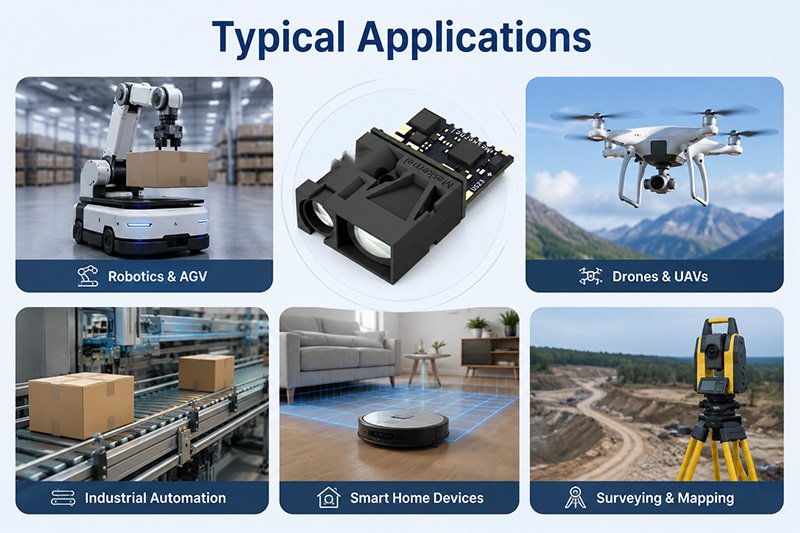
Laser Distance Sensor I2C
- Mobile robots
- AGVs and AMRs
- Smart home devices
- Embedded controllers
- IoT equipment
- Portable instruments
- Industrial PLC systems
- CNC machines
- Measurement equipment
- ファクトリーオートメーション
- Serial communication projects
正しい選択 digital laser distance sensor depends on both hardware requirements and software architecture.
Which Interface Should You Choose?
を選択する。 laser distance sensor I2C if your project requires:
- Compact PCB design
- Multiple peripheral devices
- Lower wiring complexity
- Easy future expansion
- Modern embedded platforms
Choose UART if you need:
- Simple point-to-point communication
- Fast debugging with serial tools
- Compatibility with legacy equipment
- Independent serial communication channels
Neither interface is universally better. The best choice depends on your application requirements, controller resources, and system architecture.
結論
両方 laser distance sensor I2C and UART interfaces provide reliable communication for modern laser measurement systems. I2C offers significant advantages in compact embedded designs thanks to its two-wire architecture, simplified wiring, and excellent scalability. UART remains a practical solution for industrial equipment, prototype development, and applications that prioritize straightforward serial communication.
を選択する。 laser distance module interface, engineers should evaluate PCB space, communication requirements, software support, and future expansion rather than focusing on the interface alone. Choosing the right communication protocol early in the design process can reduce development time, simplify integration, and improve overall system reliability.
FAQ
What is a laser distance sensor I2C?
A laser distance sensor I2C uses the I2C communication protocol to transmit distance data through SDA and SCL lines, making it ideal for compact embedded systems.
Is I2C better than UART for laser sensors?
I2C is better for systems with multiple peripherals and limited PCB space, while UART is often preferred for simple point-to-point communication and debugging.
Can multiple I2C laser sensors share one bus?
Yes. Compatible I2C sensors can share the same communication bus as long as each device has a unique I2C address.
Does the communication interface affect measurement accuracy?
No. Measurement accuracy mainly depends on the optical design and ranging technology rather than whether the sensor uses I2C or UART.
Which interface is recommended for embedded systems?
For most modern embedded applications, a laser distance sensor I2C is recommended because it simplifies wiring, improves scalability, and integrates easily with common microcontrollers.