Agricultural Distance Sensor for Smart Farming Applications
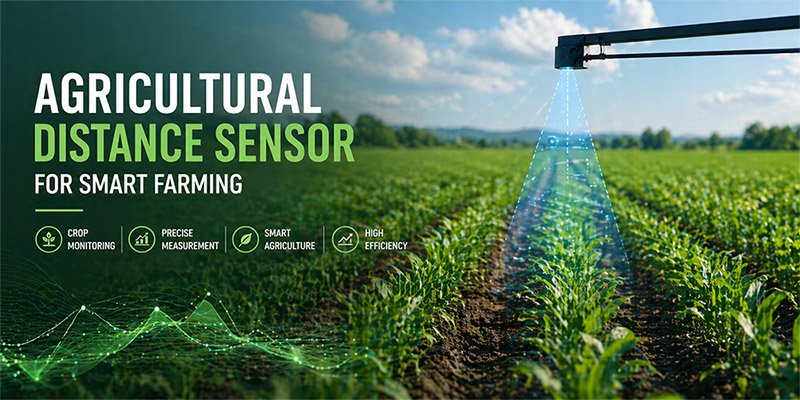
Modern agriculture is rapidly evolving with the adoption of intelligent technologies designed to improve efficiency, productivity, and sustainability. Among these innovations, the agricultural distance sensor has become an essential tool for precision farming and automated crop monitoring. By providing accurate, real-time distance measurement, these sensors help farmers optimize irrigation, monitor crop growth, and improve overall field management.
As smart farming continues to expand globally, technologies such as the laser sensor for agriculture are playing a key role in helping growers make data-driven decisions while reducing labor costs and resource waste.
The Growing Importance of Smart Farming Technology
Agriculture faces increasing challenges, including labor shortages, climate variability, and the need for higher crop yields. Traditional farming methods often rely on manual observation, which can be time-consuming and inconsistent.
Today, precision agriculture systems use sensors, automation, and data analysis to improve farming efficiency. A modern agricultural distance sensor allows farmers to monitor field conditions with greater accuracy and consistency, enabling more efficient crop management.
Smart farming technologies are now widely used in:
- Crop growth monitoring
- Irrigation management
- Greenhouse automation
- Agricultural robotics
- Autonomous farming equipment
As farms become more connected and automated, reliable sensing technology is becoming increasingly important.
How Agricultural Distance Sensors Work
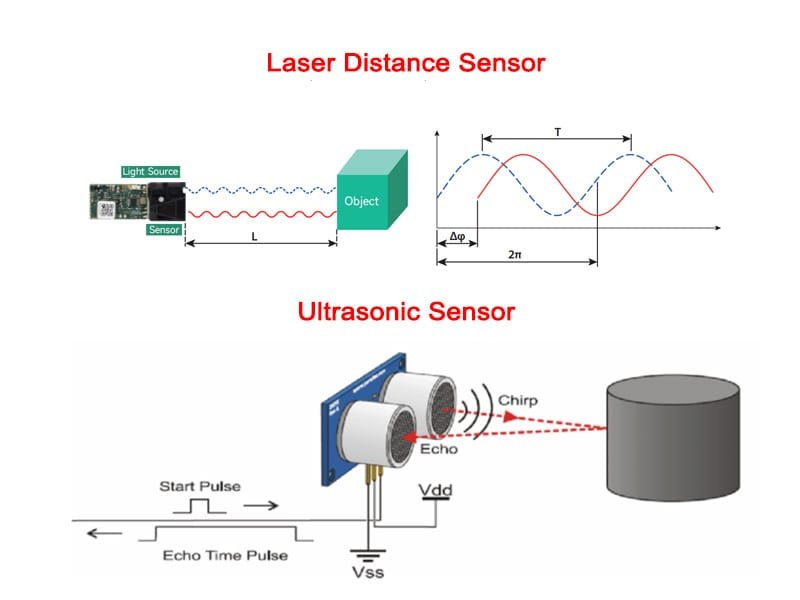
En agricultural distance sensor measures the distance between the sensor and a target object using laser or optical measurement principles. In agricultural applications, the target may include crops, soil surfaces, greenhouse structures, or farming equipment.
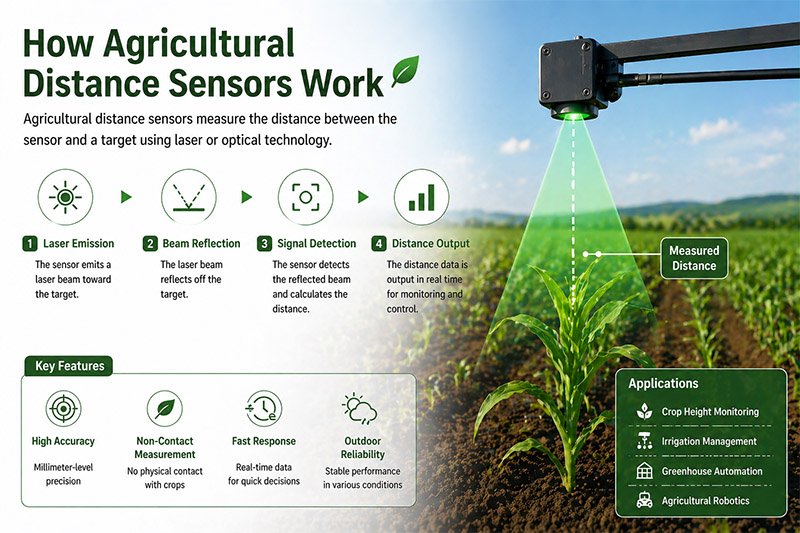
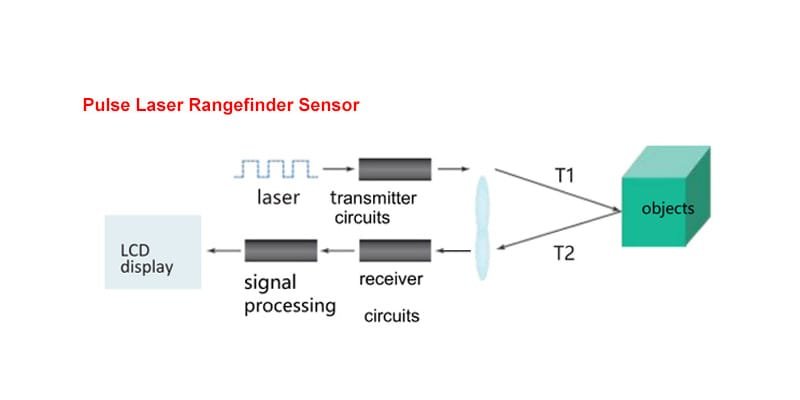
Most advanced systems use laser-based technology for non-contact measurement. A laser sensor for agriculture emits a laser beam toward the target and analyzes the reflected signal to calculate distance with high precision.
Compared with traditional measurement methods, laser sensors offer several advantages:
- Medición sin contacto
- Fast response speed
- High accuracy
- Stable outdoor performance
- Easy integration into smart farming systems
These features make laser-based sensing ideal for modern agricultural automation.
Crop Height Monitoring in Precision Agriculture
One of the most important applications of an agricultural distance sensor is crop height monitoring. Accurate crop height data helps farmers evaluate plant growth, estimate yield potential, and identify unhealthy areas within the field.
A modern crop height sensor can continuously measure crop growth throughout the growing season. This enables farmers to make better decisions regarding irrigation, fertilization, and harvesting schedules.
In traditional farming, crop measurement is often performed manually, which is labor-intensive and less accurate. Automated crop monitoring systems equipped with laser sensors provide a more efficient and scalable solution.
By using real-time crop data, farmers can improve productivity while reducing unnecessary resource consumption.
Plant Height Measurement for Smart Farming
Another key application is plant height analysis. A plant height measurement sensor helps growers monitor individual plant development and detect growth variations across different areas of the field.
Plant height data is especially useful in:
- Precision irrigation systems
- Greenhouse crop management
- Research and agricultural experiments
- Smart fertilization systems
A high-precision agricultural distance sensor can detect even small differences in plant height, providing valuable insights into crop health and environmental conditions.
As precision farming continues to evolve, automated plant measurement technologies are becoming an important part of modern agricultural management.
Advantages of Laser Sensors in Agriculture
The increasing adoption of the laser sensor for agriculture is driven by several important benefits.
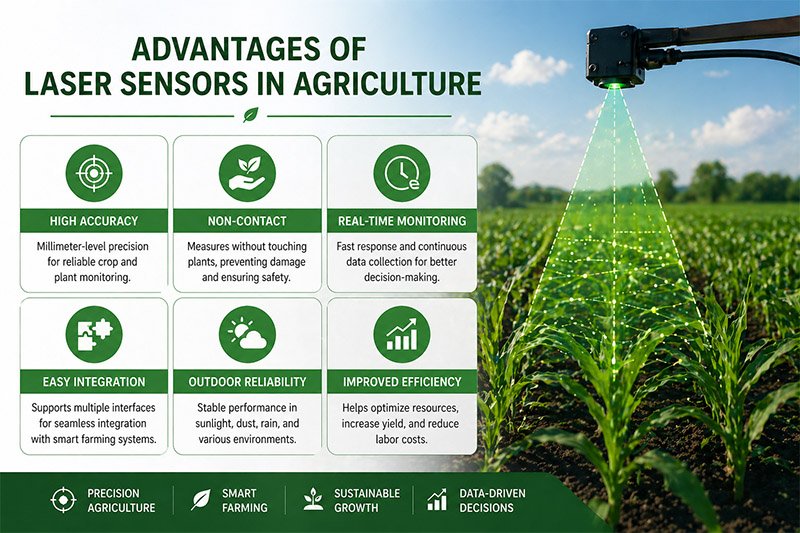
Alta precisión
Laser sensors provide millimeter-level measurement accuracy, making them suitable for precise crop and plant monitoring applications.
Funcionamiento sin contacto
Because the sensor does not physically touch the plants, there is no risk of crop damage during measurement.
Control en tiempo real
En agricultural distance sensor can continuously collect data in real time, helping farmers respond quickly to changing field conditions.
Fácil integración
Modern sensors support interfaces such as UART, RS485, and TTL, allowing easy integration into smart farming equipment, agricultural robots, and IoT monitoring systems.
Adaptability to Outdoor Environments
Advanced laser sensors are designed to operate reliably in outdoor agricultural conditions, including sunlight, dust, and varying temperatures.
Applications Beyond Crop Monitoring
In addition to crop height analysis, the agricultural distance sensor is widely used in other farming applications, including:
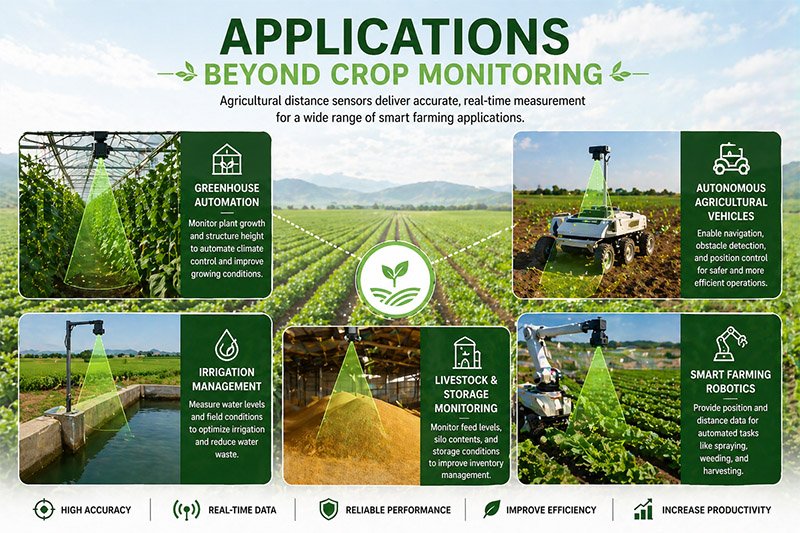
Greenhouse Automation
Laser sensors help monitor plant growth and automate environmental control systems.
Autonomous Agricultural Vehicles
Smart farming equipment uses distance sensors for navigation, obstacle detection, and automated movement.
Irrigation Management
Distance measurement technology can help monitor water levels and optimize irrigation efficiency.
Livestock and Storage Monitoring
Sensors are also used for feed level measurement and storage management in modern farms.
These applications demonstrate how sensing technology is transforming agriculture into a more intelligent and data-driven industry.
The Future of Agricultural Distance Sensors
As global agriculture continues moving toward automation and precision farming, demand for intelligent sensing technology is expected to grow significantly. Future developments in AI, IoT connectivity, and agricultural robotics will further increase the importance of the agricultural distance sensor in modern farming systems.
Advanced laser sensors for agriculture will continue improving in accuracy, size, and energy efficiency, making them suitable for a wider range of farming applications.
For growers seeking higher productivity, reduced waste, and smarter field management, distance sensing technology is becoming an essential investment for the future of agriculture.
FAQ
Q1: What is an agricultural distance sensor used for?
It is used for crop monitoring, plant height measurement, irrigation management, and smart farming automation.
Q2: Why use a laser sensor for agriculture?
Laser sensors provide accurate, non-contact, and real-time measurement for precision farming applications.
Q3: What is a crop height sensor?
A crop height sensor measures crop growth and helps farmers monitor field conditions more efficiently.
Q4: Can plant height measurement sensors work outdoors?
Yes, modern sensors are designed for stable performance in outdoor agricultural environments.