Laser Distance Sensor Solution for Vertical Distance Measurement in Truss Structures
Professional stage productions, exhibition halls, theaters, and outdoor event venues all rely on truss systems to safely support lighting fixtures, LED displays, audio equipment, and other suspended loads. During installation and lifting, even a small difference in height between lifting points can affect structural stability, equipment alignment, and operational safety.
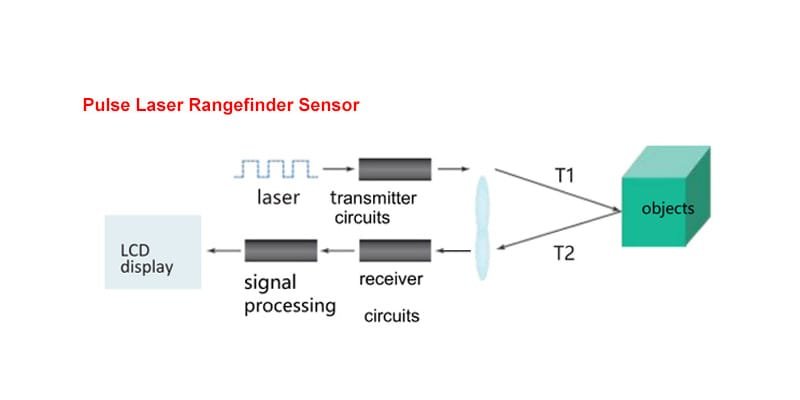
To solve this challenge, more system integrators are adopting Vertical Distance Measurement technology based on laser sensors. Compared with manual measurement methods or traditional limit switches, laser-based measurement delivers real-time positioning data, allowing multiple lifting points to remain synchronized throughout the lifting process.

This article explains how a laser ranging sensor can improve truss leveling systems, the key technical requirements for this application, and the features engineers should consider when selecting a sensor.
Why Vertical Distance Measurement Matters in Truss Lifting Systems
Modern truss lifting systems usually consist of several electric hoists positioned around a rectangular or square truss. Every hoist must move at the same speed to keep the structure level.
If one lifting point moves faster or slower than the others, several problems may occur:
- Uneven structural loading
- Increased mechanical stress
- Misalignment of lighting equipment
- Damage to LED screens
- Reduced operational safety
- Additional setup time
Accurate Vertical Distance Measurement allows every lifting point to be monitored independently. Instead of estimating height differences manually, the control system continuously compares sensor data and adjusts the lifting motors automatically whenever deviations occur.
This approach greatly improves lifting precision while reducing manual intervention.
Why Laser Sensors Are Preferred
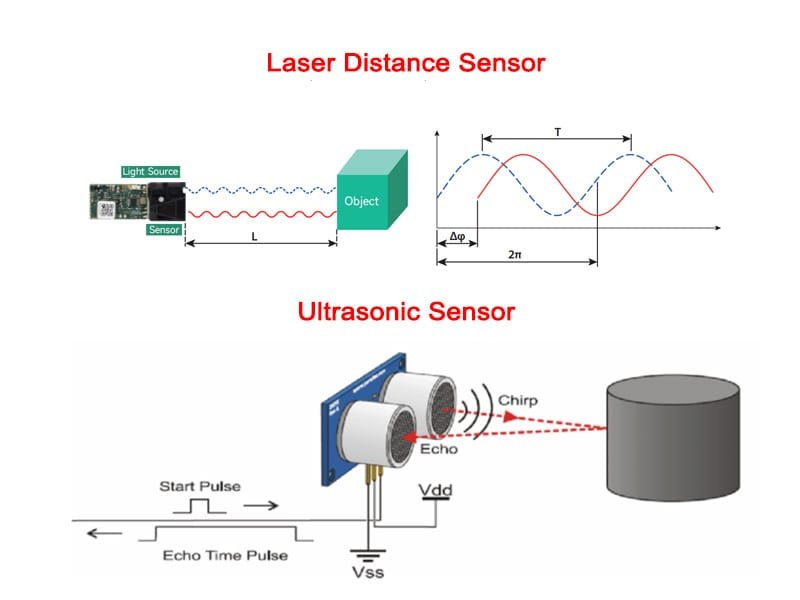
Mechanical limit switches only detect predefined positions and cannot provide continuous position feedback. Ultrasonic sensors are influenced by temperature, air movement, and surrounding objects, making them less suitable for high-precision industrial applications.
A modern laser ranging sensor offers several advantages:
- Non-contact measurement
- Millimeter-level accuracy
- Fast response speed
- Stable performance
- Long measuring distance
- Easy integration into automation systems
Because laser measurement is highly directional, it can accurately measure the distance between the truss and the floor without being affected by nearby equipment.
Typical Application Scenario
In a professional event environment, the sensors are mounted directly underneath each lifting point on the truss structure.
Each sensor continuously measures the vertical distance to the floor while the truss is moving.
Measurement data is transmitted to the main controller through an RS485 distance sensor network.
The controller continuously compares the measured values from all lifting points and automatically synchronizes the motors to maintain a level truss throughout the lifting operation.
This solution is commonly used in:
- Concert stages
- Theater automation
- Exhibition centers
- Television studios
- Rental staging equipment
- Outdoor entertainment venues
Because measurements are updated in real time, operators can immediately detect any abnormal movement before it becomes a safety issue.
Measuring Different Floor Materials
One important consideration for event applications is the wide variety of floor materials.
Unlike factory environments, stage equipment may be installed on:
- Concrete
- Wooden flooring
- Black stage flooring
- Carpet
- Painted platforms
- Composite flooring
A high-quality laser ranging sensor is capable of measuring these surfaces accurately when installed vertically.
Although darker materials generally reflect less laser energy than lighter surfaces, stable measurement can still be achieved by selecting an appropriate sensor model and installation distance.
For most indoor event applications, measurement repeatability remains excellent across common flooring materials.
Essential Features for Truss Automation
Selecting the right sensor involves much more than measuring distance.

The following features are particularly important.
Continuous Distance Measurement
A continuous distance measurement sensor provides uninterrupted position updates instead of single-shot measurements.
Continuous data allows the control system to detect height differences instantly and correct lifting speed before the deviation becomes significant.
This is especially important when several motors are operating simultaneously.
RS485 Communication
Industrial automation systems typically require reliable long-distance communication.
An RS485 distance sensor offers:
- Excellent noise immunity
- Long transmission distance
- Multi-device networking
- Stable industrial communication
RS485 also simplifies wiring when multiple sensors are installed on a large truss system
High Measurement Accuracy
Lifting synchronization depends on consistent measurement rather than extreme precision.
For most professional stage systems, an accuracy of approximately ±1–3 mm provides excellent leveling performance while maintaining stable operation.
Suitable Measuring Range
Most entertainment venues require measurements between several meters and several tens of meters.
A measuring range from 0.03 m to at least 40 m covers the majority of indoor and outdoor truss installations.
Industrial Communication Protocols
Many PLC-based control systems require Modbus RTU or a documented communication protocol for software integration.
Using standardized communication protocols reduces development time and makes system maintenance easier.
Environmental Considerations
Unlike fixed industrial equipment, event systems are frequently transported and assembled at different venues.
Sensors may therefore experience:
- Dust during installation
- High humidity
- Temporary outdoor exposure
- Mechanical vibration
- Frequent transportation
- Temperature changes
For these applications, environmental protection becomes an important factor when selecting a sensor.
Depending on project requirements, higher enclosure protection can improve long-term reliability in demanding environments.
Typical System Configuration
A typical truss leveling solution includes:
- Laser distance sensors installed at each lifting point
- RS485 communication network
- PLC or industrial controller
- Electric hoists
- Human-machine interface
- Safety alarm system
Each sensor continuously performs Vertical Distance Measurement and sends updated data to the PLC.
The controller compares every lifting point in real time.
If any point exceeds the preset tolerance, corrective commands are immediately issued to restore synchronization.
This closed-loop control significantly improves both lifting accuracy and operational safety.
Benefits of Laser-Based Vertical Distance Measurement
Compared with conventional measurement methods, laser technology provides several important advantages.
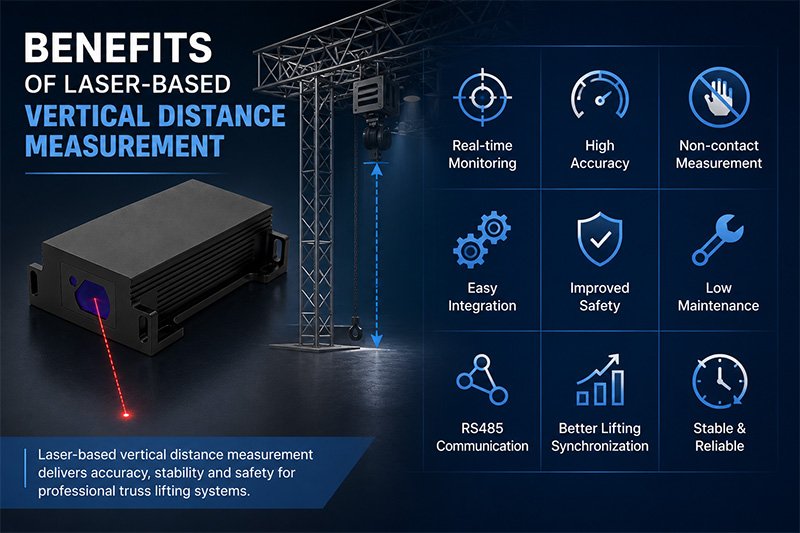
These include:
- Continuous real-time monitoring
- Fast response
- Non-contact operation
- Easy integration
- Reduced maintenance
- Improved lifting synchronization
- Better safety performance
- Flexible installation
- Reliable industrial communication
- High measurement repeatability
For system integrators, these advantages simplify commissioning while reducing maintenance costs throughout the equipment lifecycle.
Meskernel Solution for Truss Applications
Meskernel provides industrial laser distance sensors suitable for automation projects requiring reliable Vertical Distance Measurement.
Typical capabilities include:
- Measuring range from 0.03 m to 40 m or more
- Measurement accuracy up to ±1 mm depending on the model
- Continuous measurement mode
- RS485 communication interface
- Modbus RTU or communication protocol support
- Compact size for easy installation
- Integration with PLC and industrial control systems
For projects operating in challenging environments, customized housing solutions and interface options can also be discussed according to specific application requirements.
Conclusion
As stage automation continues to become more intelligent, accurate Vertical Distance Measurement plays an increasingly important role in ensuring safe and efficient truss lifting.
By combining a high-performance laser ranging sensor, reliable RS485 distance sensor communication, and a continuous distance measurement sensor, engineers can create lifting systems that deliver precise synchronization, improved operational safety, and dependable performance across a wide range of professional event applications.
Whether used in theaters, exhibition centers, television studios, or outdoor stages, laser distance sensing technology provides a practical and scalable solution for modern truss leveling systems.