How to Choose an I2C Laser Distance Sensor for Embedded Systems
As embedded systems continue to evolve, engineers demand sensing technologies that are compact, accurate, and easy to integrate. Whether you are designing a mobile robot, an industrial controller, a smart agricultural device, or a handheld measurement instrument, selecting the right I2C laser distance sensor can significantly improve system performance and development efficiency.
Unlike traditional analog sensors, an I2C laser distance sensor offers digital communication, simplified wiring, and reliable data transmission. These advantages make it a preferred solution for modern embedded applications where space, power consumption, and integration complexity are critical considerations.
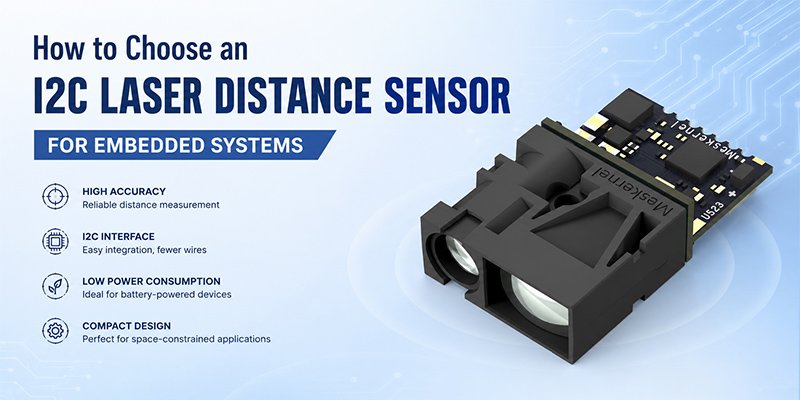
This guide explains the key factors engineers should evaluate before choosing an I2C laser distance sensor and highlights the specifications that matter most in real-world embedded designs.
Why Choose an I2C Interface?
The Inter-Integrated Circuit (I2C) protocol has become one of the most widely adopted communication standards in embedded electronics. It allows multiple devices to communicate with a microcontroller using only two signal lines—SDA and SCL.
Compared with other interfaces, an I2C laser distance sensor provides several practical benefits:
- Reduced wiring complexity
- Lower PCB routing costs
- Easy integration with popular MCUs
- Support for multiple peripherals on one bus
- Stable digital communication
Because of these advantages, many developers prefer an embedded laser sensor that supports the I2C protocol when designing compact electronic products.
Understand Your Measurement Requirements
Before selecting any sensor, clearly define the measurement task.
Important questions include:
- What is the maximum measuring distance?
- What level of accuracy is required?
- Will the target surface have different reflectivity?
- Is the sensor used indoors or outdoors?
- Does the application require continuous measurement?
Different applications require different specifications.
For example:
| Application | Recommended Range |
|---|---|
| Smart Home Devices | 0.05–5 m |
| Mobile Robots | 0.1–20 m |
| Industrial Automation | 0.1–100 m |
| Warehouse AGV | 0.2–150 m |
| Survey Equipment | 100 m+ |
Choosing an I2C laser distance sensor with an appropriate measurement range prevents unnecessary costs while ensuring reliable performance.
Evaluate Measurement Accuracy
Accuracy is one of the most important specifications of any laser distance sensor I2C solution.
Common accuracy levels include:
- ±1 mm
- ±2 mm
- ±3 mm
- ±5 mm
For applications such as robotic positioning, automated inspection, and precision manufacturing, millimeter-level accuracy is often required.
Keep in mind that environmental conditions—including sunlight, dust, fog, and target reflectivity—may affect actual measurement performance. Reviewing real operating conditions is just as important as comparing specification sheets.
Consider Measurement Frequency
Embedded systems often require real-time distance information.
Typical measurement frequencies include:
- 1–5 Hz
- 10 Hz
- 30 Hz
- 100 Hz
A higher update rate allows faster control response in robotic navigation, collision avoidance, and motion control.
However, increasing measurement frequency may also increase power consumption, so balancing speed and energy efficiency is essential when selecting an embedded laser sensor.
Check Communication Compatibility
Not all embedded platforms have identical interface requirements.
Before purchasing an I2C laser distance sensor, verify compatibility with your controller.
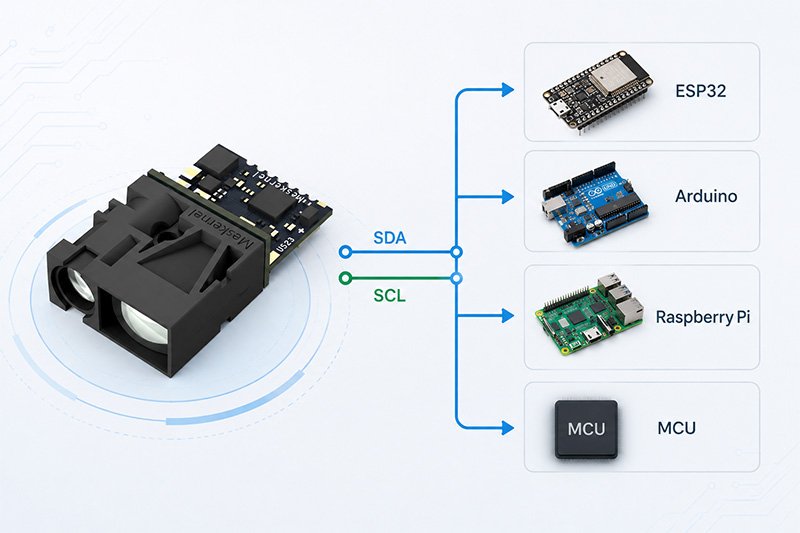
Common embedded platforms include:
- STM32
- ESP32
- Arduino
- Raspberry Pi
- Nordic nRF Series
- NXP MCUs
- Microchip PIC
- TI MSP430
Most modern controllers provide native I2C support, making integration straightforward.
Additionally, check:
- Operating voltage
- Logic level compatibility
- I2C address configuration
- Driver availability
- Software libraries
A well-designed laser distance sensor I2C should offer comprehensive documentation that shortens development time.
Size and Mechanical Integration
Many embedded products have strict space limitations.
Compact dimensions make installation much easier inside:
- Portable instruments
- Service robots
- Smart locks
- Drones
- Medical devices
- Automated equipment
Besides physical dimensions, engineers should evaluate:
- Mounting holes
- Connector location
- Cable routing
- Housing material
- Heat dissipation
Selecting a compact laser ranging module helps simplify product design while maintaining measurement performance.
Power Consumption Matters
Battery-powered devices require careful power management.
When comparing an I2C laser distance sensor, consider:
- Operating current
- Standby current
- Sleep mode support
- Startup time
Lower power consumption extends battery life and reduces thermal management requirements.
Applications such as handheld devices, autonomous robots, and IoT equipment particularly benefit from energy-efficient sensor designs.
Environmental Adaptability
Real-world operating environments are rarely ideal.
Your embedded laser sensor should perform reliably under different conditions, including:
- Bright ambient light
- Dust
- Humidity
- Temperature variations
- Mechanical vibration
Industrial projects may also require:
- IP protection ratings
- Shock resistance
- Long service life
- Stable calibration
Selecting a sensor designed for harsh environments improves long-term reliability and reduces maintenance costs.
Software Support and Development Resources
Hardware specifications alone are not enough.
Good software support can dramatically reduce development time.
Look for manufacturers that provide:
- Communication protocols
- API documentation
- Example code
- SDKs
- Integration guides
- Technical support
These resources make it easier to integrate a laser ranging module into existing embedded projects.
Typical Embedded Applications
The flexibility of an I2C laser distance sensor makes it suitable for numerous industries.
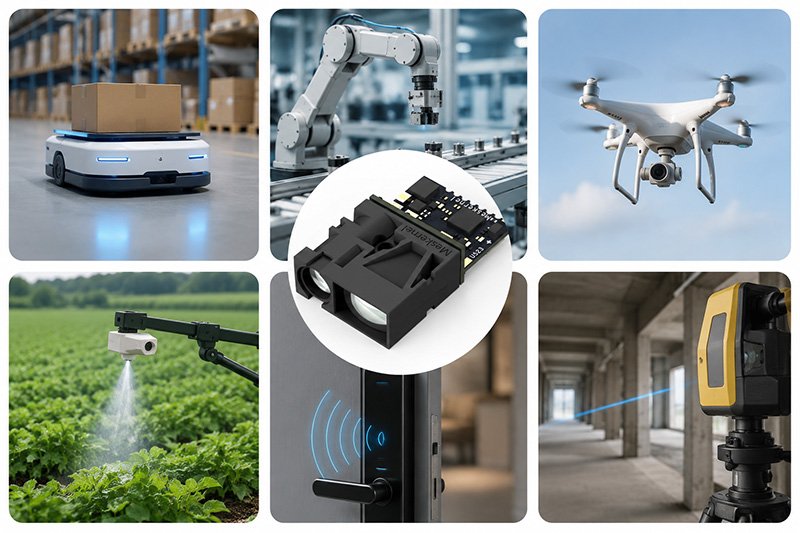
Common applications include:
Robotics
Distance measurement enables obstacle avoidance, navigation, and positioning.
Industrial Automation
Sensors monitor machine positions, material handling, and automated production lines.
Smart Agriculture
Embedded systems measure crop height, equipment positioning, and automated spraying distances.
UAV and Drone Systems
Lightweight laser ranging module solutions assist altitude measurement and obstacle detection.
Smart Buildings
Elevators, automatic doors, and intelligent access systems benefit from accurate non-contact distance measurement.
Medical Equipment
Compact embedded laser sensor technology helps improve positioning accuracy in portable medical instruments.
Questions to Ask Before Buying
Before selecting an I2C laser distance sensor, consider these practical questions:
- Does the measurement range meet my project requirements?
- Is the accuracy sufficient?
- Does the update rate support my control algorithm?
- Is the module easy to integrate?
- Are software libraries available?
- Does it support my MCU platform?
- Is power consumption acceptable?
- Can it operate in my environment?
- Is long-term technical support available?
Answering these questions early helps avoid redesigns and integration delays.
Future Trends of Embedded Laser Sensors
Embedded sensing technology continues to evolve rapidly.
Future laser distance sensor I2C solutions are expected to offer:
- Smaller footprints
- Higher accuracy
- Faster sampling rates
- Lower power consumption
- Improved ambient light resistance
- AI-assisted signal processing
- Multi-interface support
- Enhanced industrial reliability
As embedded systems become increasingly intelligent, demand for compact, high-performance laser ranging module solutions will continue to grow across automation, robotics, logistics, and smart devices.
Conclusion
Selecting the right I2C laser distance sensor involves much more than comparing measurement range. Engineers should evaluate communication compatibility, accuracy, measurement speed, environmental performance, power consumption, mechanical design, and software support together.
A high-quality embedded laser sensor not only delivers accurate distance measurements but also simplifies system integration and improves long-term product reliability. By carefully matching sensor specifications to application requirements, developers can build more efficient, intelligent, and dependable embedded systems while reducing development time and maintenance costs.
FAQ
1. What is an I2C laser distance sensor?
An I2C laser distance sensor is a non-contact distance measurement device that communicates with a microcontroller through the I2C interface. It combines accurate laser ranging with simple two-wire communication, making it ideal for embedded systems and industrial applications.
2. What are the advantages of an I2C laser distance sensor?
An I2C laser distance sensor offers easy wiring, reliable digital communication, low power consumption, and compatibility with many embedded platforms such as STM32, ESP32, Arduino, and Raspberry Pi.
3. What is the difference between an I2C laser distance sensor and a UART sensor?
The main difference is the communication protocol. An I2C laser distance sensor uses a shared two-wire bus for connecting multiple devices, while UART uses separate transmit and receive lines for point-to-point communication.
4. Which applications use an embedded laser sensor?
An embedded laser sensor is commonly used in mobile robots, AGVs, industrial automation, drones, smart agriculture, warehouse systems, and portable measuring equipment where accurate non-contact distance measurement is required.
5. How do I choose the right laser distance sensor?
When selecting a laser distance sensor, consider the measuring range, accuracy, update rate, interface type, operating voltage, environmental conditions, and software support to ensure it meets your project requirements.
6. Can an I2C laser sensor be used outdoors?
Yes, many I2C laser sensor models can operate outdoors. However, performance may vary depending on sunlight, target reflectivity, weather conditions, and the sensor’s optical design. Choosing a module designed for outdoor environments will provide more stable measurements.