
Time of Flight Sensor vs LiDAR: Key Differences and How to Choose in 2025
Time of Flight (ToF) sensors and LiDAR systems are two of the most widely used distance-measurement technologies in robotics, automation, smart devices, industrial monitoring, and autonomous navigation. Although both technologies are based on light propagation and time-measurement principles, their design, performance characteristics, and application suitability differ significantly.
As industries move toward full automation in 2025, understanding the strengths and limitations of ToF sensors and LiDAR is becoming crucial for engineers, system integrators, and product designers. This article explains how Time of Flight sensors differ from LiDAR, how each technology works, and—most importantly—how to choose the right solution for your application.
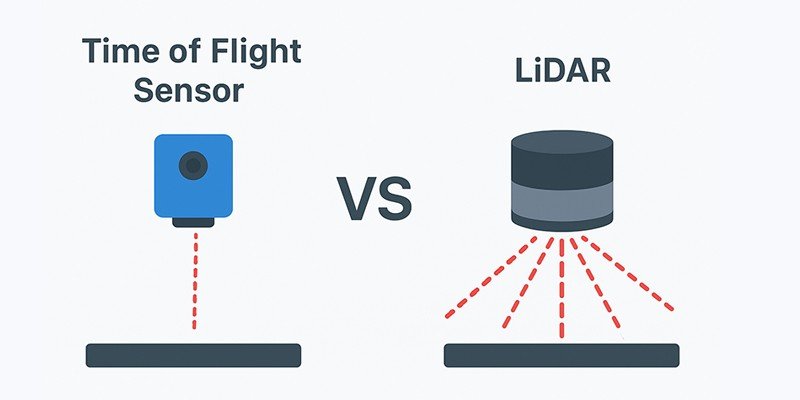
What Is a Time of Flight Sensor?
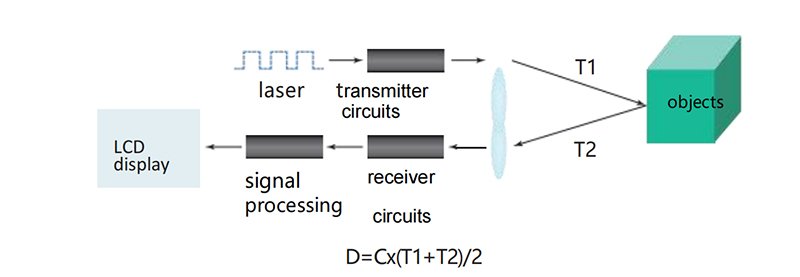
A Time of Flight sensor measures distance by emitting light (typically infrared or laser) and calculating the time it takes for the reflected light to return to the receiver. This travel time—often in nanoseconds—is converted into a precise distance measurement.
There are two primary types of ToF technology:
- Direct Time of Flight (dToF) – Measures the time directly using fast photodetectors such as SPAD or APD.
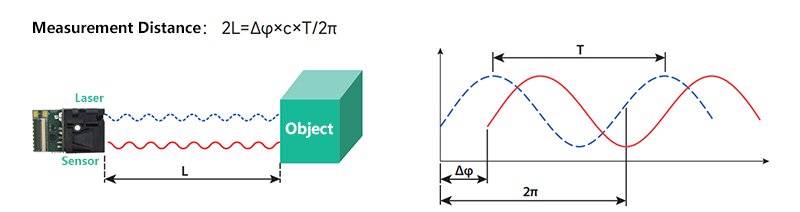
2. Indirect Time of Flight (iToF) – Measures the phase shift between emitted and received signals.
ToF sensors are widely used in robotics, smart agriculture, AGVs, industrial automation, smartphone depth sensing, and short- to mid-range distance measurement.
Key Traits of ToF Sensors:
- Compact size and low power consumption
- Typically short to medium measuring range (0.03m–80m depending on design)
- High measurement frequency
- Excellent for embedded systems, mobile devices, and real-time response
- Often offer interfaces such as UART, Modbus, RS485, RS232, USB
Products such as Meskernel’s LDL-T ToF laser distance sensor represent the latest generation of industrial-grade ToF modules with high accuracy, fast sampling, and strong environmental adaptability.
What Is LiDAR?
LiDAR (Light Detection and Ranging) is a more advanced scanning technology that emits narrow laser pulses and measures the return time from multiple points in the environment. Instead of giving only a single distance value, LiDAR creates detailed 2D or 3D point-cloud maps.
LiDAR is the key sensing technology used in autonomous vehicles, mobile robots, drones, SLAM navigation, and large-scale outdoor mapping.
Key Traits of LiDAR:
- Long detection range (tens to thousands of meters)
- High-precision multi-point scanning
- Ability to generate 2D or 3D environment maps
- Heavier processing requirements
- Higher cost compared with ToF modules
LiDAR systems include mechanical LiDAR, solid-state LiDAR, MEMS-based LiDAR, and flash LiDAR.
Time of Flight Sensor vs LiDAR: Key Differences
The following sections break down the most important differences that engineers evaluate when choosing between ToF and LiDAR.
| Category | Time of Flight Sensor (ToF) | LiDAR | Winner |
|---|---|---|---|
| 1. Measuring Principle | Measures a single point or limited points based on light travel time | Performs multi-point or full-angle scanning to build 2D/3D spatial maps | Depends on application (ToF for simple measurement, LiDAR for mapping) |
| 2. Detection Range | 0.03m to 80m (model-dependent) | 10m to >300m (high-end automotive up to 500m) | LiDAR |
| 3. Accuracy | Millimeter-level accuracy for short–mid range | Centimeter-level for long-distance mapping | Short-range: ToF / Long-range: LiDAR |
| 4. Field of View (FOV) | Narrow FOV or fixed beam | Wide scanning angles (270°–360° mechanical; 60°–120° solid-state) | LiDAR |
| 5. Data Output | Single-point or few-point distance data | Dense point cloud for mapping and obstacle detection | LiDAR |
| 6. Size & Power Consumption | Very compact (<20 mm), low power | Larger scanning head, higher power usage | ToF |
| 7. Cost | Low cost, ideal for mass integration | Medium to high cost depending on type | ToF |
How to Choose the Right Technology in 2025
Here are application-specific recommendations:
Choose a Time of Flight Sensor if you need:
- High-accuracy single-point measurement
- Short- to medium-range detection
- Compact size for embedded devices
- Fast sampling for AGVs, automation, or industrial monitoring
- Low power and low cost
Examples:
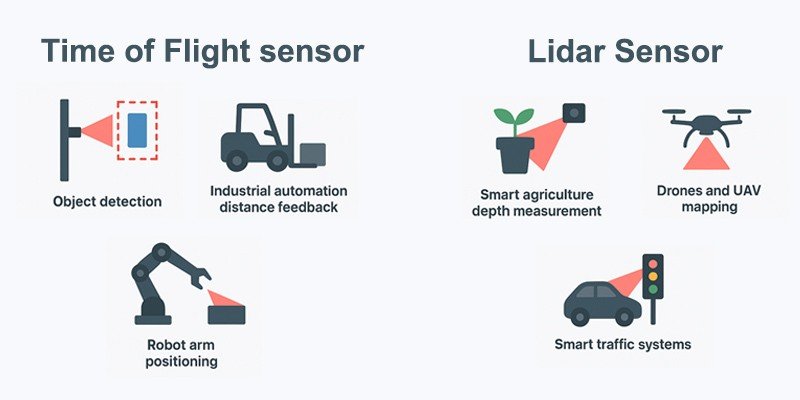
- Object detection
- Robot arm positioning
- Forklift distance detection
- Industrial automation distance feedback
- Smart agriculture depth measurement
Meskernel’s LDL-T and LDL-S ToF laser distance sensors are optimized for these scenarios.
Choose LiDAR if you need:
- Environmental mapping
- Multi-point scanning
- Autonomous vehicle navigation
- SLAM or 3D reconstruction
- Large outdoor detection range
Examples:
- AMR navigation
- Smart traffic systems
- Drones and UAV mapping
- Autonomous cars and robots
Conclusion
Time of Flight sensors and LiDAR each play an essential role in today’s automation and robotics ecosystem. ToF sensors offer compact size, low power, high precision, and cost-efficient performance for single-point industrial or robotic applications. LiDAR, on the other hand, delivers powerful scanning and mapping capabilities ideal for navigation and environmental perception.
Choosing the right technology in 2025 depends on your specific needs—range, precision, FOV, data density, processing requirements, and budget. By understanding the differences outlined in this article, engineers and system designers can make more informed decisions and select the most suitable sensing solution for their next-generation intelligent systems.