Crane Distance Sensor: Improving Safety with Laser Rangefinder Systems
Modern industrial cranes are expected to move heavier loads faster while maintaining exceptional safety standards. Whether installed in ports, steel mills, warehouses, construction sites, or manufacturing plants, cranes operate in environments where precision is critical. Even a small positioning error can result in damaged equipment, production downtime, or serious safety incidents.
A crane distance sensor has become one of the most effective technologies for improving operational safety. By continuously measuring the distance between moving equipment, obstacles, and target positions, laser-based measurement systems provide real-time information that helps crane controllers make intelligent decisions.
Unlike traditional limit switches or mechanical positioning methods, laser rangefinders offer non-contact measurement, high accuracy, long measurement distances, and reliable performance in demanding industrial environments. As Industry 4.0 continues to accelerate, laser measurement technology is increasingly becoming a standard component of modern crane safety systems.
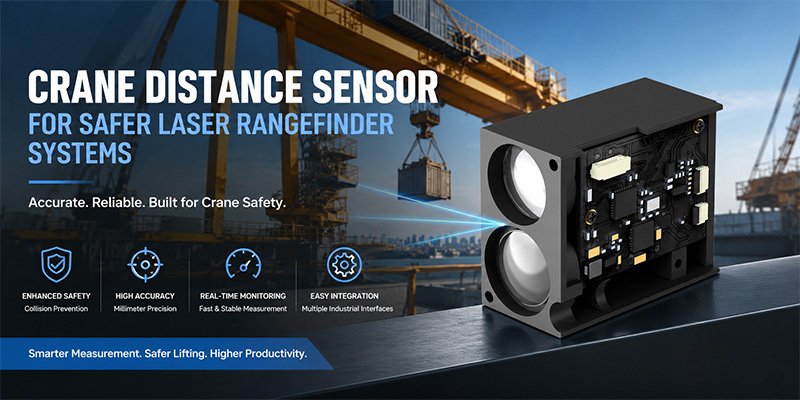
This article explains how a crane distance sensor works, where it is used, what advantages it provides, and which factors engineers should evaluate when selecting the right solution.
Why Crane Safety Requires Accurate Distance Measurement
Industrial cranes often transport loads weighing several tons while moving across large work areas. During operation, multiple risks must be managed simultaneously, including:
- Collision with nearby cranes
- Hook positioning errors
- Overtravel beyond safe limits
- Load swing caused by sudden movement
- Operator visibility limitations
- Congested working environments
Traditional sensors can detect only fixed positions or provide limited feedback. In contrast, a crane distance sensor continuously measures the actual distance to a target, allowing the control system to react before dangerous situations develop.
Real-time distance measurement enables cranes to slow down automatically, stop within safe limits, or maintain predefined safety zones without relying solely on operator judgment.
How a Crane Distance Sensor Works
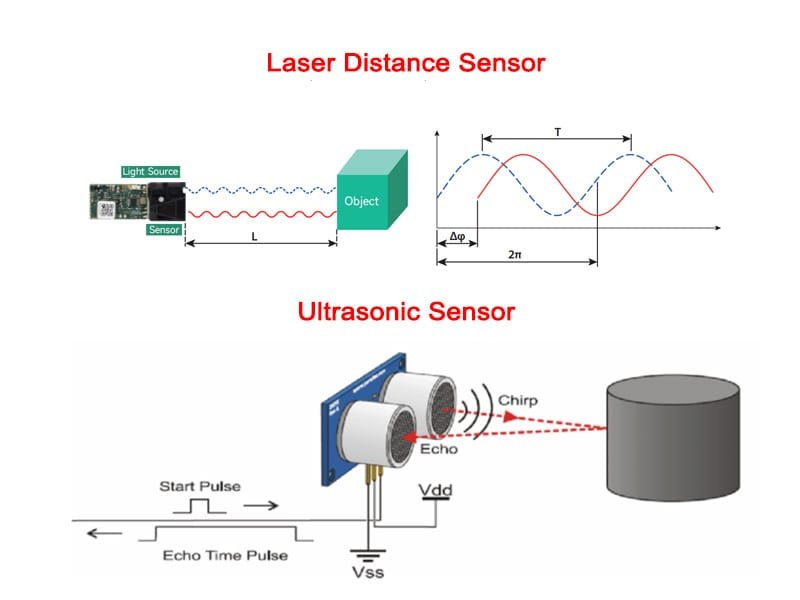
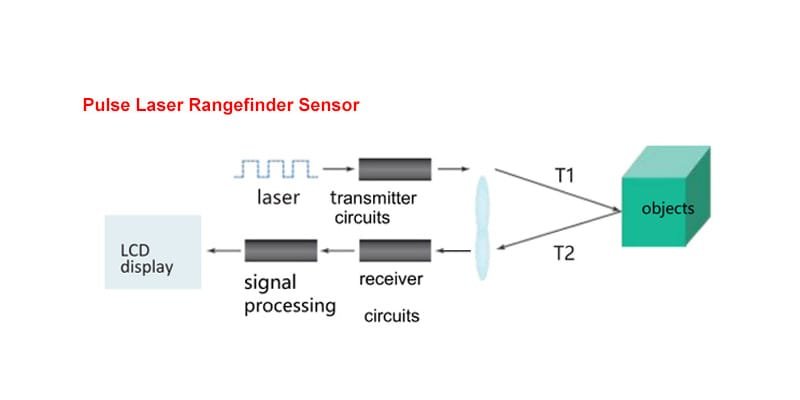
A laser distance sensor emits a narrow laser beam toward a target surface. The reflected light returns to the receiver, where the sensor calculates the distance using advanced optical measurement technology such as phase-shift or time-of-flight principles.
The measured distance is transmitted to the crane controller through industrial communication interfaces, allowing the automation system to monitor equipment position continuously.
Compared with ultrasonic sensors or mechanical encoders, laser technology offers several important advantages:
- Longer measurement ranges
- Millimeter-level positioning accuracy
- Fast measurement response
- Narrow measurement beam
- Stable performance over long distances
- Minimal mechanical wear because no physical contact is required
These characteristics make laser sensors particularly suitable for dynamic crane operations where reliable positioning is essential.
Key Applications of Laser Rangefinders in Crane Safety Systems
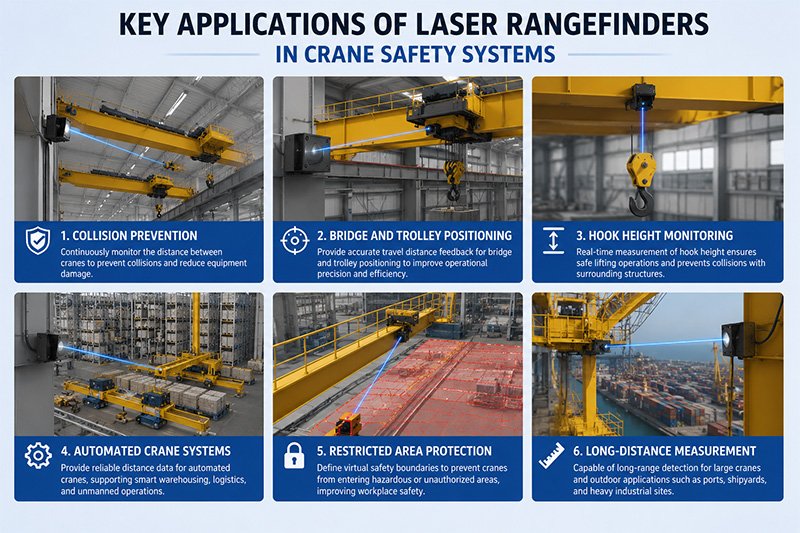
Collision Prevention
One of the most common applications of a crane distance sensor is preventing collisions between multiple cranes operating on the same runway.
As cranes approach one another, the laser continuously monitors separation distance. When the distance falls below predefined safety thresholds, the control system can automatically reduce travel speed or stop movement completely.
This approach significantly reduces the risk of equipment damage while improving operational efficiency.
Bridge and Trolley Positioning
Large overhead cranes require accurate positioning of both the bridge and trolley.
A laser rangefinder for crane safety continuously measures travel distance, enabling the controller to position equipment precisely at loading stations, storage racks, or production lines.
Higher positioning accuracy helps shorten cycle times while reducing unnecessary corrective movements.
Hook Height Monitoring
Maintaining the correct hook height is critical during lifting operations.
Laser sensors provide continuous vertical distance measurement, allowing operators and automated systems to position loads more accurately.
Accurate height feedback also reduces the possibility of collisions with equipment or surrounding structures.
Automated Crane Systems
Many warehouses and production facilities now use automated cranes with minimal operator intervention.
An industrial crane distance measurement sensor supplies continuous positioning data that supports:
- Automated storage systems
- Smart warehouse operations
- Material handling robots
- Intelligent logistics
- Remote crane control
Reliable distance measurement is one of the core technologies enabling fully automated material handling.
Restricted Area Protection
Certain work zones contain personnel, sensitive equipment, or hazardous machinery.
By defining virtual safety boundaries using a crane distance sensor, the control system can prevent cranes from entering restricted areas without authorization.
This greatly improves workplace safety while reducing dependence on manual supervision.
Benefits of Using a Crane Distance Sensor
Integrating laser measurement technology into crane systems delivers advantages beyond simple positioning.
Improved Operational Safety
Continuous monitoring allows potential hazards to be detected before collisions occur.
Automatic braking and speed reduction minimize accident risks and improve overall workplace safety.
Higher Positioning Accuracy
Laser sensors deliver precise distance measurements even across long travel distances.
Improved positioning helps operators place loads exactly where needed, reducing handling errors.
Increased Productivity
Accurate positioning minimizes repeated movements and manual adjustments.
Operators can complete lifting tasks faster while maintaining consistent accuracy.
Reduced Equipment Wear
Smooth positioning reduces sudden impacts and unnecessary mechanical stress.
Over time, this contributes to lower maintenance costs and longer equipment life.
Better Automation Capability
Distance measurement data integrates easily with PLCs, industrial controllers, and automation software.
This supports intelligent crane control strategies that improve both safety and efficiency.
Choosing the Right Crane Distance Sensor
Selecting the right sensor depends on several engineering considerations.
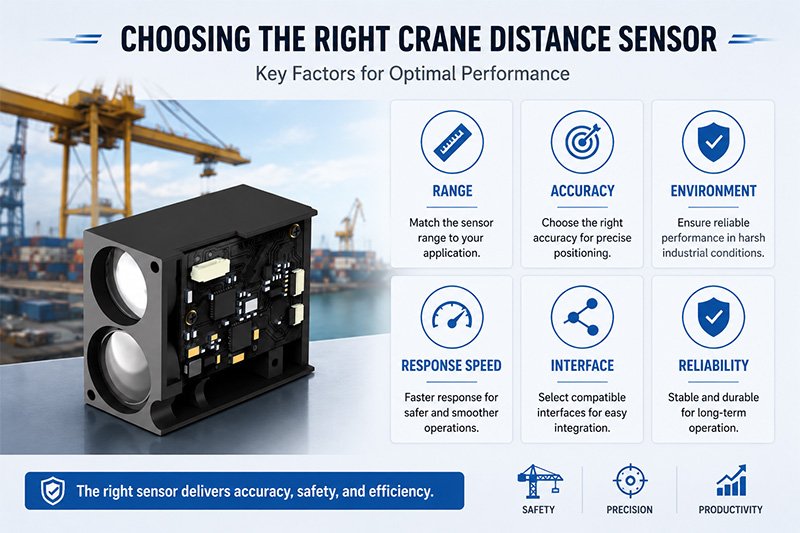
Measurement Range
Different cranes require different sensing distances.
Indoor bridge cranes may require measurements of only a few meters, while container cranes or shipyard cranes often require much longer ranges.
The sensor should provide reliable measurement across the entire operating distance.
Accuracy Requirements
Positioning accuracy directly affects operational performance.
Applications involving automated storage or precision material handling generally require millimeter-level accuracy.
Heavy-duty transport applications may prioritize measurement stability over ultra-high precision.
Environmental Conditions
Industrial cranes often operate in demanding environments, including:
- Dust
- Rain
- Fog
- Vibration
- Temperature fluctuations
- Bright sunlight
- Reflective metal surfaces
Selecting a sensor designed for industrial environments helps maintain consistent measurement performance.
Response Speed
Moving cranes require rapid measurement updates.
A high-speed anti collision laser distance sensor for cranes allows the control system to react quickly to changing operating conditions, improving both safety and positioning performance.
Communication Interfaces
Modern crane controllers may require different industrial communication protocols, including:
- RS232
- RS485
- UART
- Ethernet
- CAN Bus
- Modbus
Choosing compatible interfaces simplifies system integration and future upgrades.
Future Trends in Crane Distance Measurement
Industrial automation continues to transform crane operations.
Future crane systems will increasingly combine laser measurement with artificial intelligence, machine vision, and predictive maintenance technologies.
Emerging developments include:
- AI-assisted obstacle detection
- Digital twin positioning systems
- Smart predictive maintenance
- Cloud-based equipment monitoring
- Fully autonomous crane fleets
- Real-time safety analytics
As these technologies mature, the crane distance sensor will remain one of the foundational components supporting intelligent and safe crane operation.
Conclusion
Modern crane operations demand both precision and safety. Traditional positioning methods alone can no longer meet the requirements of today’s automated industrial environments.
A crane distance sensor provides continuous, high-accuracy distance measurement that supports collision prevention, positioning control, hook monitoring, and intelligent automation. By integrating laser rangefinder technology into crane safety systems, operators can reduce accidents, improve productivity, lower maintenance costs, and prepare their equipment for future smart manufacturing applications.
Whether the application involves overhead cranes, gantry cranes, container terminals, warehouses, or automated production facilities, laser distance measurement has become an essential technology for achieving safer and more efficient lifting operations.