Laser Triangulation Sensor vs Laser Distance Sensor: Which One Is Better for Industrial Measurement?
Introduction: Choosing the Right Laser Measurement Technology
In modern industrial automation, robotics, manufacturing inspection, and smart equipment, accurate non-contact measurement technology plays an important role in improving efficiency and reliability. Engineers often compare different sensing technologies before selecting a suitable solution, especially when choosing between a laser triangulation sensor vs laser distance sensor.
Both technologies use laser light to measure distance without physical contact, but they are designed for different application requirements. A laser triangulation sensor is usually optimized for short-range, high-resolution surface measurement, while a laser distance sensor is designed for flexible distance measurement over a wider range.
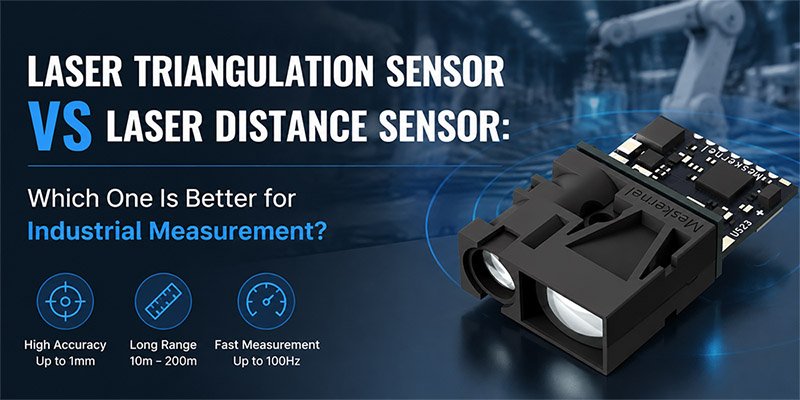
For industrial applications that require stable measurement, easy integration, and longer measuring distances, selecting the right industrial measurement sensor is critical. Understanding the working principles, advantages, and limitations of each technology helps engineers choose the most suitable distance measurement solution for their projects.
How Does a Laser Triangulation Sensor Work?
A laser triangulation sensor determines distance based on the geometric relationship between a laser source, target surface, and optical receiver. The sensor projects a laser spot onto an object, and the reflected light is captured by a camera or position-sensitive detector. According to the change in the reflected light angle, the sensor calculates the distance using triangulation principles.
The main advantage of laser triangulation technology is extremely high resolution at short distances. It is commonly used in applications such as:
- Surface profile inspection
- Thickness measurement
- Precision displacement detection
- 반도체 검사
- Quality control systems
Because the measurement accuracy can reach the micrometer level in controlled environments, laser triangulation sensors are suitable for applications where detecting small surface changes is more important than measuring long distances.
However, laser triangulation sensors also have limitations. Their measurement range is usually shorter, and performance can be affected by factors such as target surface color, reflectivity, angle, and environmental conditions.
How Does a Laser Distance Sensor Work?
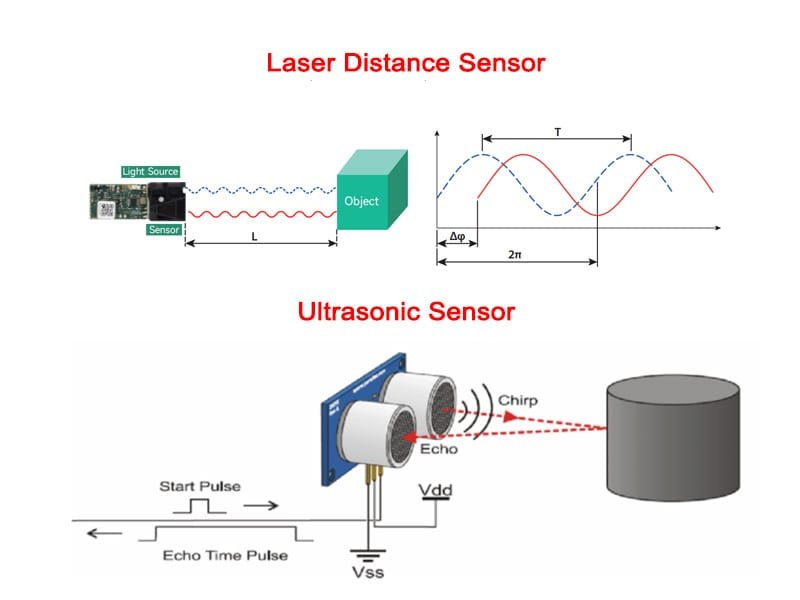
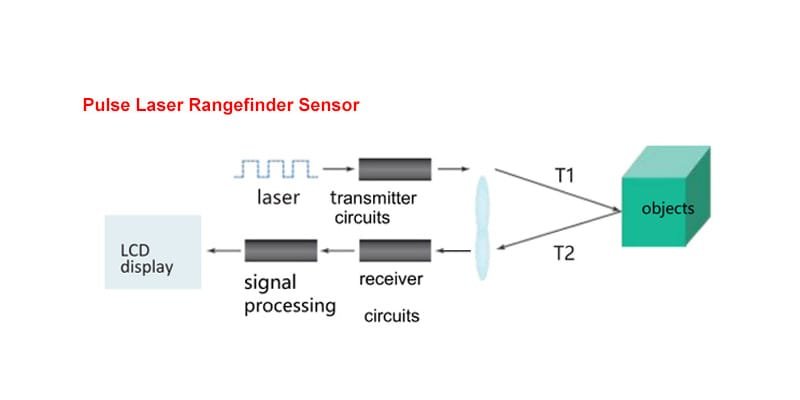
A 레이저 거리 센서 uses different optical measurement methods, including phase shift measurement and time-of-flight (TOF) technology, to calculate the distance between the sensor and the target.
Unlike triangulation sensors, laser distance sensors are designed for a broader measurement range and more flexible industrial applications. They can accurately measure distances from several meters to hundreds of meters while maintaining reliable performance.
Meskernel laser distance sensors provide multiple measurement ranges, including:
- 10m laser distance sensors
- 20m laser distance sensors
- 40m laser distance sensors
- 100m laser distance sensors
- 200m laser distance sensors
Depending on the model and application requirements, the measurement accuracy can reach up to 1mm, making them suitable for precision industrial automation systems.
With a maximum measurement frequency of 100Hz, these sensors can provide fast and continuous distance updates for dynamic applications, including robotic positioning, production line monitoring, and automated control systems.
Laser Triangulation Sensor vs Laser Distance Sensor: Key Differences
When comparing laser triangulation sensor vs laser distance sensor, engineers should consider several important factors, including measurement range, accuracy, application environment, and system integration capability.
| 기능 | 레이저 삼각 측량 센서 | 레이저 거리 센서 |
|---|---|---|
| 측정 원리 | Optical triangulation | Phase shift / TOF measurement |
| 측정 범위 | Short distance | From meters to hundreds of meters |
| 정확성 | Extremely high for short range | Up to 1mm accuracy |
| Measurement Frequency | Suitable for surface scanning | Up to 100Hz continuous measurement |
| Target Requirement | Sensitive to surface characteristics | More flexible for different targets |
| Application Focus | Profile and displacement measurement | Distance measurement and positioning |
| Integration | Limited models | Easy OEM integration and customization |
For manufacturers requiring 장거리 측정, stable operation, and flexible communication options, a laser distance sensor is often a more practical choice.
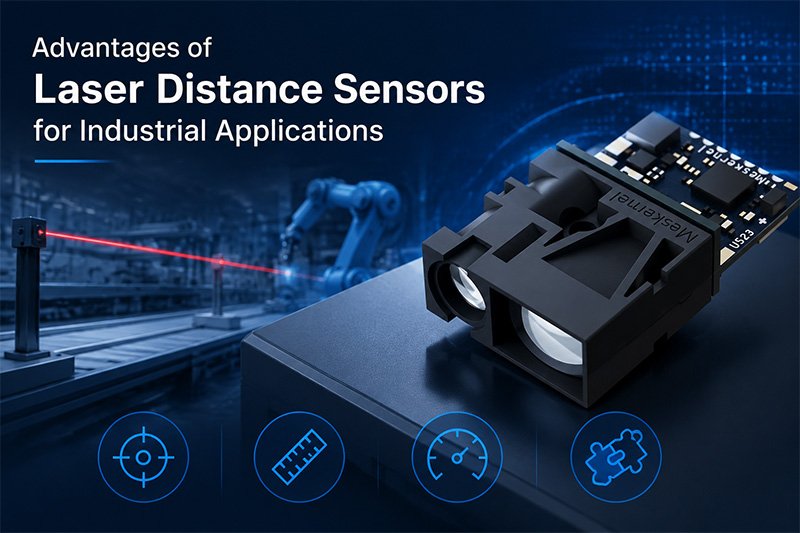
Advantages of Laser Distance Sensors for Industrial Applications
A modern industrial measurement sensor needs to provide not only accurate measurement but also reliable integration with existing systems. Laser distance sensors offer several advantages for industrial applications.
1. Longer Measurement Range
One of the biggest differences in the laser triangulation sensor vs laser distance sensor comparison is measurement distance.
Laser triangulation sensors are mainly designed for short working distances, while laser distance sensors can measure significantly farther targets.
메커넬 레이저 거리 센서 support measurement distances from 10 meters up to 200 meters, providing flexible options for different industrial environments.
This makes them suitable for:
- Warehouse automation
- Industrial positioning systems
- Crane distance monitoring
- 로봇 공학
- Smart manufacturing equipment
- Level measurement systems
2. High Accuracy and Fast Measurement Speed
Accuracy and response speed are essential for automated systems.
Meskernel laser distance sensors provide:
- Accuracy up to 1mm
- 최대 100Hz의 측정 주파수
- Stable continuous distance measurement
High-speed measurement allows machines to react quickly to position changes, improving automation efficiency and reducing production errors.
For applications requiring real-time feedback, choosing a high-performance distance measurement solution can significantly improve system reliability.
3. Flexible Light Options for Different Applications
Different industrial environments require different laser visibility options.
Meskernel laser distance sensors are available with:
- Visible red laser
- Visible green laser
The visible laser point allows engineers to easily align and install the sensor during system setup.
녹색 레이저 versions can provide better visibility in certain environments, while 빨간색 레이저 versions offer a widely used and cost-effective solution for general industrial measurement applications.
4. Easy OEM Integration and Secondary Development
Industrial customers often need sensors that can be customized and integrated into their own products.
Meskernel laser distance sensors support secondary development and OEM integration, allowing engineers to create customized measurement systems.
Integration options include:
- Embedded system development
- Robotics platforms
- Industrial controllers
- Custom automation equipment
- 스마트 장치
With flexible communication interfaces and compact designs, these sensors can be easily integrated into different hardware systems.
When Should You Choose a Laser Triangulation Sensor?
A laser triangulation sensor is a good choice when your application requires:
- Extremely high resolution measurement
- Short measurement distance
- Surface profile analysis
- Micrometer-level inspection
- Material thickness detection
For example, manufacturing inspection systems that check small surface defects may benefit from triangulation technology.
When Should You Choose a Laser Distance Sensor?
A laser distance sensor is usually the better choice when your application requires:
- Longer measurement range
- Continuous distance monitoring
- Industrial automation integration
- Fast response speed
- Flexible installation
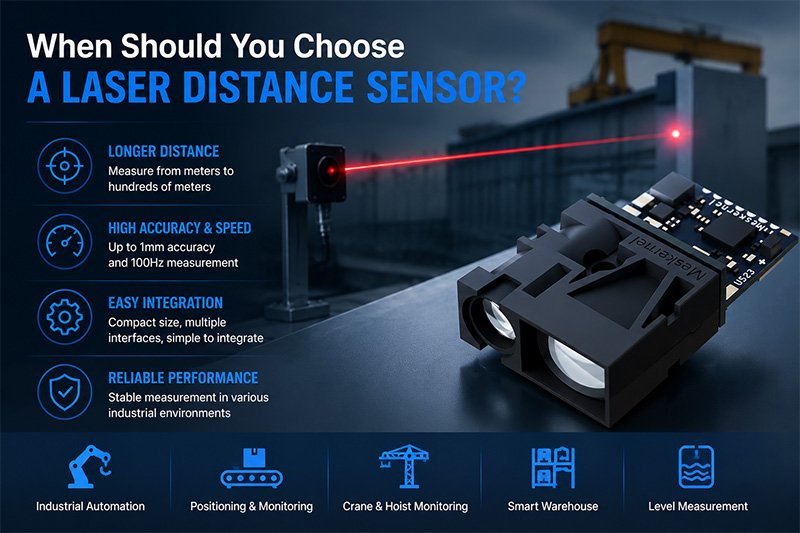
Typical applications include:
산업 자동화
레이저 거리 센서 can monitor object positions, machine movement, and production processes.
로봇 공학
Robotic systems use distance sensors for positioning, obstacle detection, and movement control.
Smart Equipment
OEM equipment manufacturers can integrate laser distance sensors into customized machines to achieve automatic measurement functions.
Outdoor and Large Equipment Monitoring
Long-range models are suitable for applications where targets are located far away from the sensor.
How to Select the Right Distance Measurement Solution?
Choosing between a laser triangulation sensor and a laser distance sensor depends on the actual application requirements.
If the main goal is analyzing tiny surface changes at short distances, a laser triangulation sensor may be the right option.
However, if the project requires reliable distance measurement from several meters to hundreds of meters, fast response, and easy integration, a laser distance sensor provides a more flexible solution.
When selecting an industrial measurement sensor, engineers should evaluate:
- Required measurement range
- Accuracy requirements
- Measurement speed
- Installation environment
- 커뮤니케이션 인터페이스
- Integration requirements
A suitable sensor selection can improve system performance and reduce development costs.
결론
The comparison of laser triangulation sensor vs laser distance sensor shows that both technologies have unique advantages. Laser triangulation sensors are excellent for short-range precision inspection, while laser distance sensors provide greater flexibility for industrial distance measurement applications.
For automation systems, robotics, OEM equipment, and industrial monitoring applications, Meskernel laser distance sensors provide a reliable distance measurement solution with measurement ranges from 10m to 200m, accuracy up to 1mm, measurement frequency up to 100Hz, and flexible OEM integration capabilities.
By choosing the correct industrial measurement sensor, engineers can build faster, smarter, and more reliable measurement systems for modern industrial environments.
자주 묻는 질문(FAQ)
1. What is the difference between a laser triangulation sensor and a laser distance sensor?
A laser triangulation sensor is mainly designed for short-range, high-resolution surface measurement, while a laser distance sensor is designed for measuring distances from several meters to hundreds of meters with high stability.
2. Which is better for industrial measurement applications?
It depends on the application requirements. Laser triangulation sensors are suitable for precision surface inspection, while laser distance sensors are better for industrial positioning, automation, robotics, and long-distance measurement.
3. How accurate can a laser distance sensor measure?
Meskernel laser distance sensors can achieve accuracy up to 1mm, depending on the model and application conditions.
4. What measurement ranges are available for laser distance sensors?
Meskernel laser distance sensors support multiple measurement ranges, including 10m, 20m, 40m, 100m, and 200m, providing flexible options for different industrial applications.
5. Can laser distance sensors be integrated into OEM equipment?
Yes. Meskernel laser distance sensors support secondary development and OEM integration, allowing engineers to customize and integrate them into robotics, automation systems, and smart devices.
6. Do laser distance sensors support fast measurement?
Yes. Some Meskernel laser distance sensors support measurement frequencies up to 100Hz, making them suitable for real-time industrial monitoring and dynamic measurement applications.