レーザー距離センサーとレーザー三角測量センサー:主な違いを説明

Laser Range Sensor vs Laser Triangulation Sensor: Key Differences Explained ​

Short-distance measurement sensors are essential to modern industrial automation, especially in robotics, warehouse logistics, semiconductor production, smart agriculture, and high-precision factory inspection. Two of the most widely used sensing technologies in this field are the laser range sensor​ and the laser triangulation sensor (also known as an optical displacement sensor).

At first glance, both sensors appear suitable for short-range detection. However, their working principles, measurement range, accuracy behavior, installation requirements, environmental tolerance, and application suitability are fundamentally different.

This article provides a detailed technical and application-level comparison to help engineers determine which technology is the best fit for their project.

laser range sensor​ vs Laser Triangulation Sensor

1. How Each Sensor Works

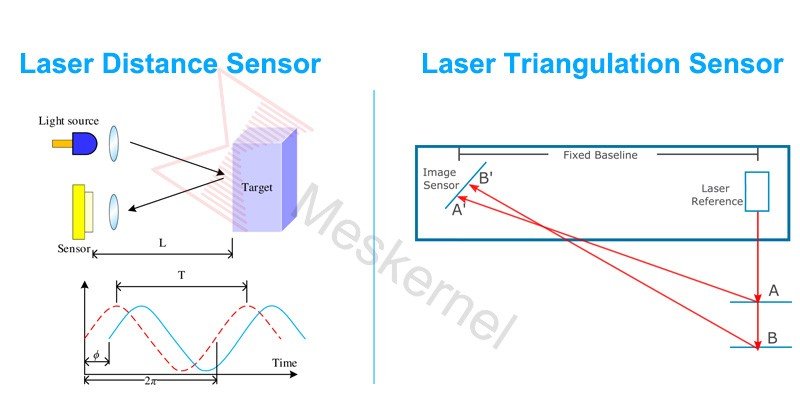
1.1 Laser Range Sensor​ (Phase-Shift or TOF Measurement)

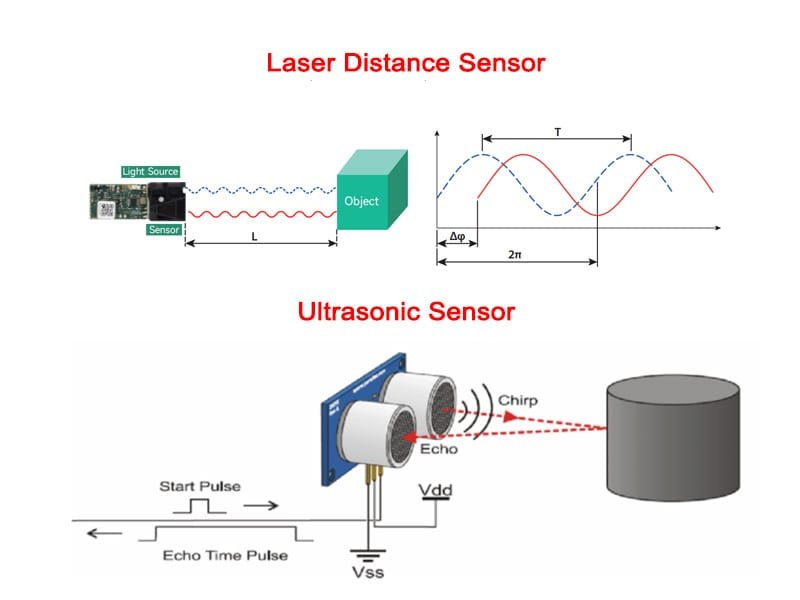
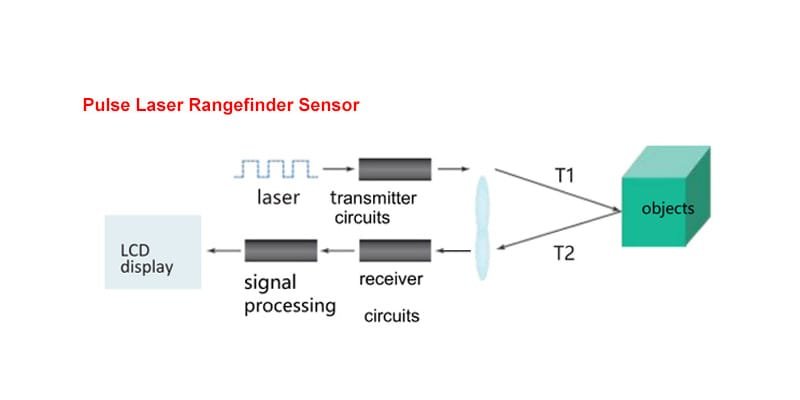
A laser range sensor​ typically uses phase-shift ranging or time-of-flight (TOF) to measure distance.

Working principle:

  1. The sensor emits a modulated or pulsed laser beam.
  2. The reflected beam returns to the sensor.
  3. The system calculates distance from the phase difference or return time.

Key strengths:

  • Distance calculation does not depend on lens geometry or beam triangulation
  • High accuracy even at several meters
  • Consistent performance regardless of angle or object color
  • Excellent outdoor stability and noise resistance
  • Works well with dark, rough, or low-reflective targets

これによって laser range sensor​ ideal for industrial-grade scenarios where stability and reliability matter.

1.2 Laser triangulation Sensor (Optical Geometric Displacement)

A triangulation sensor uses a geometry-based optical principle.

Working principle:

  1. A laser spot is projected onto the target surface.
  2. The reflected spot hits a CMOS/CCD/PSD sensor via a lens.
  3. As distance changes, the light spot shifts on the detector.
  4. The sensor calculates distance based on the displacement angle.

Key strengths:

  • Extremely high resolution at very close distances
  • Excellent for detecting micrometer-level displacement
  • Fast response speed and high sensitivity

Limitations:

  • Strongly affected by surface color, angle, and reflectivity
  • Measuring range typically short (10–500 mm)
  • Poor outdoor usability
  • Requires highly stable mounting conditions

Thus, triangulation sensors are more suitable for laboratory and controlled manufacturing environments.

laser range sensor​ vs Laser Triangulation Sensor

2. Measuring Range & Performance Comparison

特徴Laser Range Sensor​Laser Triangulation Sensor
Typical range0.03 m – 200 m10 mm – 500 mm
Usable on dark/black targetsYesOften unstable
Outdoor performanceVery strongVery weak
Angle tolerance高い低い
Range flexibilityWideVery narrow
Micro-level precisionMediumExtremely high

について laser range sensor​ dominates whenever the required range is above 0.5 m or when environmental robustness is important.

3. Accuracy, Stability & Environmental Resistance

3.1 laser range sensor​

Accuracy: typically ±1mm
Frequency: up to 30–100 Hz depending on model

メリット

  • Stable in indoor/outdoor environments
  • Resistant to sunlight, dust, fog, weak reflection
  • Minimal drift due to angle changes
  • Works on metals, plastics, fabrics, wood, etc.
  • Ideal for moving objects

This makes it the top choice for industrial automation, robotics, AGV navigation, packaging machines, sorting systems, and safety detection.

3.2 Laser Triangulation Sensor

Accuracy: extremely high within short distance (micrometer-level)
Frequency: often 1–2 kHz, good for subtle vibration detection

Limitations:

  • Extremely sensitive to installation vibration
  • Light spot easily distorted on glossy/black surfaces
  • Cannot handle strong ambient light
  • Limited maximum range

Best suited for:

  • Semiconductor inspection
  • Surface height measurement
  • Precision assembly
  • Laboratory displacement tests

4. Application Suitability

laser range sensor​ – Best For:

  • AGV & AMR navigation and anti-collision
  • ロボットアームの位置決め
  • Warehouse automation / forklift sensing
  • Material level detection
  • Intelligent agriculture machinery
  • Compact outdoor equipment
  • Distance feedback for industrial machines

Its durability and measurement range make it ideal for real-world engineering.

Triangulation Sensor – Best For:

  • Micro-displacement measurement
  • Electronics assembly lines
  • Surface flatness and thickness analysis
  • Small mechanical movement detection
  • High-precision inspection in clean environments

Triangulation is unmatched in ultra-short-range accuracy but not in practicality.

laser range sensor applications

5. Summary: Which One Should You Choose?

If your project requires:
Long short-range measurement (0.1–80 m)
Outdoor stability
Dark-object detection
Robustness and flexibility

If your project requires:
Sub-millimeter surface inspection
Extremely close-range detection (<500 mm)
Controlled lighting and stable mounting

For most industrial applications—especially robotics, automation, and AGV systems—
the laser distance measurement sensor offers superior efficiency, reliability, and long-term performance.

ja日本語
上部へスクロール