
How to Choose a Laser Distance Sensor for Industrial Projects
Industrial automation is becoming increasingly dependent on precise measurement technologies. Whether used in robotics, AGVs, warehouse automation, smart manufacturing, or process control systems, laser distance sensors play a critical role in ensuring accuracy and efficiency.
However, with dozens of sensor types available on the market, many engineers struggle with one question: How to choose a laser distance sensor that truly fits their application?
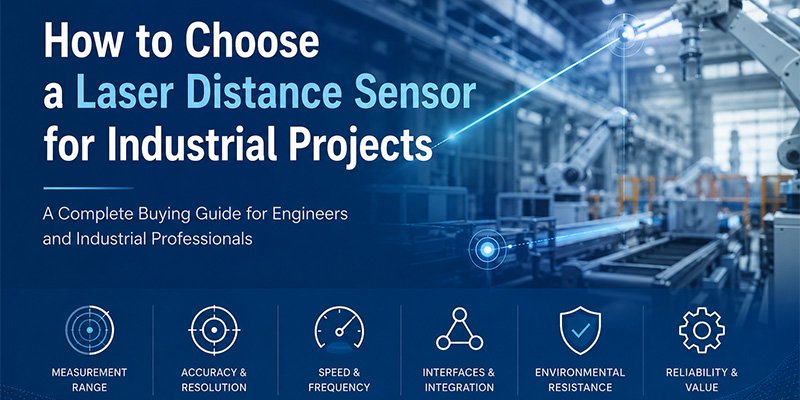
This article serves as a practical laser distance sensor buying guide, helping engineers and procurement professionals understand the key factors involved in industrial laser sensor selection.
Why Laser Distance Sensors Are Widely Used in Industry
Laser distance sensors provide non-contact distance measurement by emitting a laser beam toward a target and calculating the distance based on the reflected signal.
Compared with traditional contact measurement methods, laser sensors offer several advantages:
- 高い測定精度
- Fast response speed
- Long measuring range
- Non-contact operation
- Easy integration into automation systems
- Reliable performance in demanding environments
These benefits make レーザー距離センサー ideal for modern industrial applications such as:
- Robotic positioning
- Conveyor monitoring
- Warehouse automation
- Crane positioning
- AGV navigation
- スマート農業
- Material handling systems
- Industrial inspection
Before purchasing a sensor, understanding the actual requirements of your project is the first step in learning how to choose a laser distance sensor effectively.
1. Determine the Required Measurement Range
The measurement range is one of the most important considerations during industrial laser sensor selection.
Different industrial projects require different distance capabilities.
例えば、こうだ:
| 申し込み | 典型的な範囲 |
|---|---|
| ロボット工学 | 0.03–10m |
| Conveyor Systems | 0.1–20m |
| 倉庫オートメーション | 1–50m |
| AGVs | 0.1–80m |
| Construction Equipment | 10–300m |
| Surveying Applications | 100m+ |
Selecting a sensor with excessive range may increase costs unnecessarily, while insufficient range can lead to system failure.
When evaluating range specifications, always consider:
- Minimum measuring distance
- Maximum measuring distance
- Target reflectivity
- Environmental lighting conditions
A good laser distance sensor buying guide always recommends choosing a sensor with some measurement margin beyond the expected operating distance.
2. Evaluate Measurement Accuracy Requirements
Accuracy requirements vary significantly between industries.
例えば、こうだ:
- Warehouse positioning may tolerate ±10mm
- Industrial automation often requires ±1mm
- Precision assembly may require sub-millimeter accuracy
When considering how to choose a laser distance sensor, engineers should distinguish between:
精度
The difference between the measured value and the actual value.
決議
The smallest detectable measurement increment.
Repeatability
The sensor’s ability to consistently reproduce the same measurement.
For many industrial automation projects, repeatability can be even more important than absolute accuracy.
Always compare these specifications carefully when performing industrial laser sensor selection.
3. Consider Measurement Frequency and Response Time
Modern automation systems often require real-time measurement data.
Sensor update rates can range from:
- 1Hz
- 10Hz
- 30Hz
- 100Hz
- 1000Hz and above
Applications involving moving targets typically require higher frequencies.
Examples include:
- コンベアベルトのモニタリング
- AGV障害物検知
- ロボットアームの位置決め
- Dynamic production lines
If a sensor updates too slowly, important changes may be missed.
One key lesson in any laser distance sensor buying guide is matching measurement frequency to object speed.
Higher speed applications require faster sensors.
4. Understand the Measurement Technology
Different laser sensors use different ranging principles.
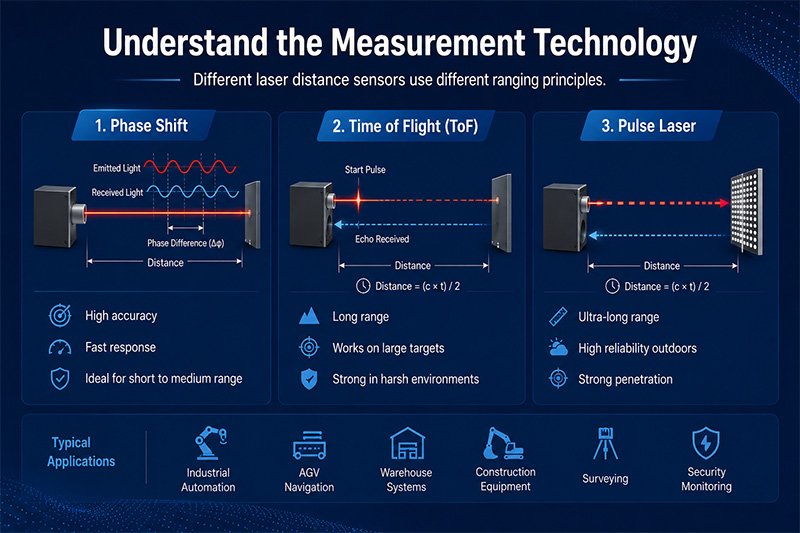
The most common technologies include:
Phase Shift Measurement
メリット
- High accuracy
- 高速測定
- Suitable for short and medium ranges
Typical applications:
- 産業オートメーション
- ロボット工学
- Warehouse systems
飛行時間(ToF)
メリット
- Longer measurement distances
- Good performance on large targets
アプリケーション
- Outdoor positioning
- Construction equipment
- Long-distance monitoring
Pulse Laser Measurement
メリット
- Extremely long range
- Outdoor capability
アプリケーション
- 測量
- Security monitoring
- Defense systems
Understanding the measurement principle is essential when deciding how to choose a laser distance sensor for a specific industrial project.
5. Check Communication Interfaces
Sensor integration is often overlooked during procurement.
Industrial systems commonly require communication through:
- UART
- TTL
- USB
- RS232
- RS485
- Modbus RTU
- CAN Bus
- イーサネット
Before purchasing, verify compatibility with:
- PLCs
- Industrial PCs
- ラズベリーパイ
- アルドゥイーノ
- ESP32
- SCADA systems
A sensor may meet performance requirements but still create integration challenges if the communication protocol is incompatible.
This is why communication compatibility remains a critical factor in industrial laser sensor selection.
6. Evaluate Environmental Conditions
Industrial environments can be harsh.
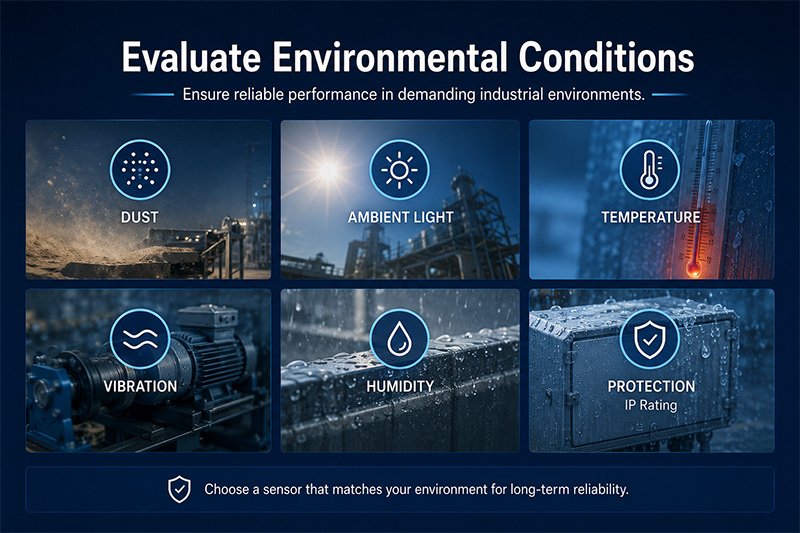
Factors that influence sensor performance include:
Dust
Warehouses, mines, and manufacturing plants often generate airborne particles.
Ambient Light
Strong sunlight can affect optical measurement systems.
Temperature
Industrial facilities may operate under extreme temperatures.
Vibration
Machines and production lines often generate constant vibration.
Humidity
Outdoor and agricultural applications may experience high moisture levels.
When researching how to choose a laser distance sensor, engineers should always verify:
- 動作温度範囲
- Protection rating (IP54, IP65, IP67, etc.)
- Shock resistance
- Vibration resistance
Environmental suitability often determines long-term reliability.
7. Consider Target Surface Characteristics
Laser sensors perform differently depending on the target material.
Common target types include:
- Metal
- Plastic
- Wood
- Glass
- Rubber
- Painted surfaces
Reflectivity directly affects measurement performance.
Challenges may arise when measuring:
- Dark objects
- Transparent materials
- Highly reflective surfaces
- Irregular geometries
A professional laser distance sensor buying guide should always account for target characteristics before selecting a sensor.
Whenever possible, perform testing on actual application samples.
8. Evaluate Physical Size and Installation Requirements
Modern industrial systems often have limited installation space.
Compact sensors offer advantages such as:
- Easier integration
- Reduced weight
- Flexible mounting options
- Better compatibility with robotic systems
Important factors include:
- Sensor dimensions
- 重量
- Mounting holes
- Connector orientation
For robotics and embedded applications, compact designs are often preferred during industrial laser sensor selection.
9. Review Long-Term Reliability and Maintenance
Industrial projects usually operate continuously for years.
When evaluating suppliers and products, consider:
- Product lifespan
- Manufacturer support
- Firmware updates
- Calibration requirements
- Spare parts availability
A lower-cost sensor may become expensive if downtime or maintenance costs increase.
Long-term reliability should always be included when deciding how to choose a laser distance sensor.
10. Balance Performance and Cost
Budget is always a factor.
However, choosing solely based on price often leads to future problems.
Instead, evaluate:
- Measurement performance
- Integration cost
- Maintenance cost
- Expected service life
- Technical support
The best sensor is not necessarily the cheapest option.
It is the one that delivers the highest value throughout the entire project lifecycle.
This principle is central to every effective laser distance sensor buying guide.
最終的な感想
Understanding how to choose a laser distance sensor requires more than simply comparing specifications. Engineers must evaluate measurement range, accuracy, speed, communication interfaces, environmental conditions, target characteristics, and long-term reliability.
A successful industrial laser sensor selection process focuses on matching sensor capabilities with real-world application requirements rather than selecting the highest specification available.
By following the recommendations in this laser distance sensor buying guide, industrial professionals can reduce integration risks, improve measurement performance, and maximize the return on investment of their automation projects.
As industrial automation continues to evolve, selecting the right laser distance sensor remains one of the most important decisions for achieving accurate, reliable, and efficient system performance.