Phase Shift Laser Sensor vs Time of Flight Sensors
はじめに
Laser sensing technology has become a cornerstone in modern industrial automation, robotics, and measurement applications. Two of the most widely used distance sensing technologies are the Phase Shift laser sensor そして Time of Flight Sensors. Understanding the differences between these technologies can help engineers, technicians, and designers select the most appropriate solution for their specific needs, ensuring accuracy, reliability, and efficiency.

How Phase Shift Laser Sensors Work
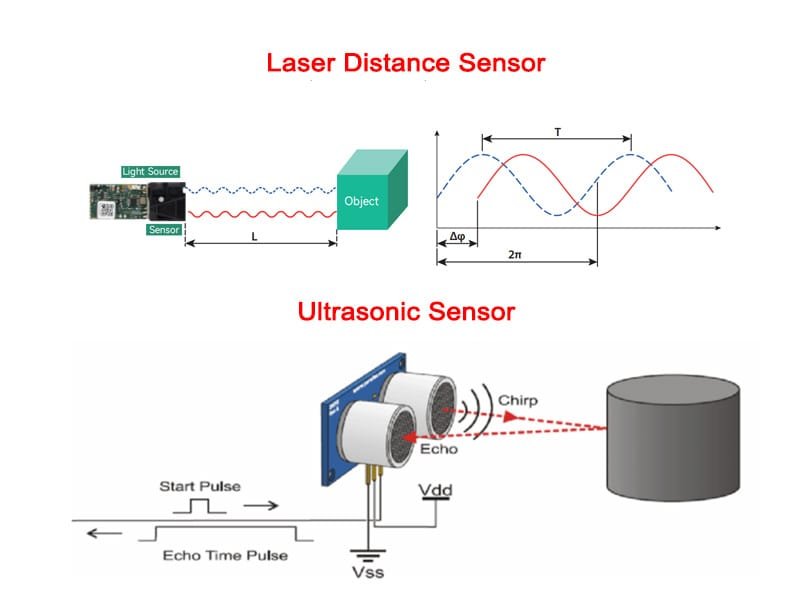
A Phase Shift laser sensor operates on the principle of continuous wave modulation. The sensor emits a laser beam toward a target and receives the reflected light. By comparing the phase difference between the emitted and reflected light waves, it calculates the distance accurately.
Key characteristics include:
- High accuracy: Often down to millimeter precision.
- Measurement speed: Extremely fast, enabling real-time monitoring.
- 範囲: Typically suitable for medium to long distances depending on the model.
- アプリケーション Industrial automation, robotics, material handling, and quality control.
This method allows continuous and precise distance measurements, making phase shift sensors ideal for environments that demand high precision, such as production lines and automated machinery.
How Time of Flight Sensors Work
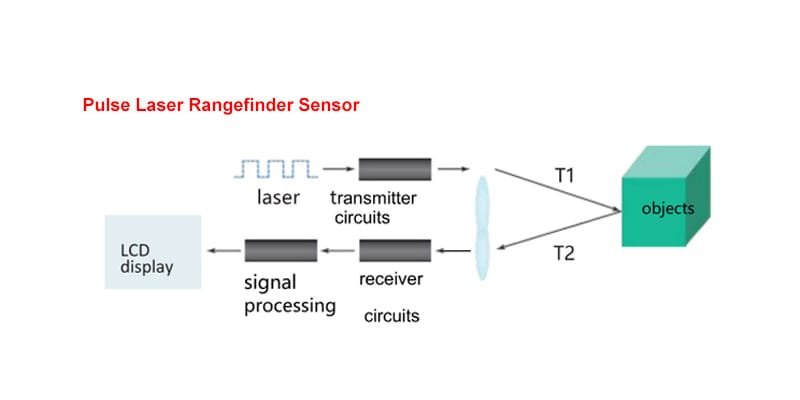
Time of Flight (ToF) Sensors measure distance by calculating the time it takes for a pulsed laser beam to travel to the target and back. Unlike phase shift sensors, ToF sensors rely on the travel time of individual laser pulses and the speed of light to determine distance.
Key characteristics include:
- 正確さ: Generally slightly lower than phase shift sensors, usually in centimeter range.
- 範囲: Can measure both short and long distances.
- アプリケーション 3D mapping, object detection, autonomous vehicles, robotics, and drones.
ToF sensors are particularly suitable for applications requiring 長距離測定 or 3D spatial mapping, where a wider coverage area is more critical than ultra-high precision.
Key Differences Between Phase Shift and Time of Flight Sensors
| 特徴 | Phase Shift Laser Sensor | Time of Flight Sensor |
|---|---|---|
| Principle | Measures phase shift of reflected light | Measures time of laser pulse travel |
| 精度 | High (mm-level) | Moderate (cm-level) |
| Measurement Speed | Continuous, real-time | Limited by pulse rate |
| レンジ | Medium to long | Short to very long |
| アプリケーション | Industrial automation, high precision measurement | 3D mapping, robotics, autonomous systems |
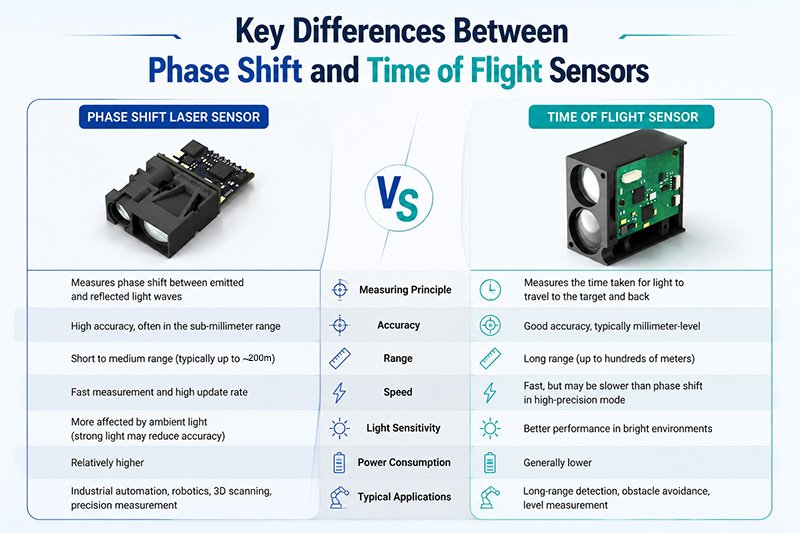
Selecting the right sensor depends on accuracy requirements, range, environmental conditions, and application type.
Advantages of Phase Shift Sensors
- Exceptional accuracy: Ideal for applications demanding precise measurements.
- Real-time continuous monitoring: No delay between measurements.
- Stability on reflective surfaces: Less affected by surface properties.
- Automation-friendly: Well-suited for robotics and industrial machinery.
Advantages of Time of Flight (ToF) Sensors
- Versatile range: Effective for both short and long-distance measurement.
- 3D mapping capability: Ideal for LiDAR and depth sensing.
- Compact and lightweight design: Easily integrated into mobile and drone applications.
- 環境適応性: Works well in various lighting conditions.
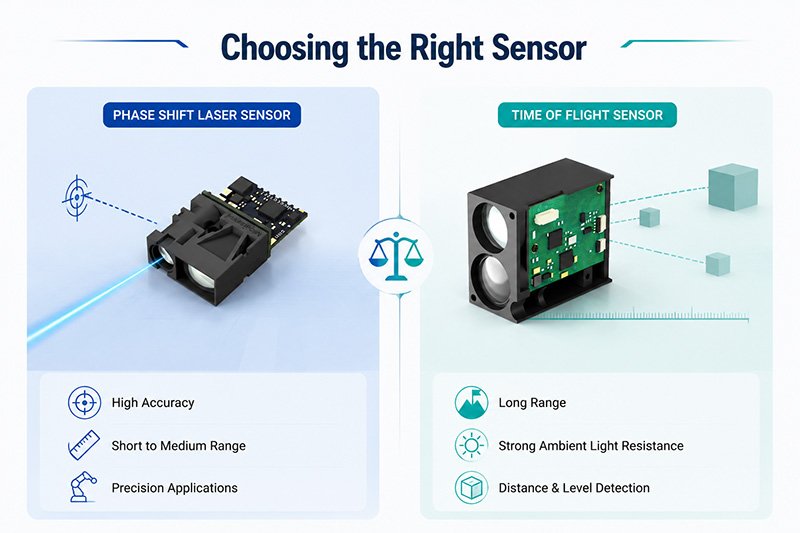
Choosing the Right Sensor
When deciding between a Phase Shift laser distance sensor そして Time of Flight (ToF) Sensors, consider:
- Accuracy needs: Phase shift for millimeter-level precision.
- Measurement range: ToF for long-distance or 3D mapping applications.
- Application environment: High-speed automation favors phase shift, while spatial mapping favors ToF.
- Additional technologies: Incorporating laser distance measurement technology そして high precision laser sensor solutions can further optimize system performance.
結論
両方 Phase Shift laser sensors そして Time of Flight Sensors provide significant advantages in modern measurement applications. Phase shift sensors excel in high precision, real-time industrial applications, while ToF sensors offer flexibility for long-range measurements and 3D mapping. By understanding the differences, engineers can select the optimal sensor to meet performance, accuracy, and reliability requirements.
FAQ
Q1: What is a Phase Shift laser sensor?
A Phase Shift laser sensor measures distance by comparing the phase of emitted and reflected light waves. It provides high-precision, real-time measurements, ideal for industrial automation and robotics.
Q2: How does a Time of Flight Sensor work?
Time of Flight (ToF) Sensors measure distance by calculating the time a pulsed laser beam takes to travel to a target and return. They are suitable for long-range applications and 3D mapping.
Q3: What is the main difference between Phase Shift and ToF sensors?
Phase Shift sensors offer millimeter-level accuracy with continuous measurements, while ToF sensors provide longer-range measurements, often with centimeter-level precision, ideal for 3D applications.
Q4: Which sensor is best for industrial automation?
Phase Shift laser sensors are generally better for high-precision, real-time industrial processes, whereas ToF sensors excel in mapping, robotics, and autonomous systems.
Q5: Can both sensors be used outdoors?
Yes, but ToF sensors are more sensitive to ambient light and surface reflectivity. Phase Shift sensors maintain higher accuracy across varying conditions.
Q6: What are some additional considerations?
Consider using laser distance measurement technology そして high precision laser sensor models to optimize performance, depending on your application’s accuracy and range requirements.