Laser Rangefinder vs LiDAR What Is the Difference and Which One Is Better
Distance measurement technologies are essential in modern automation, robotics, surveying, and unmanned systems. Among the most widely used technologies are télémètres laser et LiDAR sensors. While both rely on laser-based measurement principles, they are designed for different purposes and system architectures.
Comprendre la laser rangefinder vs LiDAR comparison helps engineers, developers, and system integrators select the right solution for their application. This article explains their working principles, accuracy, advantages, and common applications.
What Is a Laser Rangefinder
A télémètre laser is a device designed to measure the distance between the sensor and a target object using a focused laser beam. It typically measures distance along a single direction and returns a precise value representing the separation between the sensor and the object.
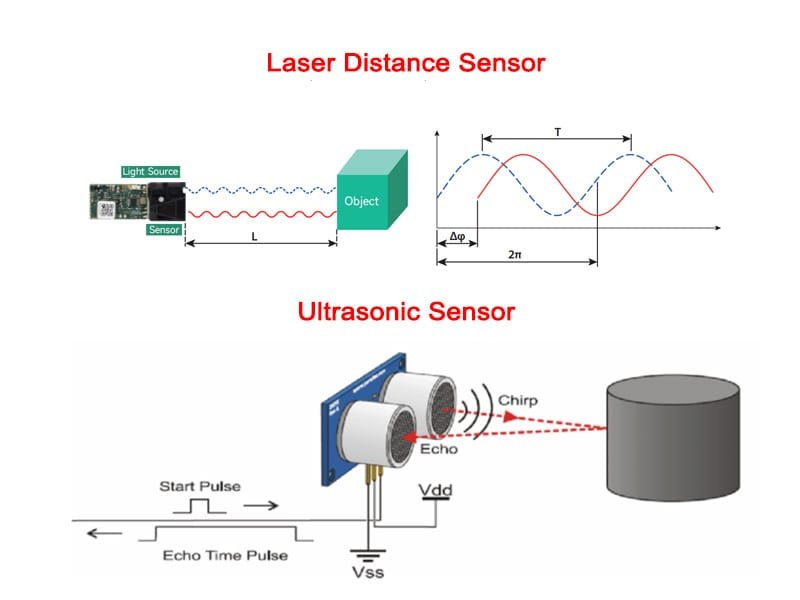
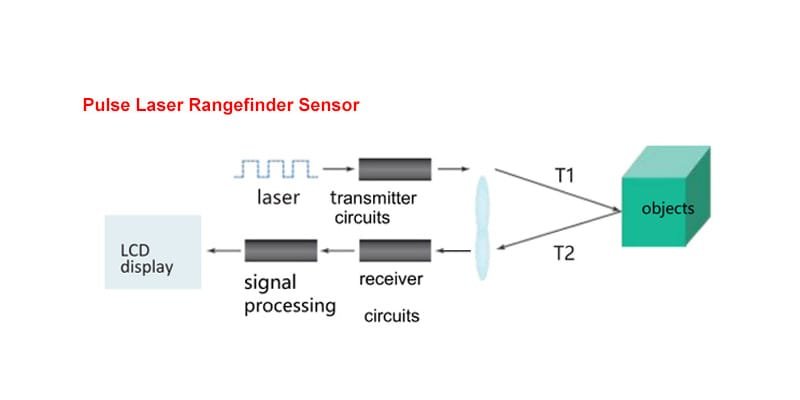
Most laser rangefinders work using one of the following measurement methods:
- Temps de vol (ToF) measurement
- Phase shift measurement
- Pulse laser measurement
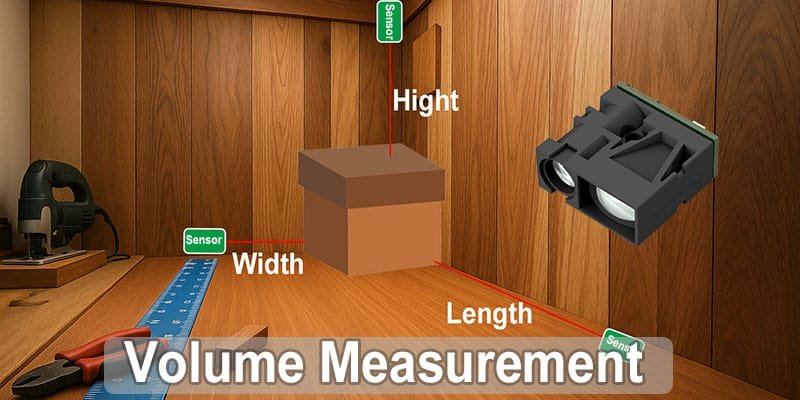
Because the measurement is focused on a single point, the sensor can provide highly accurate and fast distance readings. Many industrial systems rely on laser rangefinders for applications such as equipment positioning, object detection, and level monitoring.
Single-point laser sensors are widely used in industrial automation, robotics systems, and embedded measurement devices due to their compact size and cost efficiency.
What Is LiDAR
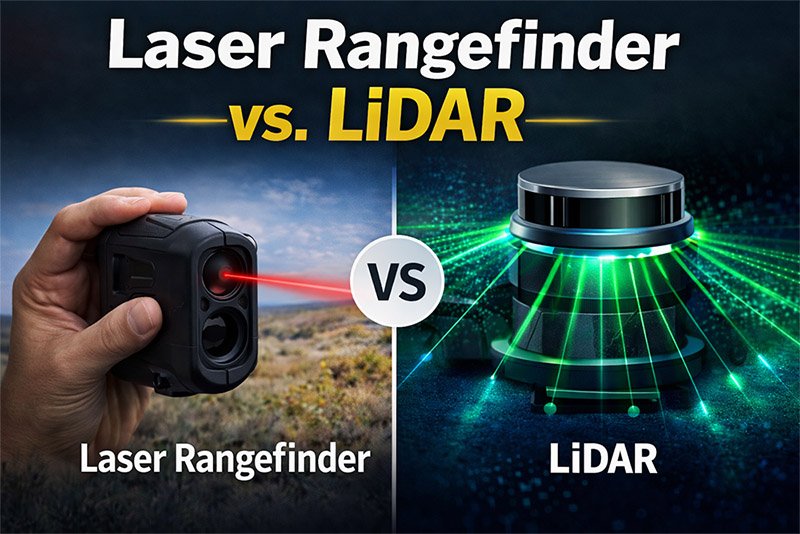
LiDAR (Light Detection and Ranging) is a more complex sensing technology that uses laser pulses to scan an environment and generate a three-dimensional point cloud of the surrounding area.
Instead of measuring distance in only one direction, LiDAR systems use rotating mirrors, scanning mechanisms, or multiple laser emitters to capture thousands or even millions of distance points per second.
This scanning capability allows LiDAR sensors to build detailed environmental maps. Because of this ability, LiDAR is commonly used in applications such as:
- Autonomous vehicles
- 3D mapping and surveying
- Drone terrain scanning
- Environmental monitoring
Compared with a single-point laser rangefinder, LiDAR systems provide spatial awareness rather than simple distance measurement.
Laser Rangefinder vs LiDAR Key Differences
Le difference between laser rangefinder and LiDAR mainly lies in their measurement approach and application scope.
| Fonctionnalité | Laser Rangefinder | LiDAR |
|---|---|---|
| Measurement type | Single point | Balayage multipoint |
| Data output | Distance value | 3D point cloud |
| System complexity | Faible | Haut |
| Power consumption | Faible | Plus élevé |
| Coût | Relatively low | Usually higher |
| Typical applications | Industrial sensing | Mapping and autonomy |
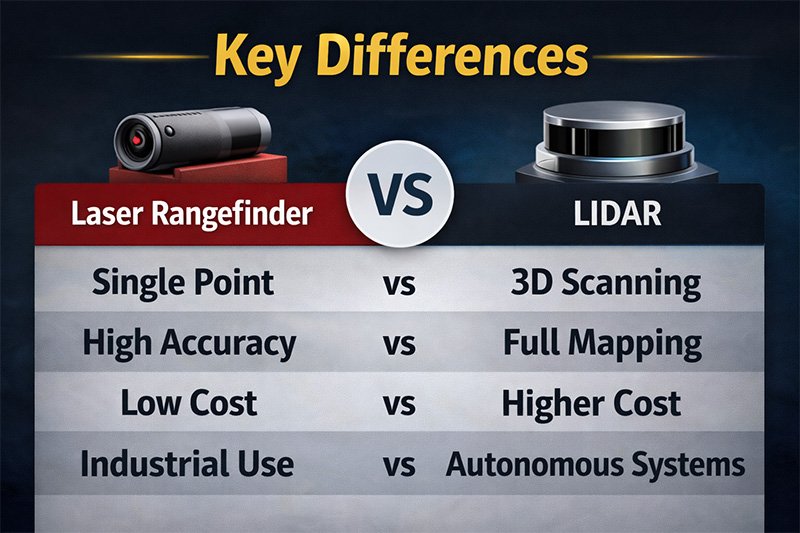
A laser rangefinder focuses on precise point-to-point measurement, while LiDAR provides a comprehensive spatial representation of an environment.
Laser Rangefinder vs LiDAR Accuracy
Accuracy is one of the most common questions when comparing these technologies.
In many industrial sensors, the lidar vs laser rangefinder accuracy comparison depends on the system design and measurement range. High-precision laser rangefinders can achieve millimeter-level accuracy because they measure only a single point.
LiDAR systems prioritize environmental scanning and coverage rather than maximum point accuracy. Although modern LiDAR sensors are highly precise, their accuracy is typically influenced by scanning mechanisms, environmental reflections, and processing algorithms.
Pour les applications nécessitant extremely precise distance measurement, engineers often choose laser rangefinders.
Laser Rangefinder vs LiDAR Applications
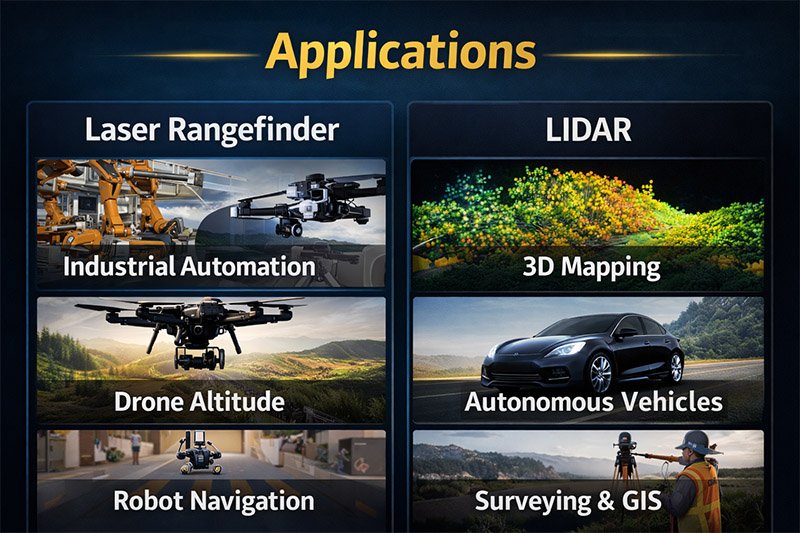
Le laser rangefinder vs lidar applications comparison shows how each technology serves different industries.
Laser rangefinders are commonly used in:
- Industrial automation systems
- Robotics obstacle detection
- UAV altitude measurement
- Warehouse automation
- Smart agriculture equipment
Because they provide direct and reliable distance feedback, these sensors are ideal for control systems and embedded measurement solutions.
LiDAR sensors, on the other hand, are widely used in:
- Autonomous vehicles
- Drone terrain mapping
- Smart city infrastructure
- Geographic surveying
- 3D environmental modeling
These applications require spatial awareness and environmental mapping rather than simple point distance measurement.
Laser Rangefinder vs LiDAR for Drones and Robotics
Both technologies are used in unmanned systems, but they serve different roles.
En laser rangefinder vs lidar for drones, a laser rangefinder is often used for altitude measurement or obstacle detection. Its compact size and lower power consumption make it suitable for small UAV platforms.
LiDAR sensors are typically used when drones need to create terrain models or perform aerial mapping.
Similarly, in robotics systems, the laser rangefinder vs lidar sensor comparison depends on whether the robot needs precise distance feedback or full environmental scanning.
Which One Should You Choose
Choosing between these technologies depends largely on your project requirements.
A télémètre laser is usually the better option if your system requires:
- High precision distance measurement
- Compact sensor size
- Lower power consumption
- Cost-efficient integration
LiDAR sensors are more suitable if the system requires:
- 3D environment mapping
- Large-scale scanning
- Navigation autonome
- Spatial awareness
For many industrial automation systems, a single point laser rangefinder vs lidar comparison often favors the rangefinder because of its simplicity and reliability.
Questions fréquemment posées
Is a laser rangefinder the same as LiDAR?
No. A laser rangefinder measures distance in a single direction, while LiDAR systems scan multiple points to generate a three-dimensional representation of the environment.
Which is more accurate LiDAR or a laser rangefinder?
For single-point measurements, laser rangefinders often provide higher accuracy because they focus on a single beam measurement rather than scanning an entire environment.
When should LiDAR be used instead of a laser rangefinder?
LiDAR should be used when applications require mapping, spatial awareness, or environmental modeling instead of simple distance measurement.
Are laser rangefinders used in industrial automation?
Yes. Laser rangefinders are widely used in industrial automation for object detection, positioning systems, and equipment control.