How to Improve Positioning Accuracy in Automated Storage and Retrieval Systems
Automated Storage and Retrieval Systems (AS/RS) are designed to move goods quickly and accurately within high-density warehouse environments. From retrieving pallets at specific rack locations to transferring materials between different storage levels, every movement requires reliable positioning feedback.
However, maintaining consistent positioning accuracy can be challenging. Mechanical backlash, structural vibration, load variations, rail misalignment, and repeated acceleration and deceleration can all affect the final position of moving equipment.
A laser distance sensor for warehouse positioning fournit non-contact distance measurement that can help automated equipment monitor its actual position and improve motion control. When integrated into an appropriate control architecture, laser measurement technology can support more consistent positioning of stacker cranes, vertical lifting mechanisms, and other automated warehouse equipment.
1. Why Positioning Accuracy Matters in Automated Warehouses
In a modern automated warehouse, stacker cranes travel horizontally along narrow aisles while lifting mechanisms move vertically to reach designated storage locations.
Both axes must operate in coordination. Even a small positioning deviation may cause difficulties when aligning forks with pallet openings, accessing rack compartments, or transferring goods between conveyors and storage positions.
Several factors can contribute to positioning errors:
- Mechanical backlash: Wear in gears, drive systems, and transmission components can create differences between commanded movement and actual displacement.
- Structural vibration: Acceleration, deceleration, and changes in load can introduce temporary movement or oscillation.
- Rail alignment deviations: Uneven rails or installation tolerances can affect the actual travel position of the crane.
- Load variations: Different pallet weights may influence mechanical deflection and lifting behavior.
- Position feedback limitations: If a control system relies only on motor rotation or preset movement values, mechanical deviations may not be fully reflected in the calculated position.
For warehouse operators, these issues can lead to inaccurate pallet placement, additional positioning corrections, longer operating cycles, and unnecessary mechanical stress.
Improving positioning accuracy therefore requires more than precise motor control. It also requires reliable measurement of the equipment’s actual movement.
2. How a Laser Distance Sensor for Warehouse Positioning Works
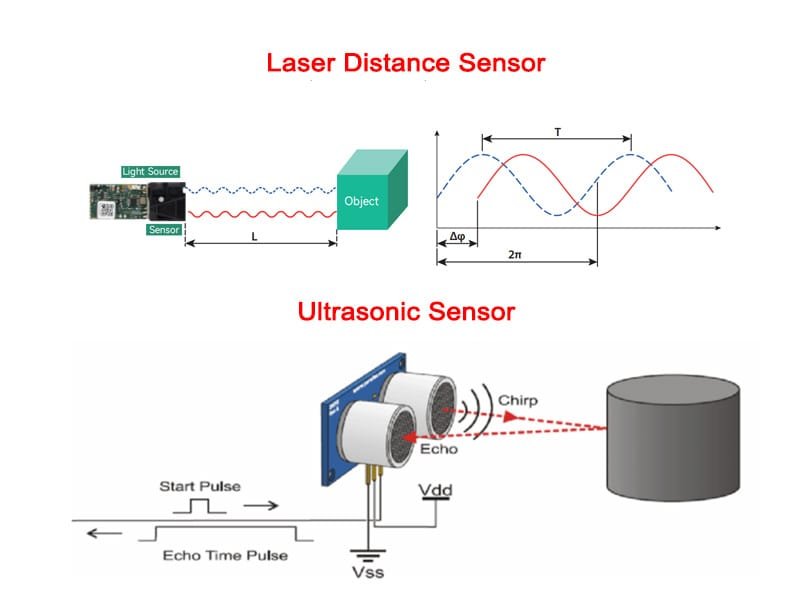
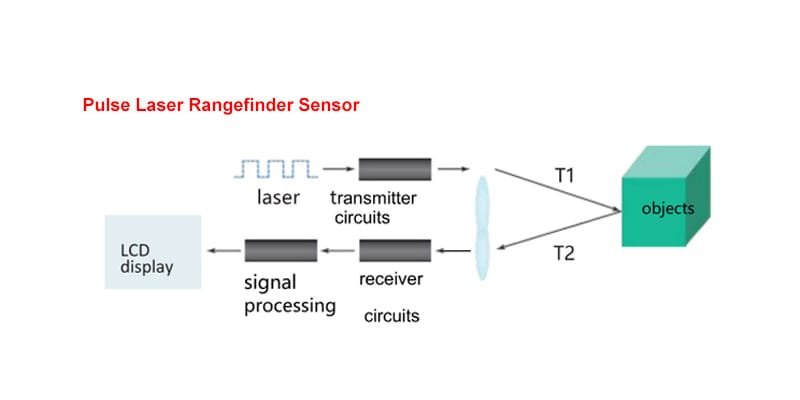
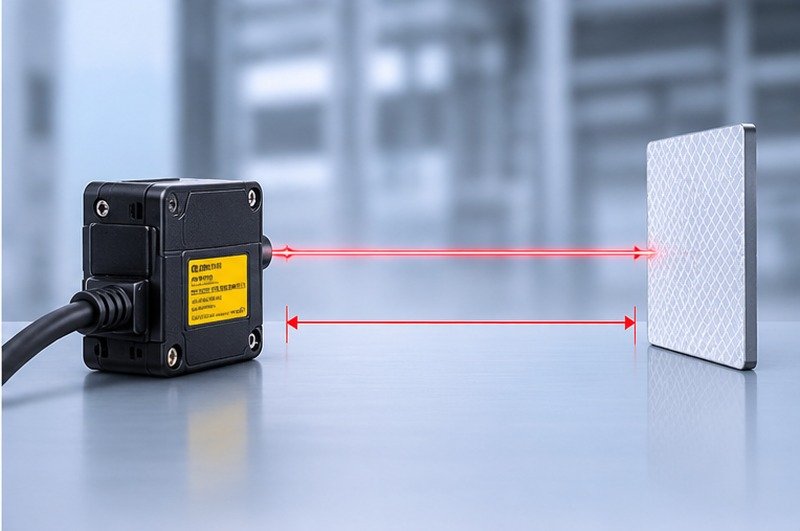
A capteur de distance laser measures the distance between the sensor and a target surface by transmitting a laser beam and analyzing the reflected light.
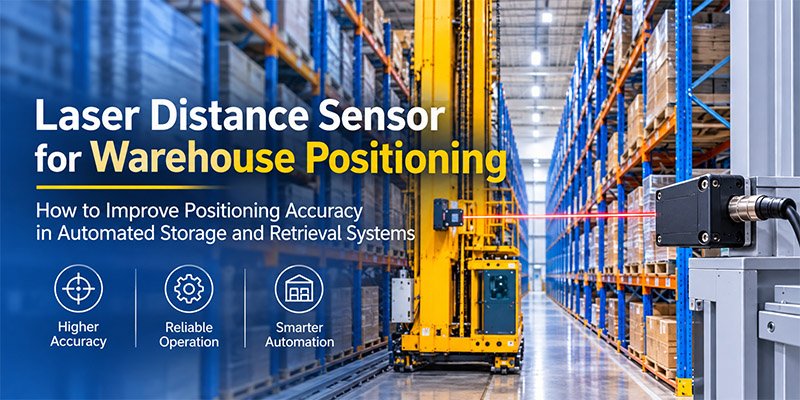
In a typical warehouse positioning application, the sensor is installed on a moving machine component and directed toward a fixed reference surface. As the equipment moves, the measured distance changes accordingly.
The control system can use these readings to determine the machine’s relative position and compare it with the target position.
A typical measurement and control process involves:
- The warehouse controller sends a movement command to the stacker crane or lifting mechanism.
- The drive system moves the equipment toward the designated position.
- The laser distance sensor continuously measures the distance to a fixed reference.
- The measurement data is transmitted to the controller through a compatible communication interface.
- The controller compares the measured position with the target position and adjusts movement when necessary.
This approach provides an additional measurement reference beyond motor rotation feedback.
A laser distance sensor for warehouse positioning is particularly useful when the system requires non-contact measurement, continuous distance feedback, or independent verification of equipment movement.
3. Key Applications in Automated Storage and Retrieval Systems
3.1 Horizontal Positioning of Stacker Cranes
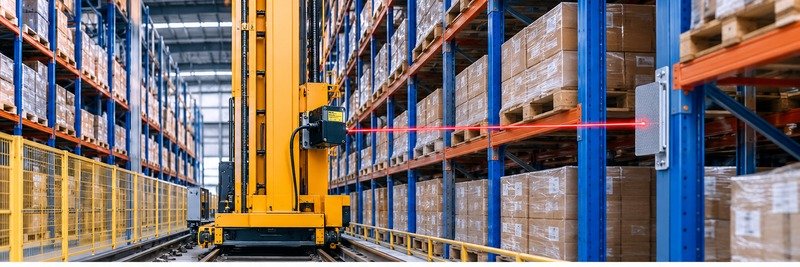
Stacker cranes move along warehouse aisles to access designated storage locations. Accurate horizontal positioning is essential for aligning the crane with the correct rack column.
A laser distance sensor can be mounted on the traveling crane and aimed at a fixed reflector or reference surface at the end of the aisle.
By monitoring the changing distance, the controller can obtain real-time position information during crane movement.
This measurement method can support:
- Accurate stopping at designated rack positions.
- Verification of actual travel distance.
- Reduction of positioning deviations caused by mechanical transmission errors.
- More consistent positioning during repeated storage and retrieval cycles.
For systems with long travel distances, the required measuring range, installation geometry, target reflectivity, and environmental conditions should be evaluated before selecting a sensor.
3.2 Vertical Positioning of Lifting Mechanisms
The vertical lifting mechanism is another critical component of an automated warehouse.
During pallet handling, the lifting platform must reach the correct height to align with different storage levels. Inaccurate height positioning may interfere with pallet transfer or increase the risk of contact with surrounding rack structures.
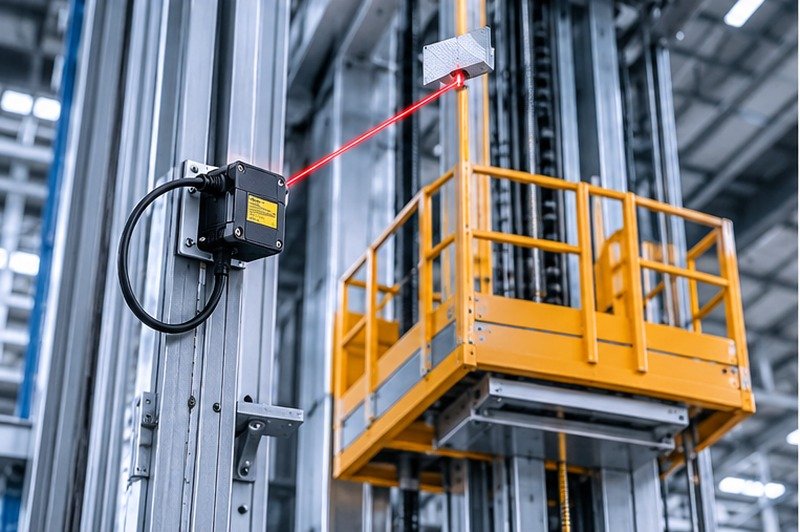
Installing a laser distance sensor to measure the vertical displacement of the lifting mechanism provides an additional source of position feedback.
The controller can compare the measured distance with predefined height references, helping the system identify deviations and make positioning adjustments.
For applications involving multiple storage levels, measurement stability and repeatability are particularly important because the lifting mechanism may perform thousands of movement cycles over its service life.
3.3 Position Verification at Pallet Transfer Stations
Pallet transfer stations connect automated storage equipment with conveyors, loading areas, and other material handling systems.
Accurate positioning is necessary to ensure that pallets are transferred at the correct height and horizontal location.
A laser distance measurement system can monitor the position of moving platforms or mechanical transfer components. The measured data can then be used by the control system to verify whether the equipment has reached its designated position.
This is especially relevant in automated warehouses where multiple machines and transfer mechanisms must operate in coordination.
4. What to Consider When Selecting a Laser Distance Sensor
Choisir le bon laser distance sensor for warehouse positioning requires more than comparing maximum measuring distances or advertised accuracy specifications.
Engineers should evaluate the complete operating environment and the control requirements of the equipment.
Plage de mesure
Determine the maximum distance between the sensor and its reference target throughout the machine’s movement.
The selected measuring range should cover the full operating distance while providing sufficient margin for installation tolerances and operating variations.
Measurement Accuracy and Repeatability
Accuracy and repeatability are two different performance characteristics.
Accuracy describes how closely a measurement approaches the actual distance, while repeatability describes how consistently the sensor produces readings under the same conditions.
For automated warehouse equipment, both parameters matter. A sensor may provide good repeatability without necessarily eliminating systematic measurement errors.
The required specifications should be determined according to the positioning tolerance of the actual machine.
Measurement Frequency
The measurement frequency determines how frequently the sensor updates its distance readings.
For equipment operating at higher travel speeds, a suitable measurement frequency helps the controller receive position updates more frequently.
However, the complete system response also depends on communication latency, controller processing time, and drive response.
Interface de communication
The sensor must be compatible with the warehouse control architecture.
Depending on the selected model, industrial measurement devices may support interfaces such as RS485, RS232, or UART.
Engineers should confirm communication protocols, baud rates, wiring requirements, and controller compatibility before integration.
Installation and Environmental Conditions
Warehouse environments may contain dust, vibration, changing temperatures, and reflective metal structures.
The sensor should be mounted securely, with its optical axis aligned toward a suitable measurement target.
Target surface properties, ambient light, mounting stability, and potential obstructions should also be considered during system design.
5. How to Improve Repeatable Positioning Performance
Installing a capteur laser alone does not guarantee accurate warehouse positioning. The measurement system, mechanical structure, and motion control strategy must work together.
The following practices can help improve overall positioning performance:
Establish a reliable reference point. Use a stable reference surface and ensure that the sensor mounting position does not change during machine operation.
Calibrate the measurement system. Compare sensor readings against known reference positions across the operating range. This helps identify installation offsets and systematic measurement deviations.
Use appropriate deceleration control. The controller should account for machine speed, braking distance, and mechanical response when approaching a target position.
Evaluate measurements under different loads. Test the system with representative pallet weights to identify potential mechanical deflection or vibration.
Monitor long-term measurement consistency. Record positioning data over repeated operating cycles to identify gradual changes caused by mechanical wear, mounting movement, or environmental conditions.
These measures help engineers distinguish between sensor measurement errors and positioning deviations originating from the mechanical or control system.
6. Why Laser Measurement Is Valuable for Warehouse Automation
Compared with purely mechanical position references, laser distance measurement offers a non-contact method of monitoring equipment displacement.
It can provide several practical advantages:
- Non-contact measurement: No physical contact with the moving equipment is required.
- Continuous distance feedback: The control system can receive measurement updates during equipment movement.
- Flexible installation: Sensors can be installed at suitable reference positions depending on machine geometry.
- Position verification: Measured distances can be compared with commanded positions to identify deviations.
- Flexibilité d'intégration : Compatible sensor interfaces can be incorporated into different automation control architectures.
A laser distance sensor for warehouse positioning can therefore serve as an important measurement component in automated material handling systems, particularly where reliable distance feedback and repeatable movement are required.
Conclusion
Positioning accuracy is a fundamental requirement for modern Automated Storage and Retrieval Systems. Stacker cranes, vertical lifting mechanisms, and pallet transfer equipment all depend on reliable position information to operate consistently.
By introducing laser distance measurement into the control architecture, warehouse engineers can obtain an additional reference for monitoring actual equipment movement, verifying target positions, and identifying positioning deviations.
The most suitable laser distance sensor for warehouse positioning depends on the required measuring range, accuracy, repeatability, measurement frequency, communication interface, and installation environment.
For system integrators and automation equipment manufacturers, evaluating these factors early in the design process can help create more reliable and consistent warehouse positioning systems.
Questions fréquemment posées
1. How does a laser distance sensor improve warehouse positioning accuracy?
A laser distance sensor measures the distance between moving equipment and a fixed reference target. The controller can use this information to monitor actual displacement, compare it with the commanded position, and make positioning corrections when required.
2. Can a laser distance sensor be used on an automated stacker crane?
Yes. Depending on its measuring range, accuracy, response frequency, and installation conditions, a laser distance sensor can be used to monitor the horizontal travel position of an automated stacker crane.
3. Can laser distance sensors measure the vertical position of warehouse lifts?
Yes. A suitably selected sensor can measure the distance between a moving lifting platform and a fixed reference surface, providing measurement data for vertical position monitoring.
4. What is more important for warehouse positioning: accuracy or repeatability?
Both are important. Accuracy determines how close the measured position is to the actual position, while repeatability indicates how consistently the same position can be measured over repeated cycles. The required performance depends on the machine’s positioning tolerance.
5. Can a laser distance sensor replace a motor encoder?
Not necessarily. A laser distance sensor can provide independent distance feedback, while a motor encoder measures motor rotation or displacement within the drive system. In many applications, combining both technologies provides more complete positioning information.
6. What should engineers consider when selecting a warehouse positioning sensor?
Important factors include measuring range, accuracy, repeatability, measurement frequency, communication interface, target reflectivity, installation geometry, and environmental conditions.
Need a Laser Distance Measurement Solution for Warehouse Automation?
Meskernel provides laser distance measurement modules and industrial laser sensor solutions for different automation and positioning applications.
If you are developing an automated storage system, stacker crane, or vertical lifting mechanism, contact our engineering team to discuss your measuring range, accuracy, and integration requirements.