How Laser Spot Size Affects Laser Distance Sensor Accuracy
Introducción
In modern industrial automation, robotics, UAV systems, and smart measurement equipment, achieving high Laser Distance Sensor Accuracy is critical for reliable performance. While many users focus on parameters such as measuring range, refresh rate, or resolution, one important factor is often overlooked: laser spot size.
The size of the laser spot directly affects how accurately a sensor can detect and measure a target surface. Whether measuring reflective materials, dark objects, or long-range targets, the relationship between laser spot size and measurement precision plays a major role in overall system performance.
This article explains how laser spot size impacts measurement quality, why beam divergence matters, and how to optimize sensor selection for better accuracy in real-world applications.
What Is Laser Spot Size?
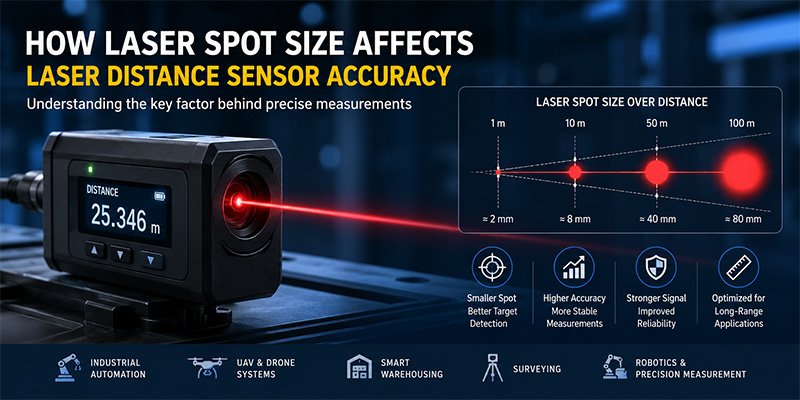
Laser spot size refers to the diameter of the laser beam when it reaches the target surface. As the beam travels farther from the sensor, it naturally expands due to beam divergence.
A smaller laser spot concentrates more optical energy on a specific point, allowing the sensor to measure smaller objects with greater precision. A larger spot covers a wider area, which may reduce accuracy when measuring edges, uneven surfaces, or small targets.
Por ejemplo:
- At short distances, the laser spot may only be a few millimeters wide.
- At long distances, the same beam can expand significantly.
- Different optical designs produce different spot sizes and divergence angles.
Understanding spot size is essential when evaluating Laser Distance Sensor Accuracy in industrial and outdoor environments.
Why Laser Spot Size Matters for Measurement Accuracy
1. Target Detection Precision
A smaller laser spot improves the sensor’s ability to isolate the intended target. When measuring narrow objects, wires, corners, or small components, a large spot may partially hit the background, causing unstable readings.
Para high-precision applications, minimizing the spot size helps maintain consistent measurement results.
Industries that benefit from small spot measurement include:
- Automatización industrial
- PCB positioning
- Robotic arm alignment
- Warehouse automation
- Precision manufacturing
In these scenarios, improving Laser Distance Sensor Accuracy depends heavily on precise beam control.
Beam Divergence and Long-Range Measurement
Beam divergence describes how quickly a laser beam spreads over distance. Lower divergence means the beam stays concentrated longer, resulting in better long-range performance.
Por ejemplo:
- A low-divergence laser maintains a smaller spot at 100 meters.
- A high-divergence beam becomes larger and weaker at the same distance.
This directly affects:
- Signal strength
- Reflection quality
- Measurement stability
- Detection reliability
Long-range systems such as UAV laser ranging modules, surveying equipment, and security systems require controlled divergence to maintain reliable Laser Distance Sensor Accuracy.
Surface Conditions Also Affect Accuracy
Laser spot size interacts closely with target surface characteristics. Different materials reflect laser light differently, influencing sensor performance.
Reflective Surfaces
Highly reflective targets usually return stronger signals. However, if the laser spot becomes too large, reflections may scatter unevenly, especially on curved or polished surfaces.
Dark or Absorptive Materials
Dark objects absorb more laser energy, reducing return signal strength. In these situations, a concentrated laser spot helps improve signal detection.
Rough or Uneven Surfaces
When the spot covers multiple surface angles at once, the returned signal may fluctuate. A smaller spot reduces this effect and improves measurement consistency.
Selecting the correct beam size helps optimize Laser Distance Sensor Accuracy across varying environmental conditions.
The Relationship Between Spot Size and Measurement Distance
As measuring distance increases, spot size expansion becomes more noticeable. This is especially important in outdoor and industrial applications where targets are located far from the sensor.
Por ejemplo:
| Distance | Approximate Spot Size |
|---|---|
| 1 meter | Small |
| 10 meters | Medio |
| 100 metros | Much larger |
If the laser spot becomes larger than the target itself, the sensor may receive reflections from surrounding objects. This can create:
- Measurement drift
- Reduced precision
- False target detection
- Unstable data output
To maintain stable Laser Distance Sensor Accuracy, engineers often select sensors with optimized optics and low divergence rates.
How High-Accuracy Laser Sensors Reduce Spot Size Problems
Moderno high-performance laser sensors use advanced optical systems to improve measurement quality.
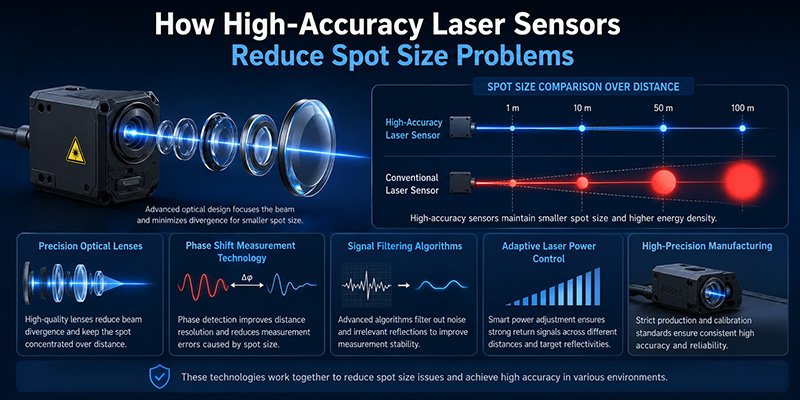
Key technologies include:
Precision Optical Lenses
Improved lens systems help focus the beam more effectively and reduce divergence.
Phase Shift Measurement Technology
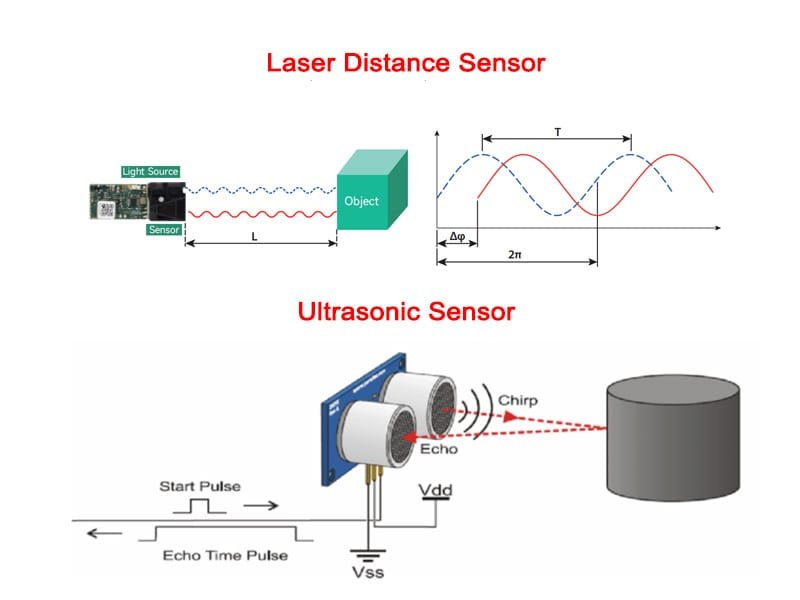
Phase-based laser distance sensors can achieve millimeter-level accuracy by analyzing phase differences in returned laser signals.
Signal Filtering Algorithms
Advanced processing algorithms remove background noise and improve target recognition.
Adaptive Laser Power Control
Some sensors automatically adjust laser output depending on distance and target reflectivity.
These technologies significantly improve Laser Distance Sensor Accuracy in demanding applications.
Applications Where Spot Size Is Critical
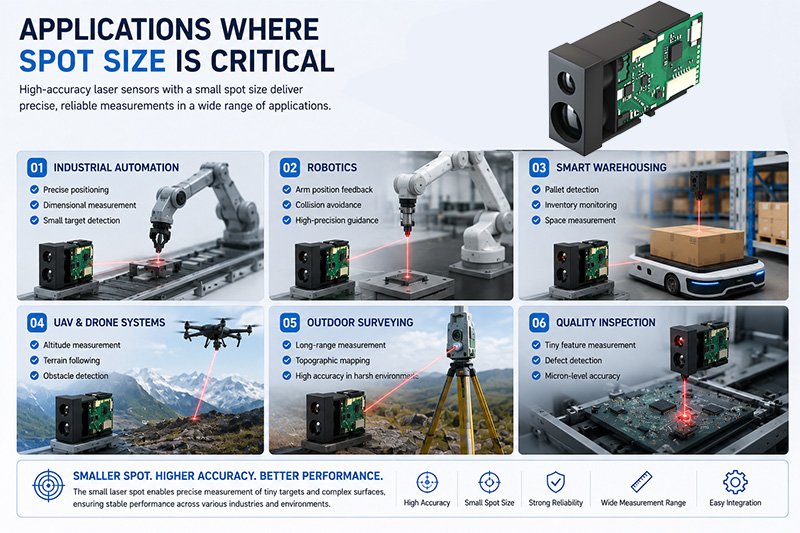
Automatización industrial
Factories use laser sensors for positioning, quality inspection, and object detection. Small spot sizes improve edge detection and alignment precision.
UAV and Drone Systems
Compact laser rangefinder modules used in UAVs require stable long-range performance. Beam divergence control becomes extremely important during aerial measurements.
Smart Warehousing
Automated logistics systems rely on accurate object positioning. Poor spot control can affect navigation and inventory tracking.
Robótica
Robotic systems often measure complex surfaces or moving targets. High-precision beam focusing improves response accuracy.
Topografía exterior
Surveying equipment operating at long distances benefits from narrow laser beams that maintain signal integrity.
In all these industries, maintaining reliable Laser Distance Sensor Accuracy is essential for operational efficiency.
Choosing the Right Laser Sensor for Better Accuracy
Al seleccionar un sensor láser de distancia, users should evaluate more than just measuring range.
Important factors include:
- Laser spot size
- Beam divergence angle
- Target material compatibility
- Measurement frequency
- Environmental adaptability
- Optical system quality
A sensor with optimized optics and stable beam control usually delivers better long-term performance.
For applications involving small targets or long distances, selecting a sensor with low divergence and high signal stability is especially important.
Future Trends in Laser Distance Measurement
As industrial automation and intelligent sensing technologies continue to evolve, laser sensors are becoming smaller, faster, and more accurate.
Future developments may include:
- AI-assisted signal processing
- Adaptive beam shaping
- Improved anti-interference capability
- Enhanced outdoor ranging performance
- Ultra-compact high-precision modules
Manufacturers are increasingly focusing on improving Laser Distance Sensor Accuracy while reducing sensor size and power consumption.
This trend is especially important in robotics, autonomous vehicles, UAV systems, and smart manufacturing applications.
Conclusión
Laser spot size is one of the most important factors influencing measurement performance. A properly controlled beam improves target detection, enhances signal stability, and supports more precise ranging results.
Whether used in industrial automation, robotics, UAV systems, or smart logistics, understanding the relationship between spot size and measurement quality helps users choose the right sensor for their applications.
As laser technology continues to advance, optimizing beam divergence and optical performance will remain essential for achieving high Laser Distance Sensor Accuracy in modern sensing systems.
FAQ
What is laser spot size?
Laser spot size is the diameter of the laser beam when it reaches the target surface.
Why does spot size affect measurement accuracy?
A larger spot may detect surrounding objects or uneven surfaces, reducing precision.
What is beam divergence?
Beam divergence describes how much a laser beam expands over distance.
Which applications need small laser spot sizes?
Industrial automation, robotics, UAV systems, and precision positioning applications benefit most from smaller spots.
How can I improve laser distance sensor accuracy?
Choose sensors with low beam divergence, high-quality optics, and stable signal processing technology.ccuracy