Time of Flight Sensors: A Complete Guide to iTOF and dTOF Technologies
As automation, robotics, smart devices, and industrial measurement systems continue to evolve, Time of Flight Sensors are becoming increasingly important in modern sensing applications. From smartphones and autonomous robots to industrial automation and smart logistics, TOF technology provides highly accurate distance measurement and depth sensing capabilities.
Among the most widely discussed technologies today are the time of flight tof sensor solutions based on Indirect Time of Flight (iTOF) and Direct Time of Flight (dTOF) principles. While both technologies measure distance using light, they operate differently and are suitable for different applications.
In this article, we will explore how Time of Flight Sensors work, compare iTOF and dTOF technologies, discuss their advantages, and explain their most common application scenarios.

What Are Time of Flight Sensors?
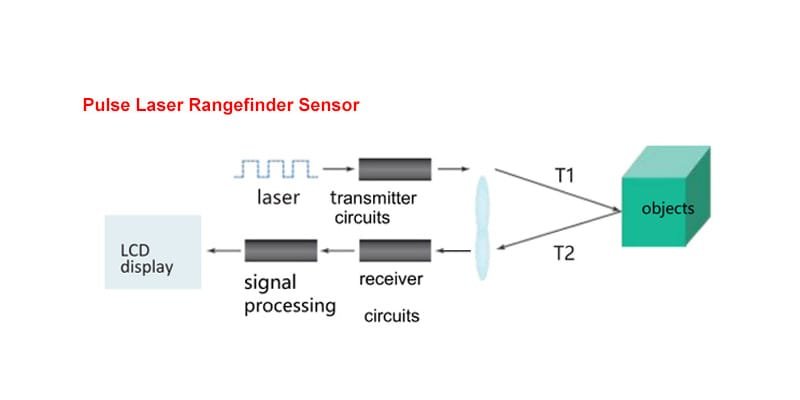
A Time of Flight Sensor measures the distance between the sensor and an object by calculating the time it takes for emitted light to travel to the object and return to the receiver.
The basic working process includes:
- The sensor emits a laser or infrared light pulse.
- The light reflects off the target object.
- The reflected light returns to the sensor.
- The sensor calculates the travel time and converts it into distance information.
The distance calculation is based on the speed of light:
d=c×t2d=\frac{c\times t}{2}d=2c×t
Where:
- ddd = distance
- ccc = speed of light
- ttt = round-trip travel time
Because light travels extremely fast, TOF systems require highly precise timing and signal processing technologies.
Main Types of Time of Flight TOF Sensor Technologies
Modern TOF systems are mainly divided into two categories:
- Indirect Time of Flight (iTOF)
- Direct Time of Flight (dTOF)
Each technology has unique advantages, limitations, and target applications.
What Is iTOF (Indirect Time of Flight)?
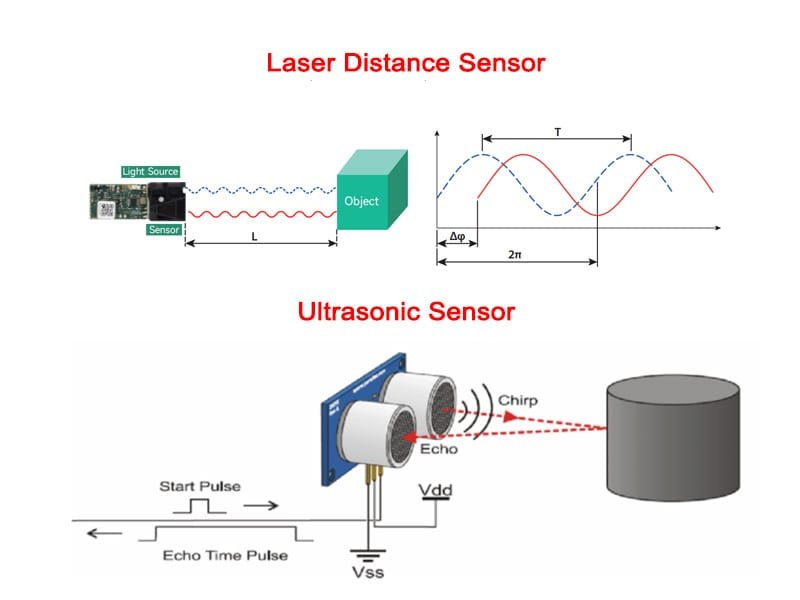
Indirect Time of Flight technology measures distance by calculating the phase difference between emitted and reflected light waves instead of directly measuring travel time.
In iTOF systems:
- The emitted light is modulated continuously.
- The reflected signal returns with a phase shift.
- The sensor calculates the distance using the phase difference.
iTOF sensors are commonly used in short-range and medium-range depth sensing applications because they provide high frame rates and relatively low manufacturing costs.
Advantages of iTOF Sensors
1. High-Speed Depth Mapping
iTOF sensors can capture depth information quickly, making them ideal for real-time applications.
2. Lower System Cost
Compared with dTOF systems, iTOF solutions are often more affordable and easier to integrate into consumer electronics.
3. Compact Design
iTOF modules are typically small and lightweight, suitable for smartphones, tablets, and portable devices.
4. Good Indoor Performance
They perform well in controlled indoor environments with moderate lighting conditions.
Common Applications of iTOF Sensors
Smartphone Face Recognition
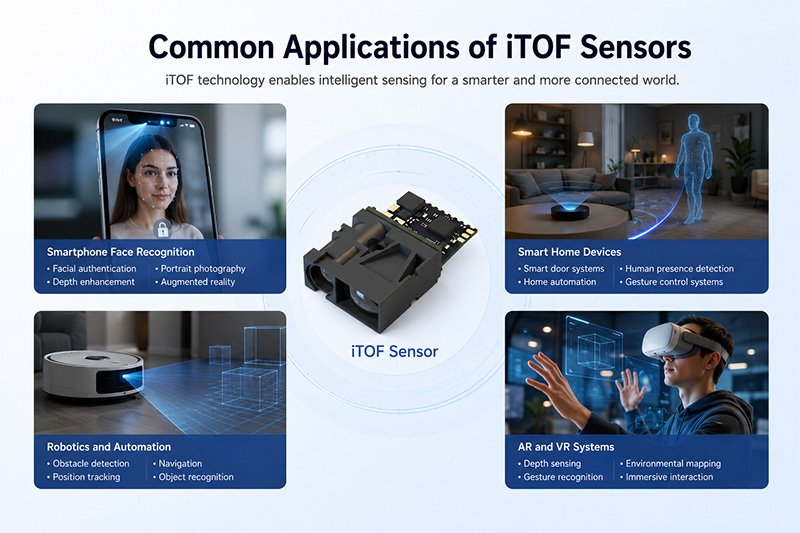
Many smartphones use iTOF technology for:
- Facial recognition
- Portrait photography
- AR depth mapping
- Gesture recognition
Consumer Electronics
iTOF sensors are widely integrated into:
- Smart home devices
- Gaming systems
- VR/AR headsets
- Service robots
Industrial Automation
In factories, iTOF sensors assist with:
- Object detection
- Positioning systems
- Short-range automation
- Conveyor monitoring
Human Presence Detection
Modern smart buildings use iTOF technology for:
- Occupancy detection
- Automatic lighting
- Energy-saving systems
- Security monitoring
What Is dTOF (Direct Time of Flight)?
Direct Time of Flight technology measures the actual travel time of individual light pulses. Instead of calculating phase differences, dTOF directly detects how long the laser pulse takes to return from the target.
This method offers superior long-range measurement performance and higher accuracy in challenging environments.
dTOF systems are commonly used in:
- LiDAR
- Autonomous vehicles
- Industrial laser rangefinders
- Robotics
- UAVs
Advantages of dTOF Sensors
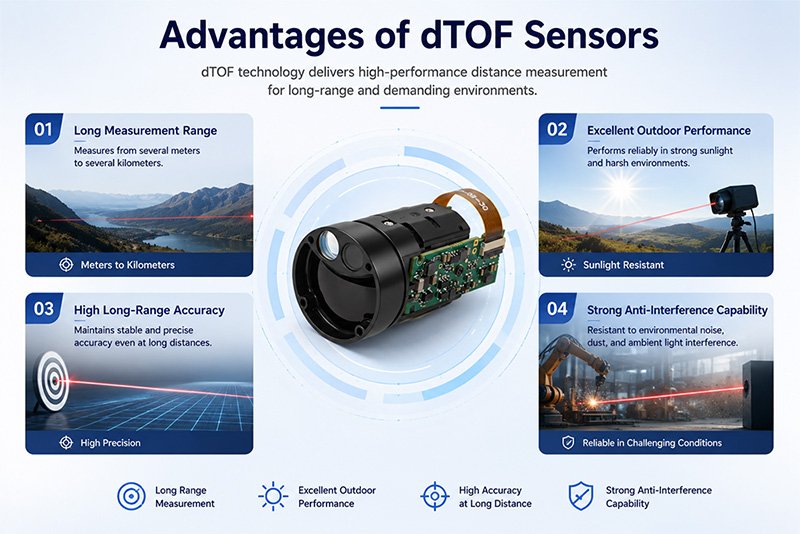
1. Longer Measurement Distance
dTOF sensors can achieve significantly longer detection ranges compared with iTOF systems.
Some industrial-grade dTOF laser rangefinder modules can measure distances from several meters to several kilometers.
2. Higher Outdoor Performance
dTOF technology performs better under strong sunlight and harsh outdoor environments.
3. Better Accuracy at Long Distances
Because the system directly measures pulse travel time, dTOF sensors can maintain stable accuracy over longer ranges.
4. Strong Anti-Interference Capability
dTOF systems are more resistant to environmental noise and ambient light interference.
Common Applications of dTOF Sensors
LiDAR Systems
dTOF technology is widely used in LiDAR solutions for:
- Autonomous vehicles
- Mapping systems
- Obstacle avoidance
- Terrain scanning
UAV Laser Rangefinding
Drones equipped with dTOF laser modules can perform:
- Altitude measurement
- Terrain following
- Target positioning
- Agricultural surveying
Industrial Laser Distance Measurement
Factories and warehouses use dTOF sensors for:
- Crane positioning
- AGV navigation
- Long-distance object measurement
- Industrial automation
Smart Transportation
dTOF sensors support:
- Traffic monitoring
- Vehicle detection
- Intelligent transportation systems
- Toll systems
iTOF vs dTOF: Key Differences
| Feature | iTOF | dTOF |
|---|---|---|
| Measurement Principle | Phase shift calculation | Direct pulse timing |
| Typical Range | Short to medium | Medium to long |
| Outdoor Performance | Moderate | Excellent |
| Frame Rate | High | Moderate |
| System Cost | Lower | Higher |
| Accuracy at Long Range | Limited | Strong |
| Power Consumption | Lower | Higher |
| Main Applications | Consumer electronics | LiDAR and industrial systems |
Choosing the Right Time of Flight TOF Sensor
Selecting the correct TOF sensor depends on the application requirements.
Choose iTOF When You Need:
- High-speed depth imaging
- Short-range sensing
- Compact size
- Cost-effective solutions
- Indoor applications
Choose dTOF When You Need:
- Long-distance measurement
- Outdoor operation
- High precision over distance
- Strong sunlight resistance
- Industrial-grade performance
For example, smartphones and AR devices usually favor iTOF technology, while industrial laser rangefinder modules and autonomous navigation systems typically rely on dTOF solutions.
Future Trends of Time of Flight Sensors
The market for Time of Flight Sensors continues to expand rapidly due to increasing demand for automation and intelligent sensing.
Several major trends are shaping the industry:
AI Integration
Future TOF systems will increasingly combine with AI algorithms for smarter object recognition and scene analysis.
Miniaturization
Manufacturers are continuously reducing sensor size while improving performance.
Higher Accuracy
Advanced signal processing and laser technologies are improving precision and stability.
Multi-Sensor Fusion
TOF sensors are being integrated with:
- Cameras
- Radar
- Ultrasonic sensors
- IMU systems
to create more reliable sensing platforms.
Why Time of Flight Sensors Are Important
Time of Flight technology offers several major advantages over traditional distance sensing methods:
- Fast response speed
- Non-contact measurement
- High accuracy
- Real-time depth perception
- Strong adaptability
As industries continue moving toward automation and intelligent systems, the demand for reliable time of flight tof sensor solutions will continue growing across consumer electronics, robotics, industrial automation, transportation, and smart infrastructure.
FAQ
What is a Time of Flight Sensor?
A Time of Flight Sensor measures distance by calculating how long light takes to travel to an object and back.
What is the difference between iTOF and dTOF?
iTOF uses phase difference calculations, while dTOF directly measures pulse travel time.
Which is better for long-distance measurement?
dTOF technology is generally better for long-range and outdoor measurement applications.
Are TOF sensors suitable for outdoor use?
Yes. dTOF sensors especially perform well in outdoor and high-brightness environments.
Where are TOF sensors commonly used?
TOF sensors are widely used in smartphones, robotics, LiDAR, industrial automation, drones, and smart transportation systems.