1535nm vs 905nm Laser Rangefinder Module: Key Differences and Applications
Laser rangefinder technology is widely used in UAVs, thermal imaging systems, night vision equipment, robotics, surveying instruments, and long-distance measurement systems. Among the different wavelengths available today, 905nm and 1535nm are two important choices for engineers designing compact and high-performance ranging systems.
Choosing between a 905nm laser rangefinder and a 1535nm solution is not simply a matter of selecting the longer wavelength. The right option depends on measurement distance, eye-safety requirements, target characteristics, atmospheric conditions, system size, cost, and application requirements.
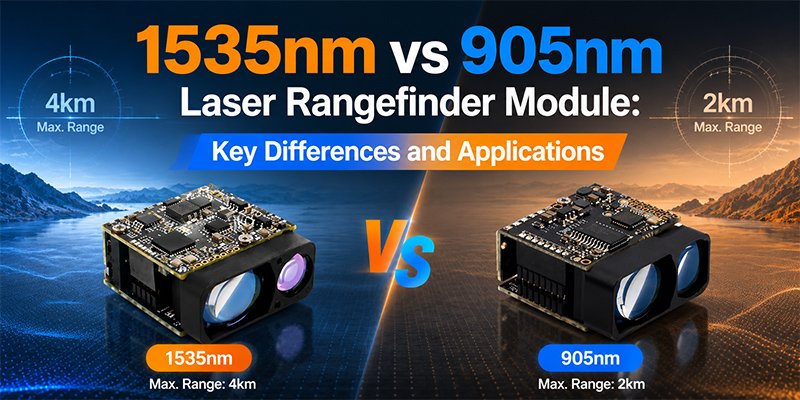
This article compares 905nm and 1535nm laser rangefinder modules and explains where each technology can provide the most practical advantages.
What Is a 905nm Laser Rangefinder?
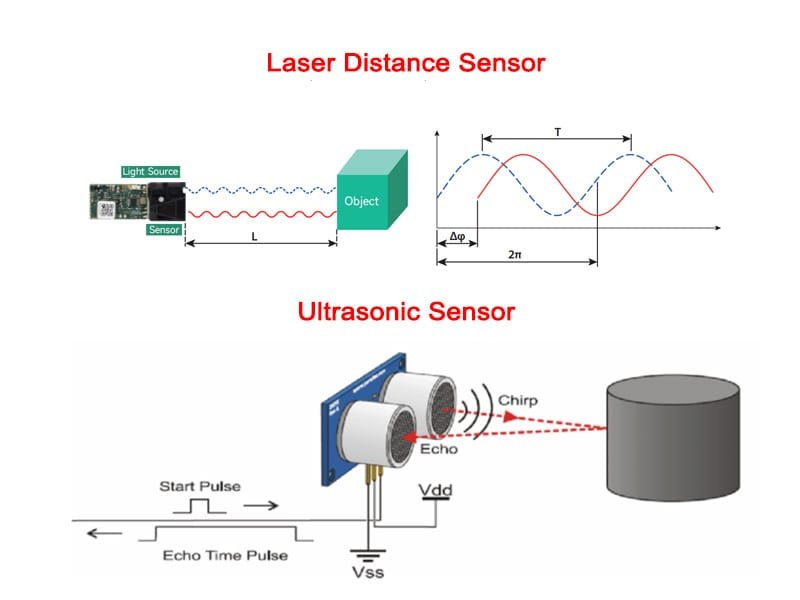
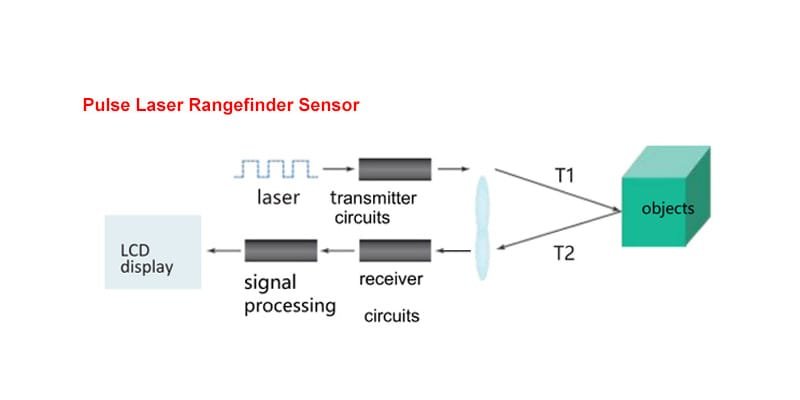
A 905nm laser rangefinder uses a near-infrared laser wavelength around 905nm to measure the distance between the module and a target. The system typically sends a short laser pulse toward the target, receives the reflected optical signal, and calculates distance according to the signal’s time of flight.
A 905nm laser rangefinder is popular because 905nm laser technology can provide a useful balance between ranging performance, module size, system cost, and integration flexibility. It is particularly suitable for applications that require a compact ranging sensor with a relatively long measurement distance.
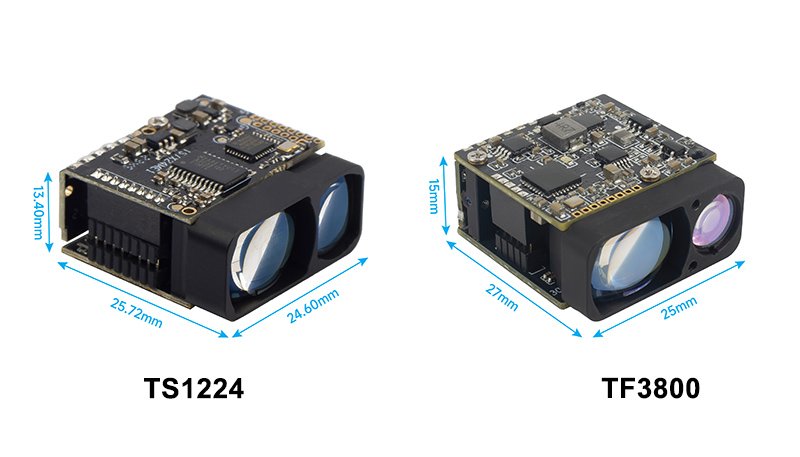
For example, the Meskernel TS1224 is a 905nm Laser-Entfernungsmesser-Modul designed for long-distance applications, with a maximum measurement distance of up to 2km. Its compact module design makes it suitable for integration into systems such as UAV payloads, thermal imaging equipment, and night vision devices.
For engineers looking for a practical long-range solution without moving to a more specialized 1535nm architecture, a 905nm laser rangefinder can be an attractive option.
What Is a 1535nm Laser Rangefinder?
A 1535nm Laser Rangefinder operates at a significantly longer infrared wavelength. This wavelength is commonly associated with long-distance ranging applications where eye-safety considerations and extended measurement capability are important design factors.
Compared with a 905nm system, a 1535nm Laser Rangefinder can offer different system-level advantages, particularly for demanding long-range electro-optical applications. However, wavelength alone does not determine the final measurement distance or accuracy. Optical design, laser energy, detector sensitivity, target reflectivity, atmospheric conditions, signal processing, and system architecture all influence actual performance.
Meskernel’s TF3800 is an example of a 1535nm long-range laser rangefinder solution, with a maximum measurement distance of up to 4km. This makes it suitable for applications where a longer measurement range is a major system requirement.
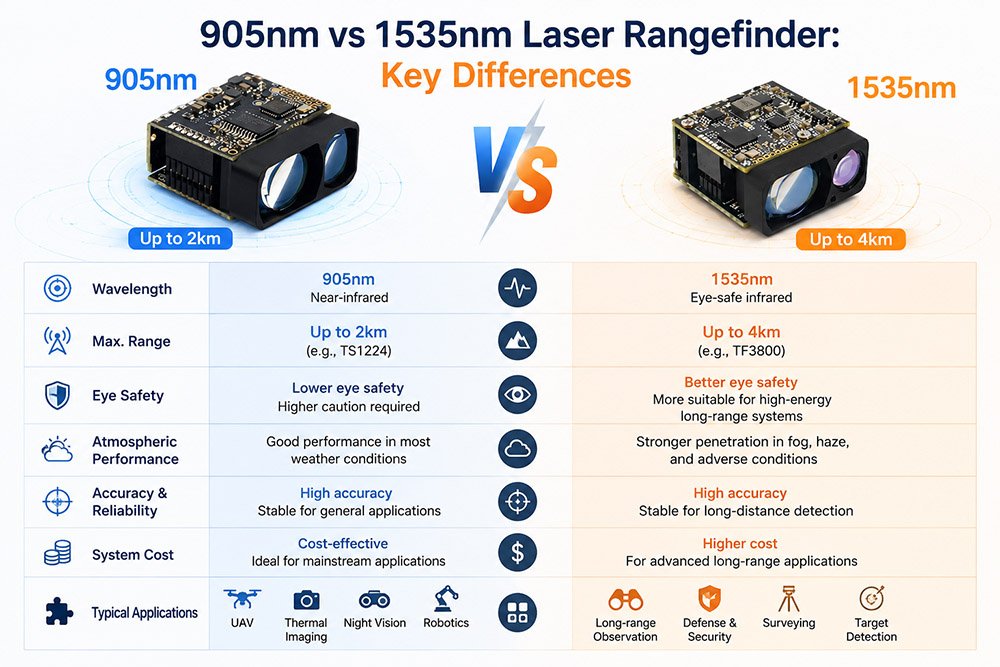
905nm vs 1535nm Laser Rangefinder: Key Differences
When comparing a 905nm vs 1535nm laser rangefinder, engineers should consider the complete system rather than focusing only on wavelength.
1. Measurement Range
Measurement distance is often the first specification considered when selecting a laser rangefinder module.
A 905nm laser rangefinder can provide substantial measurement distances while maintaining a compact and cost-effective system architecture. The TS1224, for example, can measure targets at distances of up to 2km, making it suitable for many UAV, thermal imaging, and observation applications.
For applications requiring significantly longer measurement distances, a 1535nm Laser Rangefinder may be a better candidate. The Meskernel TF3800 supports a maximum measurement distance of up to 4km, providing additional range capability for demanding applications.
It is important to understand that maximum range is application-dependent. Target size, target reflectivity, weather, optical aperture, alignment, and atmospheric transmission can all affect the actual achievable distance.
2. Eye-Safety Considerations
Eye safety is another important factor in laser ranging system design.
Both 905nm and 1535nm systems require appropriate laser safety evaluation and system-level design. However, 1535nm technology is widely considered attractive for applications where eye-safety requirements are a major consideration because radiation at this wavelength is strongly absorbed by the eye’s cornea and does not penetrate toward the retina in the same way as shorter near-infrared wavelengths.
This characteristic can influence the design of high-energy long-range systems. Nevertheless, engineers should evaluate the complete laser product against the applicable safety standards rather than assuming that a particular wavelength automatically makes a system eye-safe.
3. Long-Range Performance
A long range laser rangefinder module must maintain a usable signal-to-noise ratio as the target becomes farther away.
In a 905nm vs 1535nm laser rangefinder comparison, the system’s optical and electronic architecture is therefore just as important as the wavelength. Transmitter power, receiver sensitivity, telescope or lens design, detector performance, signal processing, and atmospheric conditions can significantly influence ranging performance.
For medium-to-long-range systems where compact integration and cost efficiency are important, a 905nm laser rangefinder can provide a strong balance of performance and practicality.
For specialized systems that prioritize extended range and specific eye-safety characteristics, 1535nm technology can provide additional design opportunities.
4. System Cost and Integration
Cost is another major consideration for OEMs and system integrators.
905nm laser rangefinder modules are widely used in commercial and industrial applications because they can provide a good combination of performance, compactness, and system integration flexibility.
A 905nm laser rangefinder may therefore be preferred when the application requires long-distance measurement but does not necessarily need the maximum range available from a higher-end system.
1535nm systems can be more specialized and are often selected for applications where long-range performance and specific optical safety characteristics justify a more advanced architecture.
905nm Laser Rangefinder Applications
The flexibility of 905nm technology makes it suitable for a wide variety of applications.
UAV and Drone Systems
A 905nm laser rangefinder can provide distance information for UAVs and airborne platforms. It can be integrated with navigation, terrain measurement, target distance measurement, and electro-optical payloads.
The Meskernel TS1224 offers measurement distances of up to 2km, making it a potential option for UAV systems that require long-range distance information in a compact module.
Thermal Imaging and Night Vision
Laser ranging is frequently combined with thermal cameras and night vision systems. The rangefinder provides distance information while the camera provides visual or thermal information.
This combination can improve situational awareness and help an integrated system determine the distance to a selected target.
Robotik und autonome Systeme
Robots operating outdoors may need to determine the distance to remote objects, structures, or terrain. Depending on the application, a 905nm laser rangefinder can provide a compact ranging function without requiring a large standalone measurement instrument.
1535nm Laser Rangefinder Applications
A 1535nm Laser Rangefinder is particularly relevant when long-range measurement is a key system requirement.
Long-Range Observation
Long-distance observation systems can benefit from a ranging module capable of measuring targets several kilometers away. The TF3800, with a maximum measurement distance of up to 4km, is designed for this type of long-range requirement.
Electro-Optical Systems
A 1535nm Laser Rangefinder can also be integrated with optical observation systems, thermal imaging systems, and other electro-optical equipment where distance information needs to be combined with imaging data.
Extended-Range Target Measurement
For applications where a 2km-class ranging capability is not sufficient, a 1535nm solution can provide a larger measurement envelope. The TF3800’s 4km maximum range makes it a suitable candidate for systems requiring extended-distance measurement.
905nm vs 1535nm Laser Rangefinder: Which One Should You Choose?
The best choice depends on the priorities of the final product.
Choose a 905nm laser rangefinder when you need:
- Up to kilometer-level measurement capability
- Compact module integration
- A balance between performance and system cost
- UAV or drone integration
- Thermal imaging or night vision integration
- A practical long-range sensing solution
The Meskernel TS1224 is one example, offering a maximum measurement distance of up to 2km.
Consider a 1535nm Laser Rangefinder when you need:
- Longer measurement distances
- Up to several kilometers of ranging capability
- Specific eye-safety characteristics associated with the wavelength
- Integration with advanced electro-optical systems
- Long-range observation and measurement
The Meskernel TF3800 provides a maximum measurement distance of up to 4km and is intended for applications where extended ranging capability is important.
Final Comparison
The 905nm vs 1535nm laser rangefinder comparison should ultimately be based on the complete system requirements rather than wavelength alone.
A 905nm laser rangefinder offers a strong combination of range, compactness, integration flexibility, and cost efficiency. For applications such as UAVs, thermal imaging, night vision, and general long-range sensing, the TS1224 provides a 2km-class ranging option.
A 1535nm Laser Rangefinder can be considered when longer measurement distances and specific system-level eye-safety requirements become more important. With a maximum range of up to 4km, the TF3800 provides a solution for more demanding Anwendungen im Bereich der Fernmessung.
For engineers selecting a long range laser rangefinder module, the most important factors are not simply the wavelength. Measurement distance, target reflectivity, optical design, detector performance, atmospheric conditions, accuracy, system dimensions, power consumption, and integration requirements should all be evaluated together.
By matching the wavelength and ranging architecture to the actual application, system designers can achieve a more reliable and practical distance-measurement solution.