Übersicht
Modern manufacturing facilities increasingly rely on robotic automation to improve productivity, consistency, and operational efficiency. Among the many technologies supporting industrial robotics, the robotic arm distance sensor has become an essential component for accurate positioning, object detection, and collision prevention.
As factories move toward Industry 4.0 and smart manufacturing, the demand for reliable laser measurement solutions continues to grow. A robotic arm distance sensor enables robotic systems to measure distances in real time, helping robots perform complex tasks with greater precision and safety.
Why Robotic Arms Need Distance Measurement
Industrial robots are widely used for assembly, welding, material handling, packaging, palletizing, and quality inspection. While robotic arms can follow programmed paths with high repeatability, many applications require continuous feedback from the environment.
Objects may shift slightly on a conveyor belt, materials may vary in size, and workpieces may not always be positioned exactly where the robot expects them to be. In these situations, a laser distance sensor for robotic arms provides accurate distance information that allows the robot to adjust its movement dynamically.
Without precise distance measurement, robotic systems may experience positioning errors, reduced productivity, or even collisions with surrounding equipment.
What Is a Robotic Arm Distance Sensor?
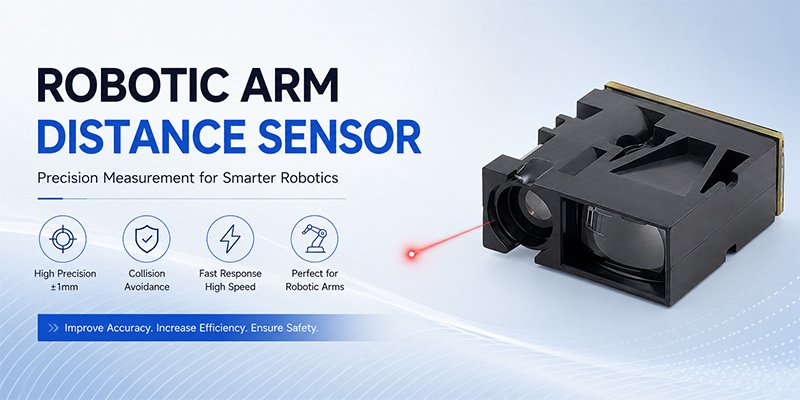
A robotic arm distance sensor is a measurement device that uses laser technology to determine the distance between the sensor and a target object. The measured data is transmitted to the robot controller, enabling the robotic arm to make intelligent decisions during operation.
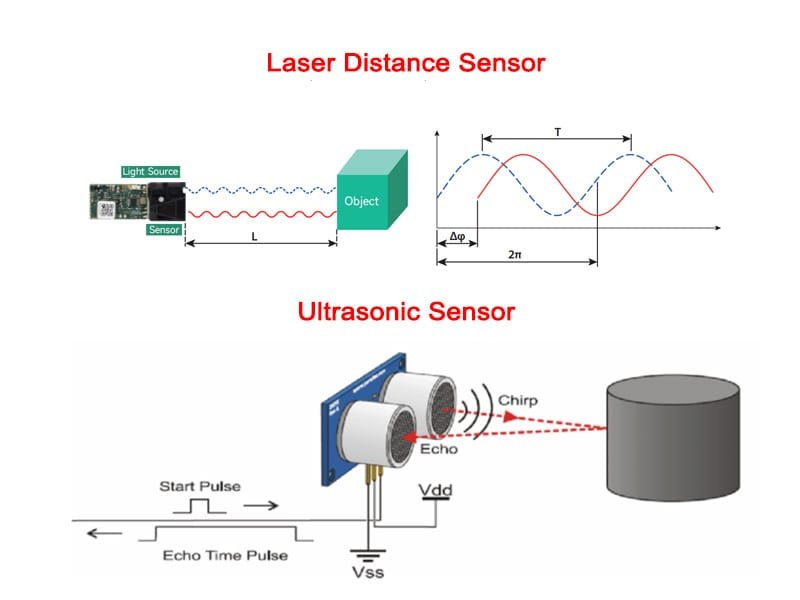
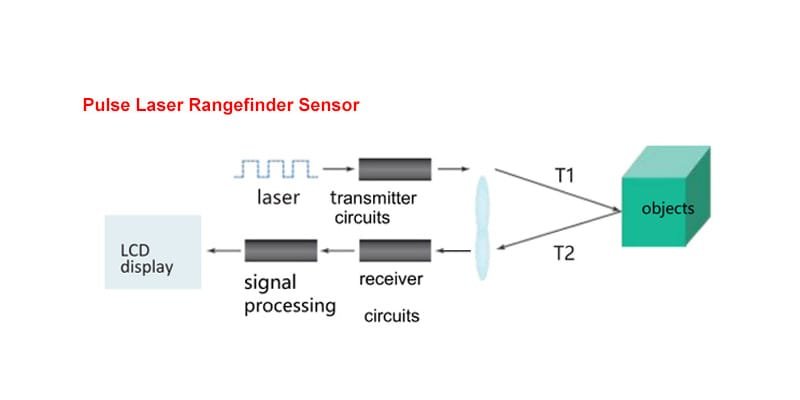
Modern Laser-Sensoren typically use either phase-shift measurement technology or time-of-flight technology. These methods provide fast and accurate distance readings suitable for industrial environments.
Compared with traditional contact measurement methods, laser distance sensors offer several advantages:
- Berührungslose Messung
- High precision
- Fast response speed
- Long measurement range
- Minimal wear and maintenance
- Easy integration with robotic systems
Because of these benefits, robotic arm distance sensors have become a preferred solution for automation engineers worldwide.
Key Applications of Robotic Arm Distance Sensors

1. Robotic Arm Positioning
Accurate positioning is critical for robotic operations. A robotic arm positioning sensor helps verify the exact location of objects before the robot begins a task.
For example, in electronic assembly lines, even a small positioning error can affect product quality. By continuously measuring distance, the sensor allows the robotic arm to adjust its position and maintain consistent accuracy.
2. Pick-and-Place Automation
Pick-and-place systems require robots to identify object locations quickly and accurately. A laser distance sensor for robotic arms can determine the height and position of items on a conveyor, ensuring reliable gripping and placement.
This capability is especially valuable in logistics, warehousing, and packaging applications where products vary in size and orientation.
3. Collision Avoidance
Safety is a major concern in automated production environments. A robot arm collision avoidance sensor continuously monitors the distance between the robotic arm and nearby objects.
When the sensor detects a potential obstacle, the robot controller can reduce speed, alter its path, or stop movement altogether. This helps protect equipment, products, and personnel from accidental damage.
4. Welding and Surface Processing
Robotic welding systems require precise control of the distance between the welding tool and the workpiece.
A high precision distance sensor for robots ensures that the welding head maintains an optimal working distance throughout the process. Similar benefits apply to grinding, polishing, coating, and cutting applications.
5. Quality Inspection
Many robotic inspection systems use laser sensors to verify dimensions, heights, and surface characteristics.
By integrating a robotic arm distance sensor into inspection equipment, manufacturers can achieve automated quality control while reducing manual intervention.
Benefits of Laser Distance Sensors in Robotic Systems
Improved Accuracy
Laser measurement technology can achieve millimeter-level precision, enabling robots to perform tasks that require exact positioning.
Faster Production Cycles
Real-time distance feedback allows robots to make adjustments without stopping production, improving overall throughput.
Erhöhte Flexibilität
An industrial robotic arm sensor enables robots to adapt to changing workpiece locations and dimensions, making production lines more flexible.
Reduced Downtime
Accurate distance measurement helps prevent collisions and operational errors, minimizing maintenance requirements and unplanned downtime.
Better Product Quality
Consistent positioning and movement control contribute directly to improved manufacturing quality and repeatability.
Important Features to Consider
When selecting a robotic arm distance sensor, engineers should evaluate several key specifications:
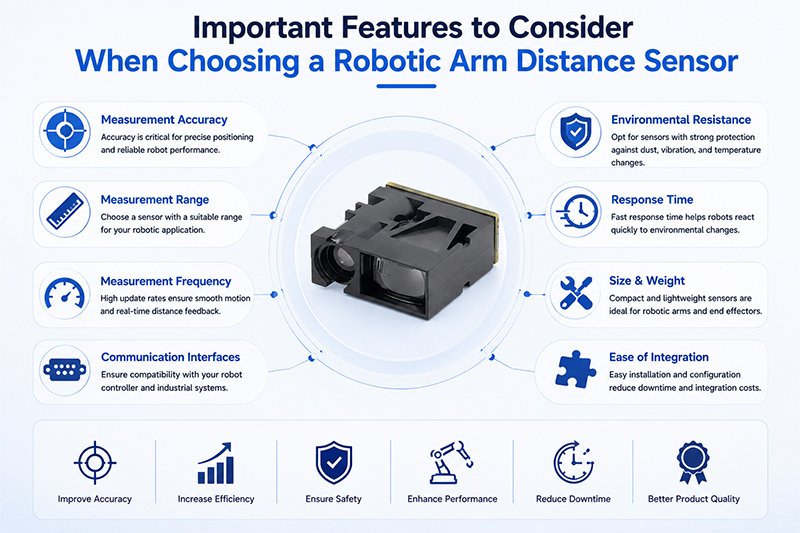
Messgenauigkeit
Accuracy requirements vary by application. Assembly and inspection tasks often require millimeter-level precision.
Messbereich
Different robotic systems require different sensing distances. The ideal sensor should provide sufficient range while maintaining stable accuracy.
Measurement Frequency
Fast-moving robotic applications benefit from sensors with high update rates. Some industrial laser sensors can provide measurements at frequencies up to 100 Hz or higher.
Kommunikationsschnittstellen
Integration is easier when the sensor supports common industrial interfaces such as UART, RS232, RS485, Modbus, Ethernet, or CAN bus.
Environmental Resistance
Industrial environments often contain dust, vibration, and temperature variations. Choosing a robust industrial robotic arm sensor helps ensure long-term reliability.
Why Phase-Shift Laser Sensors Are Ideal for Robotic Arms
For short- and medium-range robotic applications, phase-shift laser technology offers significant advantages.
Phase-shift sensors provide:
- Hohe Messgenauigkeit
- Fast response speed
- Stable performance
- Compact size
- Low power consumption
These characteristics make them particularly suitable as robotic arm distance sensors in automated production systems.
For example, compact laser distance sensors with ±1 mm accuracy can be integrated directly into robotic end effectors, enabling precise positioning and object detection without adding significant weight.
Future Trends in Robotic Distance Sensing
The future of industrial robotics is closely linked to smarter sensing technologies. As artificial intelligence, machine vision, and collaborative robots become more common, distance measurement systems will play an increasingly important role.
Advanced robotic arm distance sensors will provide:
- Höhere Genauigkeit
- Faster data processing
- Better environmental adaptability
- AI-assisted object recognition
- Seamless integration with smart factory networks
Manufacturers that invest in advanced laser sensing solutions today will be better positioned to meet the demands of next-generation automation.
Schlussfolgerung
A robotic arm distance sensor is a critical technology for modern automation systems. Whether used for positioning, collision avoidance, quality inspection, or material handling, laser distance measurement significantly improves robotic performance and operational efficiency.
By selecting a reliable laser distance sensor for robotic arms, manufacturers can achieve higher accuracy, greater flexibility, and safer operation across a wide range of industrial applications. As smart manufacturing continues to evolve, robotic arm distance sensors will remain a key component in the future of industrial automation.