AGV Distance Sensor: Improving Navigation Accuracy in Automated Guided Vehicles
لمحة عامة
Modern warehouses and manufacturing facilities are increasingly adopting Automated Guided Vehicles (AGVs) to improve efficiency, reduce labor costs, and support smart logistics operations. As these autonomous systems become more advanced, accurate distance measurement has become a critical requirement for safe and reliable navigation.
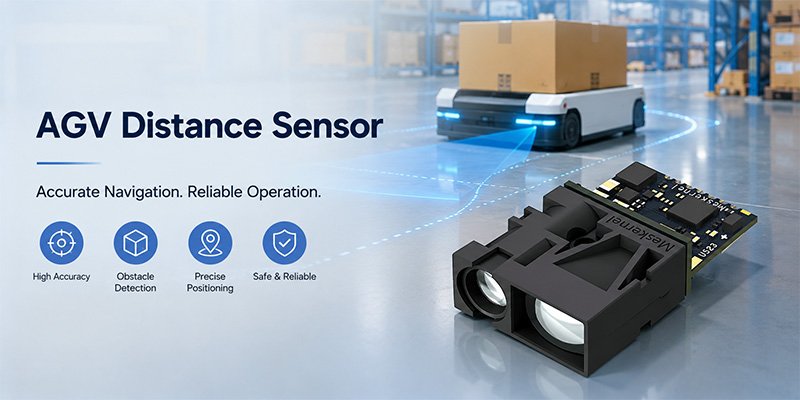
أن AGV distance sensor plays a key role in helping AGVs understand their surroundings, avoid obstacles, and maintain accurate positioning while moving through dynamic industrial environments. By providing real-time distance information, laser-based sensors enable AGVs to navigate more efficiently and operate safely alongside people, equipment, and other vehicles.
This article explores how laser distance sensors support AGV navigation, the limitations of traditional technologies, and why modern automation systems are increasingly adopting laser measurement solutions.
Why Distance Measurement Is Critical for AGVs
Automated Guided Vehicles are used in a wide range of applications, including:
- Warehouse automation
- Material transportation
- Manufacturing logistics
- Distribution centers
- Smart factories
- E-commerce fulfillment operations
Unlike fixed automation equipment, AGVs continuously move throughout a facility. To operate safely and efficiently, they must accurately determine:
- Their position
- Distance to obstacles
- Available travel paths
- Docking locations
- Loading and unloading points
Without reliable distance measurement, navigation errors can occur, resulting in reduced productivity, collisions, or unexpected downtime.
This is why selecting the right AGV distance sensor is essential for successful AGV deployment.
Challenges Faced by AGV Navigation Systems
Industrial environments present several challenges for autonomous navigation.
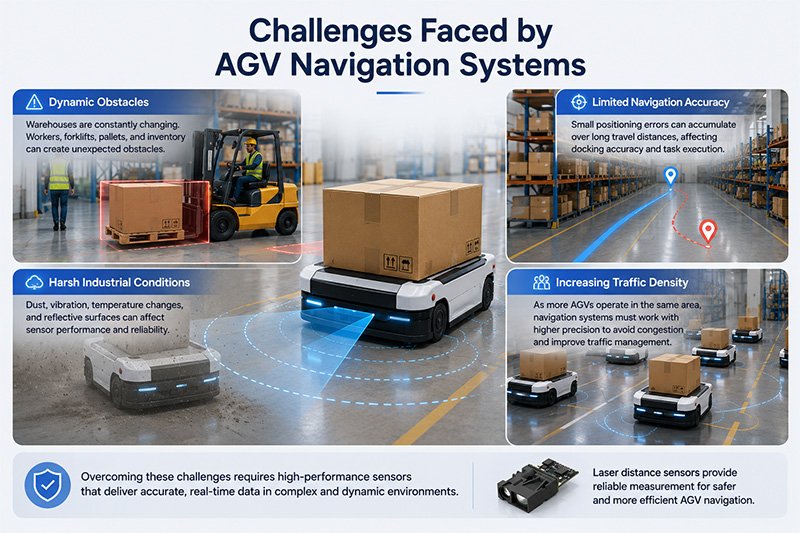
Dynamic Obstacles
Warehouses constantly change throughout the day. Workers, forklifts, pallets, and inventory can create unexpected obstacles.
An AGV must continuously monitor its surroundings and react quickly to avoid collisions.
Limited Navigation Accuracy
Small positioning errors can accumulate over long travel distances. Even a few centimeters of deviation may affect docking accuracy or material handling operations.
Harsh Industrial Conditions
Dust, vibration, temperature changes, and reflective surfaces can affect sensor performance.
Reliable navigation requires sensors capable of maintaining stable measurements in demanding environments.
Increasing Traffic Density
As facilities deploy larger fleets of AGVs, navigation systems must operate with greater precision to avoid congestion and improve traffic management.
How Laser Distance Sensors Improve AGV Navigation
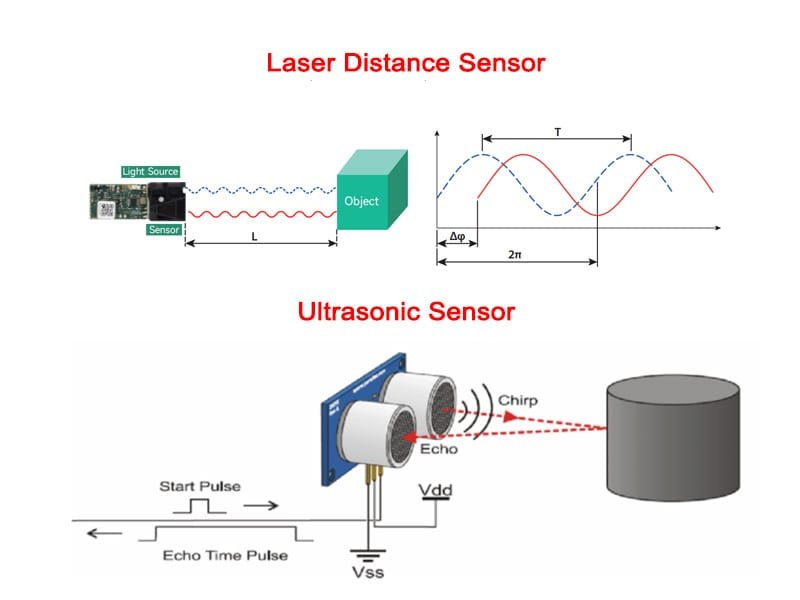
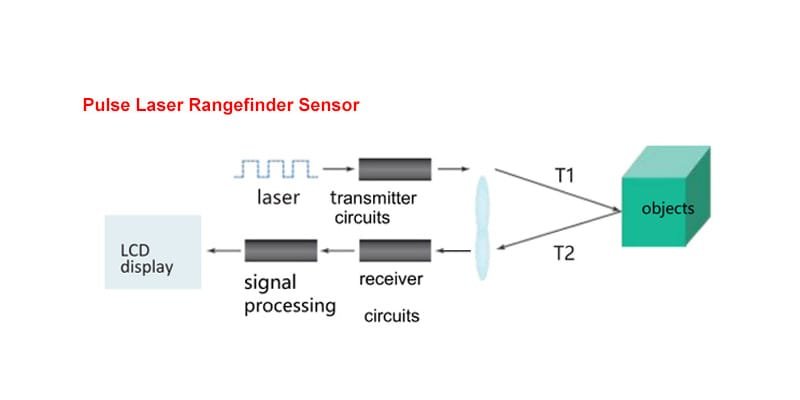
A laser distance sensor for AGV navigation measures the distance between the vehicle and surrounding objects using non-contact optical technology.
Unlike conventional detection methods, laser sensors provide continuous distance information rather than simple presence detection.
This allows AGVs to make more intelligent navigation decisions in real time.
Accurate Position Awareness
An AGV distance sensor continuously measures distances to walls, racks, pallets, and reference points.
These measurements help the vehicle determine its location and maintain accurate navigation paths.
Improved position awareness reduces navigation drift and improves operational efficiency.
اكتشاف العوائق في الوقت الحقيقي
Obstacle detection is one of the most important safety functions in AGV systems.
An AGV obstacle detection sensor enables the vehicle to identify obstacles ahead and respond immediately.
Depending on the situation, the AGV may:
- Slow down
- Stop
- Change routes
- Recalculate navigation paths
Real-time obstacle detection helps improve workplace safety while minimizing operational interruptions.
High Accuracy Measurement
Modern laser sensors can achieve millimeter-level accuracy.
A high accuracy AGV positioning sensor allows vehicles to perform tasks such as:
- Precision docking
- Automatic charging
- Pallet pickup
- Material transfer
Accurate positioning reduces alignment errors and increases task success rates.
عملية عدم التلامس
Laser sensors operate without touching the measured object.
This provides several benefits:
- No mechanical wear
- Reduced maintenance
- Long service life
- Consistent measurement performance
For facilities operating AGVs around the clock, reduced maintenance requirements can significantly lower operating costs.
Common Applications of AGV Distance Sensors
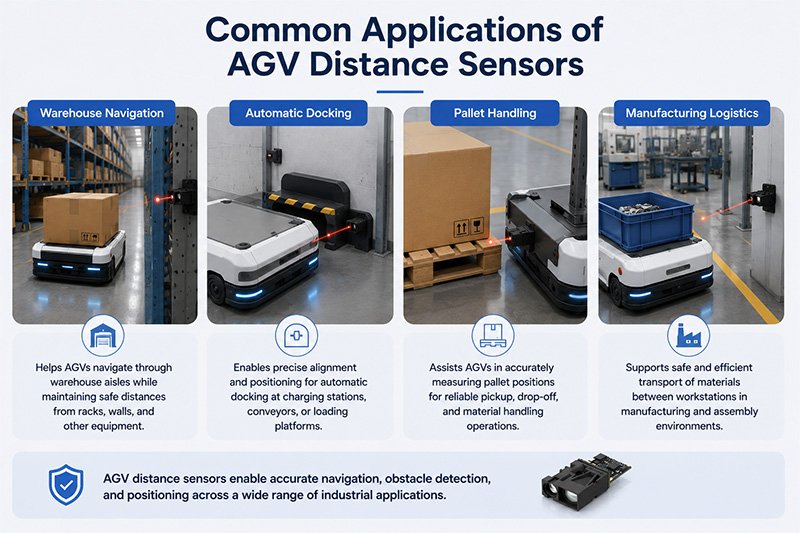
Warehouse Navigation
Warehouses are among the largest users of AGV technology.
A laser sensor for automated guided vehicles helps AGVs navigate between storage racks while maintaining safe distances from people and equipment.
قياس دقيق للمسافة improves route planning and traffic flow throughout the facility.
Automatic Docking Systems
Many AGVs must dock precisely at loading stations or charging points.
An AGV distance sensor provides real-time feedback that enables precise vehicle alignment.
This improves loading efficiency and reduces docking errors.
Pallet Handling
AGVs used for pallet transportation require accurate distance information when approaching loads.
An autonomous mobile robot distance sensor allows vehicles to identify pallet positions and execute pickup operations more reliably.
Manufacturing Logistics
Production facilities use AGVs to transport materials between workstations.
Laser distance sensors help ensure safe navigation while maintaining accurate delivery schedules.
This improves workflow efficiency and supports lean manufacturing initiatives.
Advantages of Laser Sensors Compared with Traditional Technologies
Greater Accuracy
Laser sensors typically provide significantly higher measurement accuracy than ultrasonic or contact-based technologies.
This enables better navigation performance and more reliable positioning.
Faster Response Time
Laser measurement systems provide rapid updates that allow AGVs to react quickly to changing conditions.
Fast response times are particularly important in busy industrial environments.
Improved Reliability
Modern laser sensors are designed for industrial applications and can operate reliably under challenging conditions.
Stable performance contributes to improved system uptime and reduced maintenance requirements.
التكامل المرن
Many laser sensors support industrial communication interfaces such as:
- UART
- RS232
- RS485
- مودبوس
This simplifies integration with AGV controllers and automation systems.
Selecting the Right AGV Distance Sensor
Several factors should be considered when choosing an AGV distance sensor.

نطاق القياس
The sensor must provide sufficient range for navigation and obstacle detection requirements.
الدقة
Applications involving docking or pallet handling often require high measurement precision.
Update Frequency
Fast-moving vehicles benefit from sensors capable of delivering rapid measurement updates.
القدرة على التكيف البيئي
The sensor should maintain stable performance despite dust, vibration, and changing lighting conditions.
Selecting an industrial-grade laser distance sensor helps ensure long-term operational reliability.
Future Trends in AGV Navigation
As smart factories continue to evolve, AGV systems are becoming increasingly intelligent.
Emerging developments include:
- AI-powered navigation
- Autonomous fleet management
- Collaborative mobile robots
- Smart warehouse automation
- Digital twin integration
These technologies rely heavily on accurate real-time distance measurement.
As a result, demand for laser distance sensor for AGV navigation solutions is expected to continue growing across logistics, manufacturing, and warehouse automation industries.
الخاتمة
An AGV distance sensor is a critical component in modern AGV navigation systems. By providing accurate real-time distance measurements, laser sensors help vehicles navigate safely, avoid obstacles, and achieve precise positioning.
Compared with traditional sensing technologies, laser-based solutions offer higher accuracy, faster response times, and greater reliability. Whether used for warehouse navigation, pallet handling, automatic docking, or manufacturing logistics, a laser sensor for automated guided vehicles can significantly improve operational efficiency and safety.
As automation technologies continue to advance, laser distance measurement will play an increasingly important role in enabling smarter, safer, and more efficient AGV systems.